Recommended resources
The freely available resources this lesson will direct you to.
- 6 Pillars of the AWS Well Architected Framework (you should really know this)www.youtube.com
- Are you Well Architected?www.youtube.com
- How to use the Azure Well-Architected Framework documentation - Microsoft Azure Well-Architected Framework | Microsoft Learnlearn.microsoft.com
- Design review checklist for Reliability - Azurelearn.microsoft.com
Good to see you again. In the previous lesson, you built a Director operating system: shared outcomes and guardrails, explicit decision rights, purposeful cadences, active risk ownership, and clear escalation. This lesson applies that same leadership discipline to a different object of review: the architecture itself.
A Director does not need to personally design every database schema, network policy, or recovery mechanism. But they must be able to ask whether a high-level design can safely meet its customer promise—and whether the organization can realistically deliver and operate it. This is particularly important when reviewing a new infrastructure capability, a major automation proposal, or a release with dependencies that are technically plausible but operationally immature.
By the end of this lesson, you will be able to use a practical architecture-review checklist to identify risks in six areas: scalability, resilience, security, operability, cost, and delivery feasibility.
Architecture review is a decision process, not a design critique
An architecture review is sometimes treated as a technical presentation in which architects explain boxes and arrows, senior engineers ask detailed implementation questions, and the meeting ends with a vague approval. That is not the Director-level use of a review.
A useful review asks:
Given the customer promise, expected scale, constraints, and delivery date, what could prevent this design from succeeding—and what decisions or evidence are needed now?
The output should not be “architecture approved.” It should be a short, prioritized view of:
- the most consequential risks;
- the assumptions that still need validation;
- trade-offs that require an explicit business decision;
- actions, owners, and dates needed before the design can proceed safely.
This is a natural continuation of the operating-system lesson. A technical risk without an owner, a decision date, or escalation authority is not yet under control.
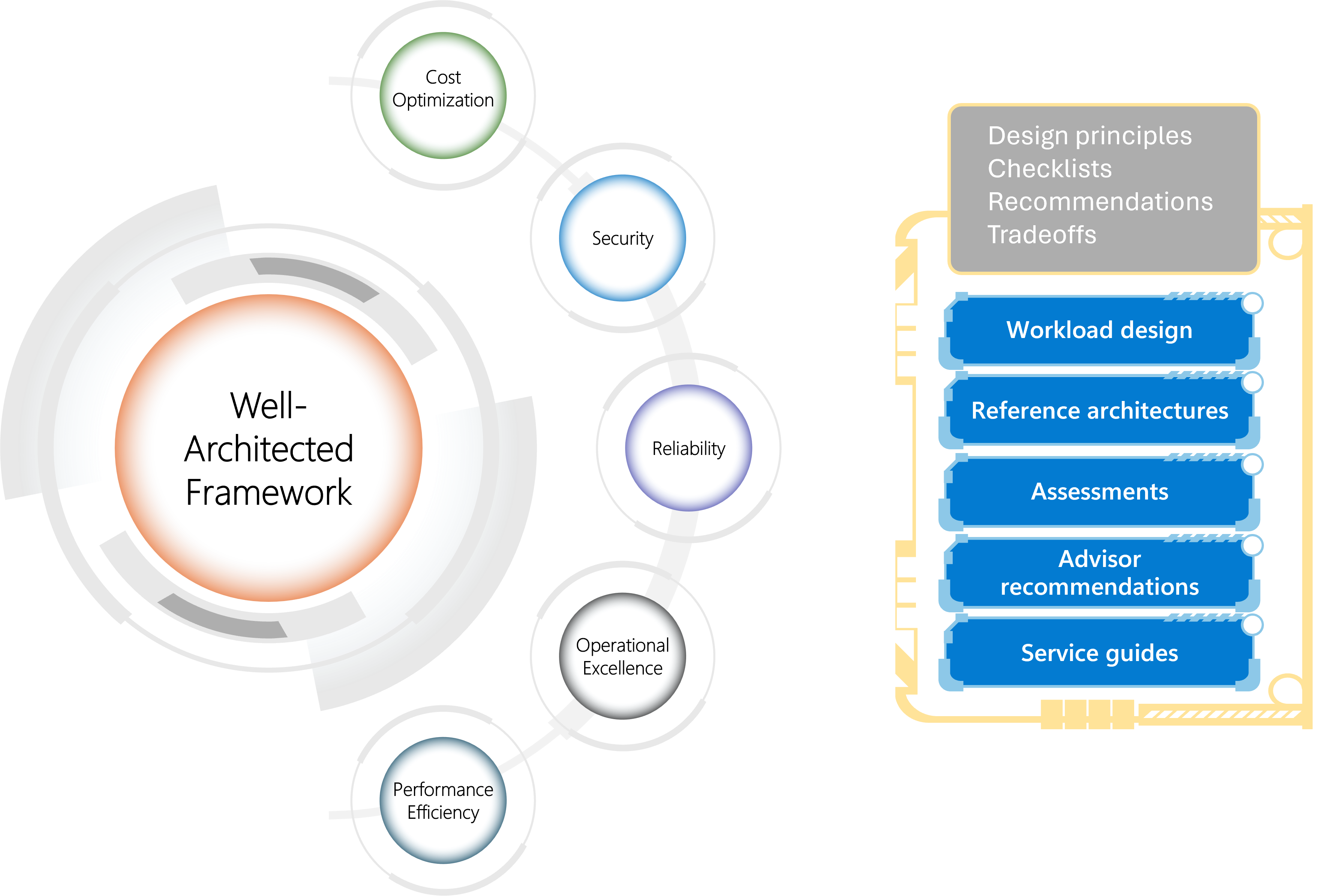
The Azure Well-Architected Framework offers a useful vendor-specific source for a provider-neutral review habit. Its core idea is more important than the cloud platform: a design must be assessed across several competing dimensions, not just whether it works on the happy path.
Read Microsoft Learn’s overview to establish the review mindset: architecture quality is multi-dimensional, iterative, and shaped by explicit trade-offs rather than a single “correct” design.
In the opening section, read the five pillars. Then, under “Building blocks of the framework,” read the framework elements, focusing on why checklists, risks, and trade-offs belong together. Finally, in the “Goals” section, read the trade-off discussion. Treat Azure-specific terminology as examples; the review approach applies equally to on-premises, hybrid, and multi-cloud infrastructure.
The five pillars are reliability, security, cost optimization, operational excellence, and performance efficiency. For interview and leadership use, it is helpful to translate them into six plain-language review lenses:
| Review lens | Core Director question |
|---|---|
| Scalability | Can the system handle expected and exceptional demand without creating unacceptable latency, backlog, or failure? |
| Resilience | When components, dependencies, or regions fail, can critical customer flows continue or recover within agreed targets? |
| Security | Are identities, data, privileged actions, and interfaces protected according to the actual threat and compliance exposure? |
| Operability | Can teams observe, deploy, support, diagnose, and recover the system without heroic manual intervention? |
| Cost | Does the design create value economically at expected scale, and are its major cost drivers measurable and controllable? |
| Delivery feasibility | Can the organization build, test, migrate, and launch it with the available teams, dependencies, and time? |
The first five lenses correspond closely to the well-architected pillars. The sixth, delivery feasibility, is deliberately added for Director reviews. A technically sound architecture is still a poor business choice if it needs unavailable skills, uncommitted dependencies, an unsafe migration, or eighteen months of foundational work to deliver a six-month opportunity.
Start with the promise, the critical flows, and the constraints
Do not begin a review by asking, “What technology are we using?” Begin with the promise the system is making.
For an infrastructure product or platform capability, establish five facts before reviewing the diagram:
-
Customer and business outcome
What customer problem is being solved? What would a successful launch change: adoption, renewal risk, support cost, time to provision, deployment safety, or operational efficiency? -
Critical flows
Which user or system flows must work? For example: provisioning a database, applying a security patch, restoring a backup, executing an upgrade, or viewing an operational alert. -
Demand and growth assumptions
What is normal load, peak load, expected growth, and the most important burst scenario? A design cannot be called scalable if its expected workload is undefined. -
Service and recovery commitments
What availability, latency, recovery-time, and data-loss commitments are being made? These do not need to be perfect initially, but they must be explicit enough to guide trade-offs. -
Constraints
Identify data residency requirements, compatibility obligations, release date, budget range, deployment environments, existing operational teams, and external dependencies.
This opening discipline prevents a common failure mode: reviewing a system according to generic technical preferences rather than the requirements that matter.
For example, an internal reporting portal may reasonably tolerate a few hours of disruption. A control service that orchestrates production database patching cannot make the same assumption. Its most important flow may not be “render a dashboard”; it may be “reliably prevent an unsafe change from being applied twice.”
In infrastructure systems, distinguish three planes:
- The data plane performs the workload’s core customer-facing function, such as serving database traffic or executing a managed operation.
- The control plane provisions, configures, and changes that workload.
- The management plane is how operators monitor, repair, back up, deploy, and govern it.
A design can have a healthy data plane while its management plane is fragile. That distinction matters for release-readiness and platform organizations: operational scripts, repair tools, deployment procedures, and rollback mechanisms are production capabilities, not informal supporting work.
The six-lens checklist
1. Scalability: locate the actual bottleneck
“Cloud-native” or “distributed” does not automatically mean scalable. Scalability is the system’s ability to handle growth and bursts while maintaining an acceptable level of service. The relevant question is not whether some components can scale; it is whether the critical flow can scale end to end.
Inspect the following:
- Demand model: What request rate, concurrent jobs, data growth, and burst pattern does the design assume?
- State and bottlenecks: Which components retain state or serialize work? Common limits include a metadata database, a shared lock, an API rate limit, a message consumer, network bandwidth, or a dependency with fixed capacity.
- Scaling mechanism: Does capacity increase automatically, through a documented operational procedure, or only after an engineer manually intervenes?
- Workload protection: Are quotas, rate limits, queues, prioritization, and back-pressure mechanisms present? Can one large customer or failed job flood shared capacity?
- Evidence: Has the critical flow been load-tested at expected peak and at a meaningful growth case?
A queue is not automatically a scalability solution. It can absorb a burst, but it can also conceal an ever-growing backlog. Ask what happens when incoming work arrives faster than processing capacity for several hours. Does the system reject low-priority requests, extend completion time visibly, add workers safely, or silently accumulate work until a customer impact emerges?
For a database-infrastructure control service, another important question is whether operations are idempotent: can a request be retried without unintentionally creating duplicate resources or applying a change twice? This is both a scalability and reliability concern because retries become common under load and partial failure.
2. Resilience: design for recovery, not wishful prevention
Resilience is the ability to withstand faults and restore service. It starts with accepting that components will fail: a deployment will be defective, a dependency will time out, a certificate will expire, a network path will degrade, or an operator will make an error.
A meaningful resilience review examines:
- Criticality: Which flows are truly business-critical, and which can degrade temporarily?
- Dependencies: What internal services, data stores, identity systems, vendors, agents, and human procedures must work for each critical flow?
- Failure modes: What happens if each dependency is slow, unavailable, corrupt, overloaded, or returning incorrect data?
- Recovery targets: What recovery time and data-loss exposure are acceptable?
- Redundancy and isolation: Is there an alternative path for critical components? Can one customer, tenant, or dependency failure be contained?
- Recovery proof: Have failover, restore, rollback, and degraded-mode procedures been tested?
Microsoft’s reliability checklist is useful because it connects basic design choices with operational evidence: define critical flows, analyze failures, establish recovery targets, build redundancy and scaling, then test and monitor the resulting system.
Design review checklist for Reliability - Azure
Use Microsoft’s concise reliability checklist as a model for the questions you should bring to any infrastructure design review. It is especially useful for converting a vague concern such as “this may not be robust enough” into a specific evidence request.
Read the complete checklist, from simplicity through monitoring. Focus particularly on critical-flow rating, failure-mode analysis, recovery targets, scaling, disaster recovery, and continuous health measurement. For each item, ask yourself what artifact would demonstrate that the design meets the recommendation: a stated target, a dependency map, a load test, a recovery test, or production telemetry.
The central Director question is:
What happens when this fails, how will we know, who responds, and how quickly can the critical customer flow recover?
If the answer is, “The team will investigate,” the design is not operationally mature enough.
3. Security: review trust boundaries and privileged action
Security is not a late-stage checklist of encryption, vulnerability scans, and access-control tickets. It begins with identifying what must be protected and who or what is trusted to act.
At high level, inspect:
- Assets: Customer data, credentials, encryption keys, operational metadata, backups, audit records, and deployment artifacts.
- Identity: How users, services, administrators, and automation authenticate.
- Authorization: Whether each identity has only the permissions needed for its task, particularly for tenant administration, deletion, network changes, and data export.
- Trust boundaries: Where requests, credentials, and data cross from a browser to an API, one service to another, one tenant to another, or an internal network to an external dependency.
- Secrets and encryption: How secrets are stored, rotated, and accessed; whether sensitive data is protected in transit and at rest.
- Auditability: Whether privileged actions and sensitive changes are attributable to a specific identity and retained for investigation.
- Response readiness: Whether the organization can revoke access, isolate a compromised component, and communicate through a defined incident process.
A useful challenge in review is to ask: what is the most damaging plausible misuse of this interface? For example, a service account that can patch every customer environment may simplify automation, but it creates a severe blast radius. The alternative might require stronger tenant scoping, separate credentials, approval controls, or a more constrained execution model. Those are not merely implementation details; they are product and operational risk choices.
4. Operability: assess day-two ownership
Many designs receive most of their attention before launch. Yet most system cost, customer trust, and leadership attention are determined after launch, when the system must be monitored, patched, upgraded, supported, and changed.
An operability review asks:
- Can an on-call engineer determine which customer flow is failing, where it is failing, and what changed?
- Do dashboards measure customer experience and service health, not merely machine CPU and memory?
- Are alerts actionable, routed to a responsible team, and tied to a runbook?
- Can teams deploy a small change safely, observe its effects, and roll it back?
- Are configuration, infrastructure, and operational procedures versioned and reviewed as code where appropriate?
- Can an engineer repair a failed workflow without manually editing production data?
- Who owns the service after launch, including support handoffs, on-call, operational documentation, and incident reviews?
The following short video provides useful language for this lens. Its distinction between data, control, and management planes is especially relevant when reviewing infrastructure products.
In “Are you Well Architected?” from Amazon Web Services, the speaker connects architecture principles to practical operational mechanisms: management-plane engineering, tested recovery, and cost visibility.
Watch operational planes for the distinction between customer-facing, provisioning, and management work. Then watch recovery thinking, focusing on the argument that untested recovery paths are likely to fail when first needed. Finish with cost visibility, which frames cost as a design metric connected to business value rather than solely a finance concern.
For an organization that already has release and quality processes, the important step is often broadening the definition of “ready.” A release is not ready because functional testing passed. It is ready when teams can detect failure, diagnose it, restore service, communicate with affected parties, and learn from the event.
5. Cost: connect technical choices to unit economics
Cost optimization does not mean choosing the cheapest infrastructure. It means delivering the required outcome at a sustainable cost and understanding the financial consequences of architectural choices.
Review these questions:
- What are the largest cost drivers: compute, storage, database capacity, data transfer, logs, third-party services, support effort, or people-intensive operations?
- How does cost change as customers, data volume, requests, or managed environments grow?
- Is there a meaningful unit metric, such as cost per managed database, workflow, successful deployment, or customer environment?
- Are non-production environments, idle capacity, long-lived logs, backups, and overprovisioned resources governed deliberately?
- Who can see the spend, explain its drivers, and make trade-offs?
Consider a design that maintains large always-on worker pools so that infrequent maintenance jobs start instantly. It may be appropriate for an urgent security-response workflow. It may be wasteful for a low-priority reporting task that can tolerate a short queue. Cost cannot be judged apart from latency, reliability, and business importance.
A Director’s role is often to make the trade-off explicit:
We will spend more on warm capacity for the customer-critical recovery workflow, but not for bulk reporting. We will measure the difference and revisit it when demand changes.
6. Delivery feasibility: turn architecture into an executable plan
The final lens tests whether the design can become a working product or capability on the required timeline.
Inspect:
- Dependency commitments: Are external teams committed to interfaces, capacity, environments, and dates, or are they merely assumed to be available?
- Unknowns: Which claims need a prototype, compatibility test, threat model, performance test, or recovery experiment before the plan is credible?
- Migration and compatibility: Can existing customers, agents, APIs, data, and operational procedures transition safely?
- Testing path: Are test environments, representative data, failure injection, security validation, and performance tests available?
- Release strategy: Is rollout staged? Can it be paused or reversed? Are customer communication and support readiness planned?
- Operating ownership: Has the post-launch team accepted on-call, support, documentation, and service-level obligations?
- Decision gates: What evidence is required before funding, build, beta, general availability, and expansion decisions?
This is where the previous lesson’s governance concepts matter directly. Each material risk should have a named owner, a mitigation plan, a trigger, and an escalation path. Architecture reviews become ineffective when everyone identifies concerns but nobody owns validation.
Worked review: a fleet-management control service
Consider this confidentiality-safe scenario.
A company plans a new control service that lets enterprise customers schedule database patching, backup verification, and configuration checks across a large fleet. Customers submit requests through a portal and API. A central workflow service stores jobs in a queue; workers execute them through customer-side agents. A single metadata database stores tenant configuration and job status. Notifications are sent synchronously to an external messaging provider when each job completes.
The proposal targets launch in twelve weeks. Product expects adoption to grow from a few pilot customers to several hundred environments over the next year. The architecture diagram shows the major components, but it does not include service objectives, a capacity model, a migration plan for older agents, or an operating model after launch.
The review should not reject this design because it is incomplete. Early high-level designs are normally incomplete. Instead, identify the risks that must be addressed before treating the launch plan as credible.
| Lens | Evidence in the proposal | Risk diagnosis | Required action or decision |
|---|---|---|---|
| Scalability | Job queue exists, but no forecast for concurrent patch windows or worker throughput. | Large customers may schedule work in the same maintenance window, creating an unbounded queue and delayed critical operations. | Define load assumptions, priority classes, per-tenant quotas, and a load test for peak maintenance demand. |
| Resilience | One metadata database is central to all job state; external notifications occur synchronously. | A database or notification-provider outage can prevent job progress or leave customers uncertain about execution status. | Define recovery targets; test database restore and notification failure behavior; decouple notification from job completion where appropriate. |
| Security | Workers can execute privileged actions through agents; service-account scope is not described. | A compromised service identity could affect many customer environments. | Produce a threat model and least-privilege authorization design before beta. |
| Operability | The proposal includes basic infrastructure metrics but no workflow tracing, runbooks, or ownership model. | Support teams may not be able to diagnose whether a failure is in the portal, queue, worker, agent, or target database. | Define service ownership, customer-flow telemetry, alerting, escalation, and repair procedures. |
| Cost | Workers are assumed to run continuously; log retention is unspecified. | Cost may grow faster than customer value, particularly during low-utilization periods and at high log volume. | Estimate cost per managed environment and define capacity, retention, and environment-lifecycle policies. |
| Delivery feasibility | Existing agents need a new capability, but the agent team has not committed a compatible release date. | The control service could be complete but unusable for the installed customer base at launch. | Create an agent compatibility plan, secure the dependency commitment, and define a fallback or phased launch scope. |
Notice the distinction between a risk and a decision.
- “The metadata database is a single point of failure” is a risk observation.
- “Do we fund a higher-availability design before beta, accept a narrower pilot commitment, or defer the feature?” is a decision.
A Director should ensure that the review converts the first into the second.
A concise decision record might read:
Decision required: Approve a limited pilot only after the team demonstrates recoverable job state, tenant-scoped service permissions, and support visibility for failed workflows.
Rationale: The current design may support a small pilot, but the evidence does not yet support a broad availability commitment.
Trade-off: A limited pilot protects customer trust and creates operational learning, while delaying the revenue and adoption benefits of a larger launch.
Owners: Engineering validates workflow recovery; security validates service authorization; product and program leadership define pilot eligibility and customer communication.
Decision date: Before external pilot commitments are made.
This is a stronger leadership response than either extreme:
- “The architecture looks fine; let the team build it.”
- “The design has risks, so stop everything.”
The Director-level move is to distinguish what is safe to learn through a controlled launch from what must be proven before exposing customers or the business to the risk.
A repeatable review format
Use this compact sequence for a 45- to 60-minute high-level architecture review.
-
Set the context
State the customer outcome, critical flows, expected scale, commitments, and constraints. -
Walk the critical flow
Follow one important request from entry point through identity, processing, storage, dependencies, customer-visible completion, and operational support. -
Review six lenses
Ask only the questions needed to identify meaningful risks in scalability, resilience, security, operability, cost, and delivery. -
Classify findings
Separate:- factual gaps requiring evidence;
- design risks requiring mitigation;
- trade-offs requiring an accountable decision;
- lower-priority improvements that can be deferred.
-
Leave with accountable next actions
Record each material item in a simple structure:
| Item | Example |
|---|---|
| Risk statement | Peak patch windows may create a backlog that delays critical customer operations. |
| Evidence needed | Load test with defined concurrent job volume and priority mix. |
| Owner | Workflow engineering manager. |
| Decision or mitigation | Establish quotas and priority queues; determine whether pilot scope must be limited. |
| Due date and escalation | Review evidence before pilot commitment; escalate if dependency capacity is insufficient. |
The review is successful when it increases confidence through evidence and explicit trade-offs—not when it produces the longest list of theoretical concerns.
A strong architecture review connects technical design to customer promises, operational reality, and delivery accountability. The practical checklist is:
- establish the customer outcome, critical flows, assumptions, and constraints;
- test scalability through end-to-end bottlenecks and load evidence;
- test resilience through failure modes, recovery targets, and tested recovery paths;
- test security through identity, authorization, trust boundaries, and auditability;
- test operability through telemetry, runbooks, safe change, and clear ownership;
- test cost through measurable drivers and value-aware trade-offs;
- test delivery through dependencies, migration, validation, rollout, and staffing reality.
For Director-track interviews, this framework lets you speak about architecture without pretending to be the deepest specialist in every component. Your value is recognizing where a design’s technical choices create customer, operational, commercial, or execution risk—and ensuring the organization makes those choices consciously.
In the next lesson, you will assess a cloud deployment diagram more specifically, examining operating model, distributed-workflow risks, security controls, and regional resilience trade-offs.