Recommended resources
The freely available resources this lesson will direct you to.
In our previous lesson, we established how to use a prefix sum array to answer any range sum query in constant time after an initial linear-time precomputation. This technique is a powerful building block, and today we'll see how it can be extended to solve a more dynamic and common category of interview problems.
This lesson focuses on the learning outcome: Combine prefix sums with a hash map to count subarrays with a given target sum. We will tackle the classic "Subarray Sum Equals K" problem, a staple in coding interviews that elegantly blends the prefix sum concept with the fast look-up capabilities of a hash map.
From Querying Ranges to Finding a Target Sum
In the last lesson, the problem was "given a range [L, R], find its sum." Now, we're flipping the problem on its head: "given a target sum k, find how many contiguous subarrays have this sum."
A brute-force approach would be to generate every possible subarray, calculate its sum, and check if it equals k. Generating all subarrays takes time, and for each, summing the elements can take up to time, leading to a naive solution. We can optimize this to by reusing the sum from the previous subarray. However, for typical interview constraints where can be up to or , an solution is still too slow. We need a linear-time approach.
The following video from take U forward provides an excellent overview of the progression from the brute-force approach to a more optimized one, which sets the stage for our final, optimal solution.
Count Subarray sum Equals K | Brute - Better -Optimal
This video illustrates the problem and develops the thought process from a naive to a better solution.
Watch the initial explanation and the development from an O(N^3) to an O(N^2) solution, from the brute force idea. This will help solidify why a more efficient method is necessary.
You might wonder if a sliding window approach could work. As the NeetCode video below explains, the presence of negative numbers in the array makes a standard sliding window unreliable, because expanding the window doesn't guarantee the sum increases.
The Core Insight: An Algebraic Transformation
Let's return to the foundation of our previous lesson. The sum of a subarray from index i to j (inclusive) can be expressed using prefix sums:
We are looking for cases where this sum equals k:
With a bit of algebraic rearrangement, we can isolate the term representing the past:
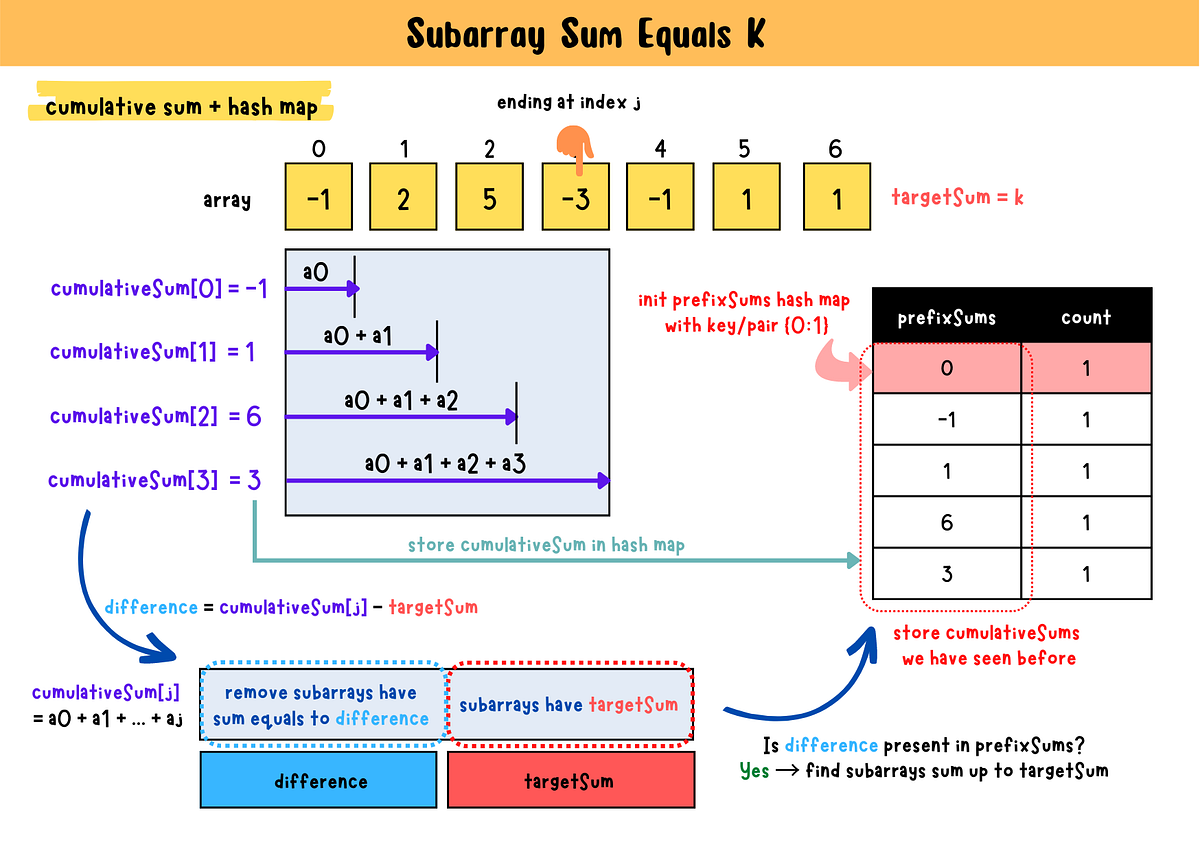
This equation is the key. It tells us that for a subarray ending at index j to have a sum of k, there must have been a previous point i-1 where the prefix sum was exactly equal to prefix_sum[j] - k.
So, the problem transforms. As we iterate through the array from left to right, calculating the current prefix sum (prefix_sum[j]), we no longer need to look back at all possible start points. We only need to ask one question: "How many times have we previously seen a prefix sum equal to current_prefix_sum - k?"
This is where the hash map comes in. A hash map provides average time complexity for lookups, making it the perfect tool to track the prefix sums we've encountered so far.
The following image provides a high-level visual of this exact logic.
The Algorithm: Prefix Sums and a Hash Map
Here is the step-by-step algorithm that runs in time:
-
Initialize:
count = 0to store the number of valid subarrays.current_sum = 0to keep track of the running prefix sum.- A hash map,
prefix_sums, to store the frequencies of the prefix sums encountered so far.
-
The Critical Base Case: Before starting, add an entry
{0: 1}to theprefix_sumsmap. This represents the "empty prefix" (the sum before we've processed any elements), which has a sum of 0 and occurs once. This is crucial for correctly counting subarrays that start from index 0. For such a subarray,prefix_sum[j] = k, and our formula becomesprefix_sum[j] - k = 0. The{0: 1}entry allows us to find this match. -
Iterate through the array: For each number
numinnums:
a. Update the running sum:current_sum += num.
b. Find the required past sum: Calculatediff = current_sum - k.
c. Check the hash map: Ifdiffexists as a key inprefix_sums, it means there are one or more subarrays ending at the current position with a sum ofk. Add the frequency ofdiffto ourcount:count += prefix_sums.get(diff, 0).
d. Update the hash map: Increment the frequency of thecurrent_sumin theprefix_sumsmap.prefix_sums[current_sum] = prefix_sums.get(current_sum, 0) + 1.
The order of operations is vital: you must check for diff (step 3c) before updating the map with current_sum (step 3d). If you update first, you might incorrectly count an empty subarray when k = 0.
The following detailed guide from AlgoMonster provides a superb explanation of the intuition, the algorithm, and common pitfalls.
560. Subarray Sum Equals K - In-Depth Explanation
This guide walks through the entire logic, from intuition to implementation details.
First, read the Intuition section to solidify your understanding of the s - k formula. Then, read the Solution Approach for a clear breakdown of the algorithm. Finally, pay close attention to the Common Pitfalls section, especially the parts about initializing the hash map and the order of operations.
A Detailed Walkthrough
Let's trace the algorithm with an example. Consider nums = [1, 2, 3] and k = 3.
-
Initial state:
count = 0,current_sum = 0,prefix_sums = {0: 1}. -
num = 1(index 0):current_sumbecomes1.diff = 1 - 3 = -2. Is-2inprefix_sums? No.countremains0.- Update map:
prefix_sumsis now{0: 1, 1: 1}.
-
num = 2(index 1):current_sumbecomes1 + 2 = 3.diff = 3 - 3 = 0. Is0inprefix_sums? Yes, its count is1.countbecomes0 + 1 = 1. (This found the subarray[1, 2]).- Update map:
prefix_sumsis now{0: 1, 1: 1, 3: 1}.
-
num = 3(index 2):current_sumbecomes3 + 3 = 6.diff = 6 - 3 = 3. Is3inprefix_sums? Yes, its count is1.countbecomes1 + 1 = 2. (This found the subarray[3], because the prefix sum up to the previous element was 3).- Update map:
prefix_sumsis now{0: 1, 1: 1, 3: 1, 6: 1}.
-
Final result:
count = 2. The two subarrays are[1, 2]and[3].
The following image provides another excellent trace for a different example.

For a dynamic walkthrough, the NeetCode video provides a clear, step-by-step explanation with a great example.
Subarray Sum Equals K - Prefix Sums - Leetcode 560 - Python
This segment provides a full, step-by-step execution of the algorithm.
Watch the detailed walkthrough from this section. The visualization of how previous prefix sums are "removed" to find the target subarray is particularly helpful.
Python Implementation
Here is a clean Python implementation using collections.Counter, which simplifies handling missing keys by automatically providing a default value of 0.
from collections import Counter

def subarraySum(nums: list[int], k: int) -> int:
    """
    Calculates the number of contiguous subarrays whose sum equals k.

    Time complexity: O(N)
    Space complexity: O(N)
    """
    count = 0
    current_sum = 0


    # The hash map stores {prefix_sum: frequency}
    # Initialize with a prefix sum of 0 having occurred once.
    prefix_sums = Counter({0: 1})

    for num in nums:


        # Update the running prefix sum
        current_sum += num


        # Calculate the difference we need to find in our map
        diff = current_sum - k


        # Add the number of times we've seen the required 'diff'
        count += prefix_sums[diff]


        # Increment the count for the current prefix sum
        prefix_sums[current_sum] += 1

    return count


# Example
nums = [1, 2, 3]
k = 3
print(f"Number of subarrays with sum {k}: {subarraySum(nums, k)}") # Output: 2

nums = [1, -1, 1, -1, 1, -1]
k = 0
print(f"Number of subarrays with sum {k}: {subarraySum(nums, k)}") # Output: 9
Conclusion
In this lesson, you've leveled up your understanding of prefix sums by combining them with a hash map to solve a non-trivial problem efficiently. This pattern is a powerful tool in your algorithmic arsenal.
Key Takeaways:
- The Problem: Counting all contiguous subarrays that sum to a target
k. - The Core Insight: The problem can be transformed algebraically: if
sum(i, j) = k, thenprefix_sum[i-1] = prefix_sum[j] - k. - The Solution: Iterate through the array, maintaining a running
current_sum. For eachcurrent_sum, use a hash map to instantly look up how many times you've previously seen the requiredcurrent_sum - k. - The Complexity: This approach achieves time and space, a significant improvement over naive solutions.
- The Critical Detail: Always initialize the hash map with a count of 1 for a prefix sum of 0 (
{0: 1}) to handle subarrays that start from the beginning of the array.
We've now explored problems involving sums of subarrays. In the next lesson, we'll shift our focus slightly. Instead of finding a specific sum, we will learn how to find the subarray with the maximum possible sum using another famous and elegant linear-time algorithm: Kadane's Algorithm.