Recommended resources
The freely available resources this lesson will direct you to.
Welcome to your first lesson in the "Core Array and Subarray Techniques" module. We'll begin our journey by exploring a fundamental pattern that is surprisingly powerful: the Prefix Sum. While you may have encountered this concept in your LeetCode practice, our goal here is to ensure you have a "neat" and thorough understanding, focusing on its construction, application, and the subtle details that lead to clean, efficient code.
This lesson directly addresses the learning outcome: Construct a prefix sum array to answer range sum queries in O(1) time. We will see how a simple precomputation step can dramatically improve the efficiency of solving a common class of problems, a trade-off between space and time that is a recurring theme in algorithm design.
The Problem: Answering Many Range Sum Queries
Imagine you are analyzing daily stock returns for a portfolio. You have an array of numbers representing the profit or loss for each day. A common task is to calculate the total return over various periods, for example, "What was the total return from day 10 to day 30?" or "from day 5 to day 50?".
If you have an array of N days and you receive Q such queries, the most straightforward approach is to loop through the array for each query and add up the numbers in the given range.
- A single query for a range of length
ktakesO(k)time. - In the worst case, the range could span the entire array, so a query takes
O(N)time. - Answering
Qqueries would then takeO(N * Q)time in total.
For the constraints often seen in coding interviews (e.g., N and Q up to 100,000), an O(N * Q) solution is far too slow. This is where precomputation comes in.
To get a better feel for this problem, the following video uses an intuitive example of YouTube video performance to illustrate the inefficiency of the naive approach.
Prefix Sum Array and Range Sum Queries
This video from Profound Academy introduces the core problem of answering range sum queries efficiently.
Please watch the introductory segment from the beginning up to the explanation of the naive approach. Notice how repeated calculations become a major bottleneck when handling multiple queries.
The Solution: The Prefix Sum Array
The key insight is that we can pre-calculate the cumulative sums of the array. We can create a new array, let's call it prefix_sum, where prefix_sum[i] stores the sum of all elements in the original array from the start (index 0) up to and including index i.
Let's say our original array is nums = [2, -1, 4, 5, -3].
The prefix_sum array would be constructed as follows:
prefix_sum[0] = nums[0] = 2prefix_sum[1] = nums[0] + nums[1] = 2 + (-1) = 1prefix_sum[2] = nums[0] + nums[1] + nums[2] = 1 + 4 = 5prefix_sum[3] = nums[0] + ... + nums[3] = 5 + 5 = 10prefix_sum[4] = nums[0] + ... + nums[4] = 10 + (-3) = 7
So, prefix_sum = [2, 1, 5, 10, 7].
Notice a pattern? Each new value in the prefix sum array is just the previous prefix sum plus the current element from the original array. This gives us a simple recurrence relation for building the array:prefix_sum[i] = prefix_sum[i-1] + nums[i] (for i > 0)
This construction process takes only one pass through the original array, giving it a time complexity of O(N).
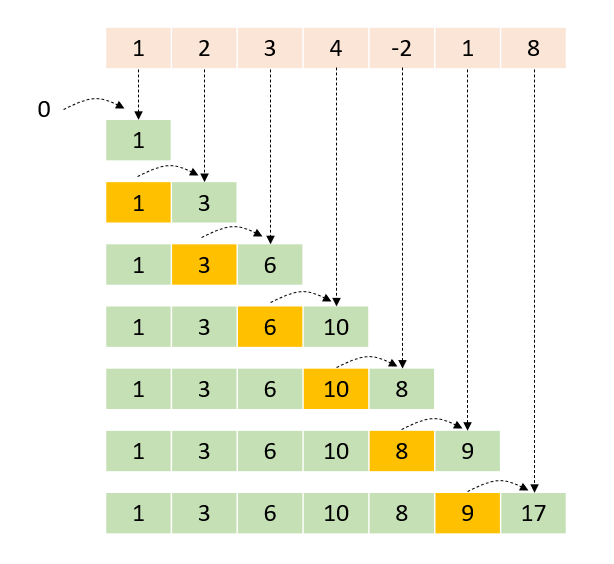
Answering Queries in O(1)
With the prefix_sum array built, how do we find the sum of a range, say from index L to R (inclusive)?
The sum of elements from L to R is equivalent to:
(Sum of elements from 0 to R) - (Sum of elements from 0 to L-1)
Using our prefix_sum array, this translates to:sum(L, R) = prefix_sum[R] - prefix_sum[L-1]
For our example nums = [2, -1, 4, 5, -3] and prefix_sum = [2, 1, 5, 10, 7], let's find the sum from L=1 to R=3 (i.e., [-1, 4, 5]). The true sum is 8.
Using our formula:sum(1, 3) = prefix_sum[3] - prefix_sum[1-1] = prefix_sum[3] - prefix_sum[0] = 10 - 2 = 8.
It works! This calculation is a single subtraction, an O(1) operation.
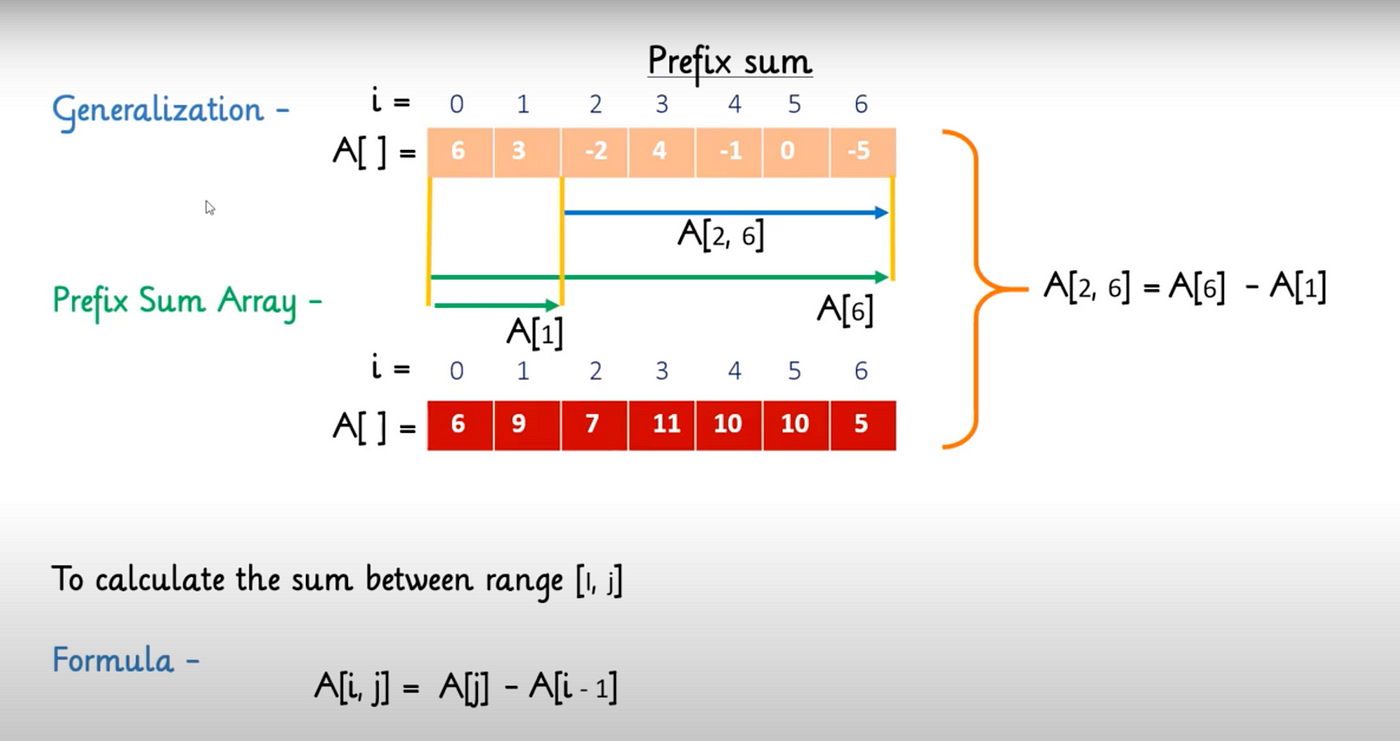
The following reading provides a formal explanation of this technique. While it uses 1-based indexing (common in competitive programming contexts), the underlying mathematical principle is identical.
This guide provides a concise, formal definition of the prefix sum technique.
Please read the "Explanation" section, starting from the initial problem statement down to the time complexity analysis. Pay close attention to how the formula prefix[R] - prefix[L-1] is derived.
A Practical Pitfall and an Elegant Solution
The formula prefix_sum[R] - prefix_sum[L-1] has a critical edge case: what if the range starts at index L=0? The expression prefix_sum[L-1] would become prefix_sum[-1], leading to an out-of-bounds error.
You could handle this with an if statement: if L == 0, the sum is simply prefix_sum[R]. However, a more common and cleaner approach is to adjust the prefix sum array itself.
The Standard Fix: Create a prefix sum array of size N+1 and initialize it with a leading zero.
prefix_sum[0] = 0prefix_sum[i+1] = prefix_sum[i] + nums[i]forifrom 0 toN-1.
Let's use our example nums = [2, -1, 4, 5, -3]. The padded prefix sum array is:prefix_sum = [0, 2, 1, 5, 10, 7]
Now, the formula for the sum of a 0-indexed range [L, R] becomes:sum(L, R) = prefix_sum[R+1] - prefix_sum[L]
Let's re-calculate sum(1, 3):sum(1, 3) = prefix_sum[3+1] - prefix_sum[1] = prefix_sum[4] - prefix_sum[1] = 10 - 2 = 8.
And what about the edge case, sum(0, 2)? (i.e., [2, -1, 4], which sums to 5)sum(0, 2) = prefix_sum[2+1] - prefix_sum[0] = prefix_sum[3] - prefix_sum[0] = 5 - 0 = 5.
This padded approach handles all cases with a single, consistent formula, eliminating the need for conditional logic in your query function. This is a crucial practical detail for writing robust code under pressure.
Prefix Sum Technique: 8 Companies Test It, Few Practice It
The author of this Codeintuition blog post highlights common mistakes engineers make when implementing prefix sums.
Focus on the first bullet point, "Off-by-one on the range," which describes this exact problem and the standard fix of using an n+1 size array.
The following video segments provide a complete walkthrough, from deriving the formula to implementing this elegant fix.
Prefix Sum Array and Range Sum Queries
The video now demonstrates how to use the prefix sum array for queries and how to handle the L=0 edge case.
Watch from this segment, which covers the query formula, the edge case, the elegant solution of adding a leading zero, and a final summary of the algorithm's performance.
Python Implementation
Here is a clean Python implementation within a class structure, similar to what you'd see on LeetCode for a problem like "Range Sum Query - Immutable". This implementation uses the padded prefix sum array.
class NumArray:
    def __init__(self, nums: list[int]):


        # Initialize a prefix sum array of size N+1 with a leading zero.
        self.prefix_sum = [0] * (len(nums) + 1)


        # Build the prefix sum array.
        for i in range(len(nums)):
            self.prefix_sum[i+1] = self.prefix_sum[i] + nums[i]

    def sumRange(self, left: int, right: int) -> int:


        # Apply the universal formula.
        # This works for all valid 'left' and 'right', including left=0.
        return self.prefix_sum[right + 1] - self.prefix_sum[left]


# Example usage:
nums = [2, -1, 4, 5, -3]
numArray = NumArray(nums)
print(numArray.sumRange(1, 3))  # Output: 8
print(numArray.sumRange(0, 4))  # Output: 7
As a final note, Python's standard library offers a convenient function in the itertools module called accumulate, which can build a prefix sum array for you. list(itertools.accumulate(nums)) will produce the non-padded version.
Conclusion
In this lesson, we established a core pattern for efficiently handling range sum queries. You have learned not just the "what" but also the "why" and "how," including a key implementation detail that avoids common errors.
Key Takeaways:
- The Problem: Answering multiple range sum queries naively is inefficient (
O(N*Q)). - The Solution: Precompute a prefix sum array in
O(N)time. This allows each subsequent range query to be answered inO(1)time. - The Trade-off: We use
O(N)extra space to reduce the total time complexity toO(N + Q). - The Formula: For a 0-indexed range
[L, R], the sum isprefix_sum[R] - prefix_sum[L-1]. - The Elegant Implementation: By using a padded prefix sum array (size
N+1with a leading zero), the formula simplifies toprefix_sum[R+1] - prefix_sum[L]and gracefully handles all edge cases.
This concept of precomputation is a cornerstone of algorithm design. In our next lesson, we will see how prefix sums become even more powerful when combined with another fundamental data structure: the hash map. This combination unlocks solutions to a whole new class of "subarray sum" problems that are very common in interviews.