Recommended resources
The freely available resources this lesson will direct you to.
Introduction
Welcome back. In our previous lesson, we used supply and demand diagrams to demonstrate a fundamental problem in economics: externalities cause market failures. We saw that markets, when left alone, overproduce goods with negative externalities (like pollution) and underproduce goods with positive externalities (like education), leading to a loss of overall societal welfare, which we identified as deadweight loss.
Today, we shift from diagnosing the problem to exploring the solutions. The learning outcome for this lesson is to explain how Pigouvian taxes and subsidies can be used as corrective policy tools. These policies are designed to "internalize" the externality—essentially, to make producers and consumers account for the external costs or benefits of their actions. This is a powerful example of how economic theory can inform real-world policy to improve market outcomes.
Correcting Negative Externalities with Pigouvian Taxes
The first tool in our kit is the Pigouvian tax, named after the British economist Arthur Pigou. It is a tax levied on each unit of a good or service that generates a negative externality. The core idea is to force the decision-maker to confront the full social cost of their actions, not just their private cost.
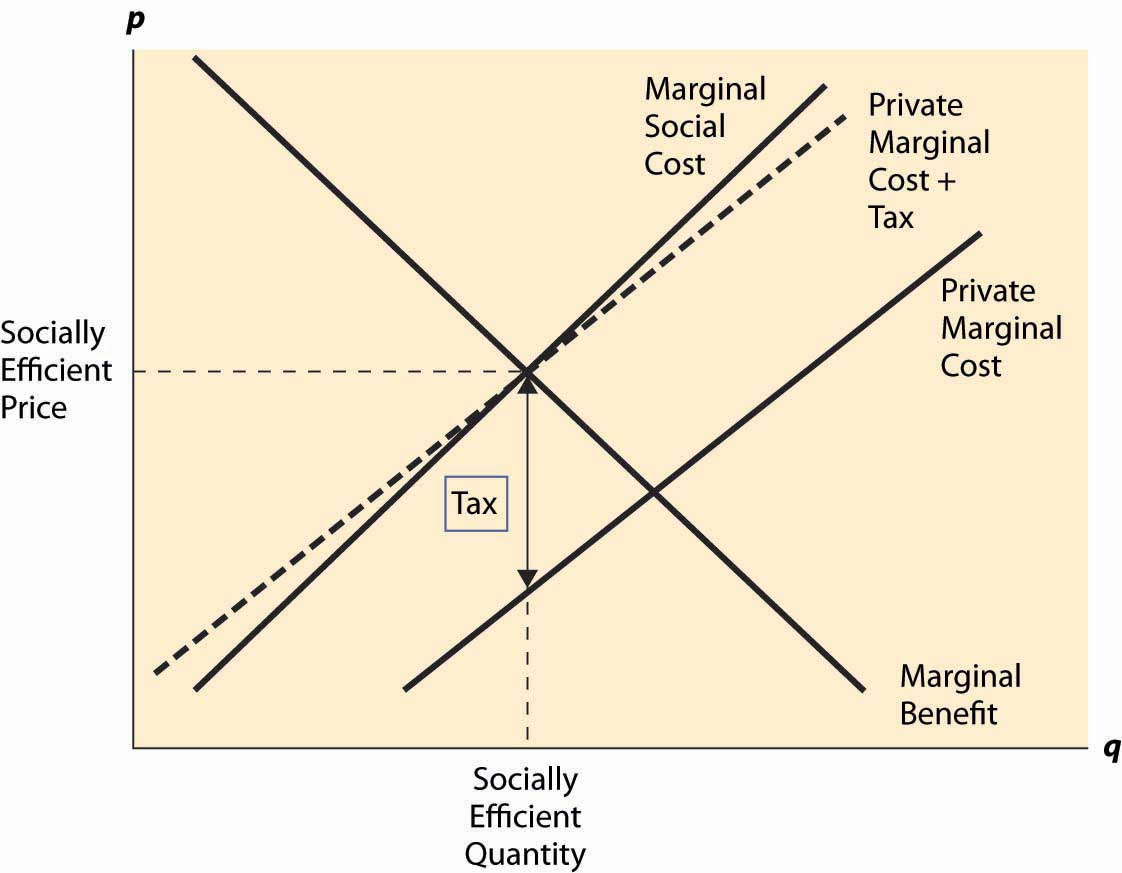
Recall the graph for a negative externality: the Marginal Social Cost (MSC) is higher than the Marginal Private Cost (MPC). The market produces at , where , resulting in overproduction. The socially optimal quantity, , is where .
How can a tax fix this? By setting a per-unit tax exactly equal to the marginal external cost (MEC) at the socially optimal quantity (), the government can align private incentives with social costs.
The firm's new cost becomes . If the tax is set correctly, this new private cost curve will intersect the marginal benefit curve precisely at the socially optimal quantity, .
To see this mechanism in action, let's start with a video that explains the concept and illustrates it graphically.
The following video from Edspira provides a clear and intuitive explanation of Pigouvian taxes. It uses the example of traffic congestion to demonstrate how the tax works to correct the market failure.
Please watch from the beginning to 08:23. As you watch, focus on these key points: How the tax 'internalizes' the external cost of driving. How the tax shifts the marginal private cost curve upwards. How this shift leads the market to the socially efficient quantity, eliminating the deadweight loss.
The video effectively shows that the tax isn't meant to be punitive; it's designed to correct a price signal. Before the tax, the price of the activity was too low because it didn't include the external costs. The Pigouvian tax corrects this by making the private cost reflect the social cost.
A More Formal Look at Pigouvian Taxes
Now that you have the graphical intuition, let's deepen your understanding with a more formal reading. Given your analytical background, you may appreciate seeing the logic laid out with more precision, including the underlying math.
10.4 Solving the problem: Regulation, taxation, and compensation
The CORE Econ textbook offers a detailed breakdown of Pigouvian taxes. It presents a clear diagram and includes a mathematical extension that formalizes how the optimal tax rate is determined.
Please read the sections titled 'Taxation' and the 'Extension 10.4 Pigouvian taxes'. Pay close attention to: How the tax is set equal to the gap between MSC and MPC at the efficient quantity. In the extension, how the tax x changes the firm's cost function and profit-maximization decision, leading it to choose the Pareto-efficient output Q*.
This reading introduces two important points:
- Distributional Effects: While the tax leads to an efficient outcome for society as a whole, the producer (the polluter) is made worse off. They produce less and pay a tax on what they do produce. The revenue from the tax goes to the government, and the third parties (e.g., fishermen) are better off due to the reduced externality.
- The "Double Dividend": As the Edspira video also mentioned (from 08:23 onwards), not only does the tax correct the market failure, but it also generates revenue. This revenue can be used to fund public services or even to reduce other, more distortionary taxes (like income tax), creating a second benefit for the economy.
One common misconception is that the goal of a Pigouvian tax is to eliminate the externality entirely. This is incorrect. The goal is to achieve the optimal level of the externality, where the marginal social benefit of the activity equals its marginal social cost.
Correcting Positive Externalities with Pigouvian Subsidies
The logic for positive externalities is a mirror image of what we've just discussed. When an activity generates external benefits (e.g., R&D, vaccinations), the market underproduces it because the decision-maker doesn't receive the full social benefit.
A Pigouvian subsidy is a payment from the government to encourage the production or consumption of a good with positive externalities.
- In the case of a positive consumption externality (MSB > MPB), a subsidy to consumers effectively increases their private benefit, shifting the MPB curve up towards the MSB curve.
- In the case of a positive production externality (MSC < MPC), a subsidy to producers lowers their private cost, shifting the MPC curve down towards the MSC curve.
In either case, the goal is to set the subsidy equal to the marginal external benefit at the socially optimal quantity, .
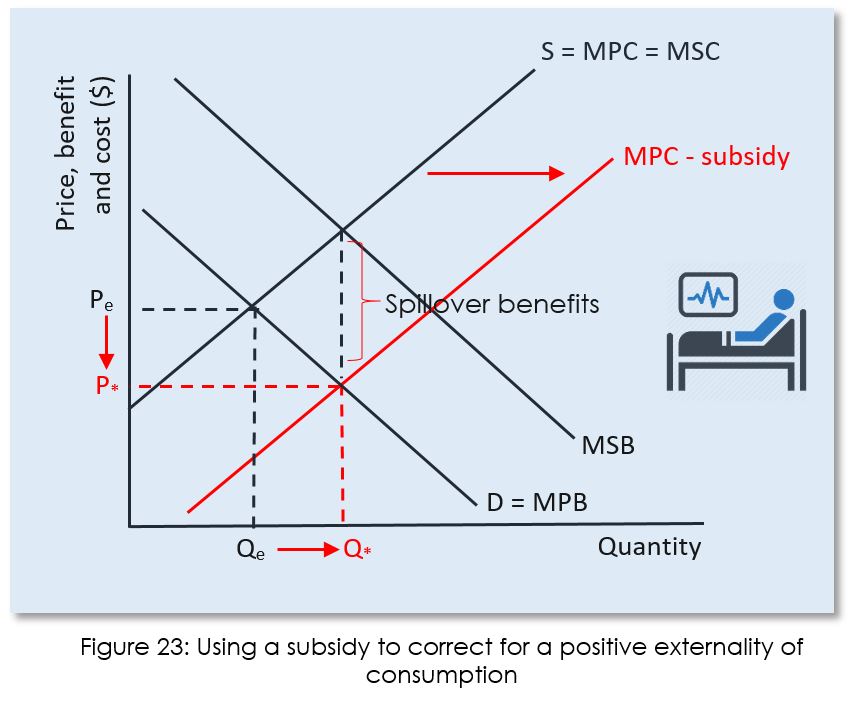
The following video explains how subsidies work and, crucially, discusses some of the real-world challenges in implementing them.
Y1 30) Subsidy and Market Failure
This video from EconplusDal details how subsidies solve the underproduction problem of positive externalities. It also provides a critical evaluation of subsidies as a policy tool, which is essential for a complete understanding.
Please watch the entire video (around 8 minutes). Focus on: How a subsidy shifts the marginal private cost curve to achieve the socially optimal quantity. The significant drawbacks discussed, such as the cost to the government, the information problem of setting the 'right' subsidy level, and the potential for firms to become dependent.
The Challenge of Getting It Right
As the video on subsidies highlighted, implementing these corrective policies is not as simple as drawing them on a graph. The same challenges apply to Pigouvian taxes.
- The Information Problem: To set the perfect tax or subsidy, the government needs to know the exact monetary value of the marginal external cost or benefit. This is incredibly difficult to measure. How do you value the cost of one more ton of CO2 or the benefit of one more person getting a college degree? An incorrect tax/subsidy can create its own deadweight loss, a situation known as government failure.
- Political and Distributional Hurdles: These policies create winners and losers. A carbon tax, for example, is opposed by industries that would have to pay it. Consumers may oppose higher fuel prices. The benefits (a healthier climate) are diffuse and long-term, while the costs are concentrated and immediate, making them politically challenging to implement.
- Elasticity Matters: The effectiveness of a subsidy or tax depends on the price elasticity of demand. As the video pointed out, if demand for public transport is highly inelastic (people won't change their behavior much in response to a price change), then a subsidy may not significantly increase ridership, making it an expensive and ineffective policy.
Conclusion
In this lesson, we explored the primary policy tools for correcting externalities. By adjusting market prices, these instruments aim to align private incentives with social welfare.
Key Takeaways:
- Pigouvian Taxes are levied on goods with negative externalities. They increase the marginal private cost of production, causing output to fall to the socially optimal level.
- Pigouvian Subsidies are payments to encourage goods with positive externalities. They reduce the marginal private cost (or increase the marginal private benefit), causing output to rise to the socially optimal level.
- The ideal tax or subsidy is set equal to the marginal external cost or benefit at the socially efficient quantity.
- In practice, these policies face significant challenges, including information problems (measuring the externality) and political opposition.
We have now seen how governments can intervene directly to "fix" prices when externalities are present. However, is government intervention always necessary? In our next lesson, we will explore the Coase Theorem, a fascinating proposition that suggests under certain conditions, private parties might be able to bargain their way to an efficient solution without any government involvement at all.