Recommended resources
The freely available resources this lesson will direct you to.
Introduction
Welcome to the final lesson in our module on Market Failures and Government Intervention. In previous lessons, we've explored how markets can lead to inefficient outcomes due to externalities, public goods, common resources, and asymmetric information. Today, we address another major source of inefficiency: the lack of competition caused by monopolies.
Recall from Module 5 that a monopolist, unlike a competitive firm, can restrict output and raise prices to maximize its profit. This behavior creates a deadweight loss, meaning that some mutually beneficial trades that would occur in a competitive market do not happen. This loss of economic welfare is a form of market failure and provides a strong rationale for government intervention.
Our learning outcome for this lesson is to explain how price regulation and antitrust policy are used to address monopoly power. We will investigate the two primary tools governments use to "debug" monopolistic markets:
- Price Regulation, typically used to manage natural monopolies.
- Antitrust Policy, used to prevent the formation and abuse of monopoly power in other sectors.
This lesson will bridge your understanding of firm behavior with the role of government, completing our foundational study of microeconomics.
1. The Rationale for Intervention: Monopoly and Deadweight Loss
Before we examine the solutions, let's briefly revisit the problem. A monopolist faces a downward-sloping demand curve and maximizes profit by producing the quantity where marginal revenue (MR) equals marginal cost (MC). However, they charge the price consumers are willing to pay for that quantity, which is found on the demand curve. This price is higher than marginal cost, and the quantity is lower than what would be produced in a competitive market.
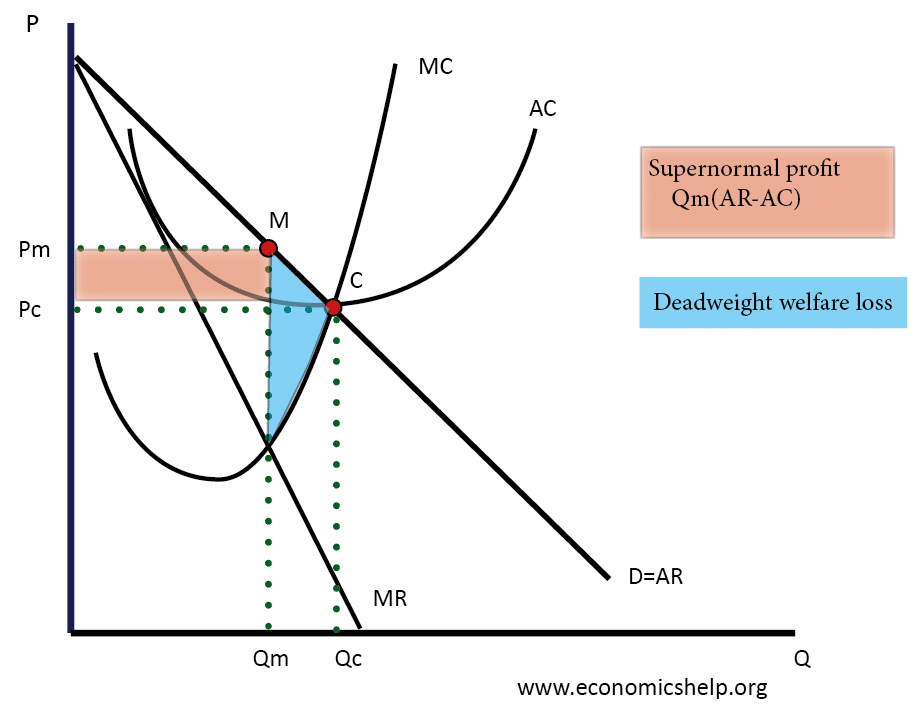
This deadweight loss represents the core economic argument for government intervention. The goal of public policy is to reduce this inefficiency and move the market outcome closer to the competitive ideal (point C in the diagram).
2. Tool #1: Price Regulation of Natural Monopolies
Not all monopolies are created equal. In some industries, it is more cost-effective for one firm to supply the entire market than for multiple firms to compete. This situation is called a natural monopoly.
To understand what a natural monopoly is and why regulating it is often preferred to breaking it up, please watch the following video.
Monopolies and Anti-Competitive Markets: Crash Course Economics #25
This segment from CrashCourse Economics explains the concept of a natural monopoly, using public utilities as a key example. It sets the stage for why governments often choose regulation over dissolution.
Watch the clip from 06:38 to 07:54. Focus on why having a single provider can be more efficient in certain industries and how this justifies a regulatory approach.
As the video explains, natural monopolies typically have very high fixed costs and low marginal costs, causing their long-run average total cost (LRATC) to decline over a large range of output. Think of a water utility: the cost of laying a network of pipes across a city is enormous, but the cost of providing an extra litre of water is tiny. Having multiple firms build redundant pipe networks would be incredibly wasteful.
Since breaking up a natural monopoly would increase average costs, the government's approach is to allow the monopoly to exist but regulate its price. The challenge is deciding what the "right" price is.
The Regulator's Dilemma: Efficiency vs. Viability
Let's explore the different pricing rules a regulator could impose.
This section from the textbook by Parkin provides an excellent, clear explanation of the different pricing rules for regulating a natural monopoly and the trade-offs involved.
Please read the sections titled 'Efficient Regulation of a Natural Monopoly' and 'Second-Best Regulation of a Natural Monopoly' (pages 313-314). Pay close attention to: Marginal Cost Pricing Rule: Why is it considered efficient but often impractical? Average Cost Pricing Rule: How does this rule work as a 'second-best' compromise?
To summarize the key points from your reading:
- Marginal Cost Pricing (P = MC): This is the most efficient rule from a social perspective. It forces the monopolist to produce the quantity where the marginal benefit to consumers (the price they are willing to pay) equals the marginal cost of production. This eliminates deadweight loss entirely.
- The Problem: For a natural monopoly, the average total cost (ATC) is falling, which means the marginal cost (MC) must be below it. Setting P = MC would mean the firm's price is below its average cost, causing it to make an economic loss and eventually go out of business.
- Average Cost Pricing (P = ATC): This is a common compromise. The regulator sets a price equal to the average total cost. At this price, the firm earns zero economic profit (it breaks even), which is enough to keep it in business. While this outcome is not as efficient as marginal cost pricing (there is still some deadweight loss), it is a significant improvement over the unregulated monopoly outcome.
The image below visually contrasts the unregulated outcome with the regulated outcome using average cost pricing.

Modern Approaches and Challenges
In practice, regulators have developed more sophisticated methods and face several challenges.
Y2 30) Competition Policy - Monopoly Regulation
The following video from EconplusDal discusses real-world regulatory practices, such as price caps, and the difficulties regulators face.
Please watch from the beginning to 05:54. Focus on: Price Cap Regulation (RPI - X): How does this create an incentive for firms to become more efficient? Problems with Regulation: Note the issues of imperfect information and 'regulatory capture'.
The video highlights two key points:
- Price Cap Regulation: Instead of directly setting a price based on a firm's reported costs, the regulator sets a maximum price that can be charged, often allowing it to rise with inflation (RPI) minus an expected efficiency gain (the 'X' factor). This incentivizes the firm to cut costs more than 'X' to increase its profits, promoting efficiency.
- Regulatory Capture: This is a significant risk where the regulated firm develops a close relationship with the regulator, influencing decisions in its own favor rather than in the public interest.
3. Tool #2: Antitrust Policy
When a monopoly is not natural, the government's goal is not to manage it, but to promote competition. This is done through antitrust laws.
Antitrust policies are rules and regulations designed to prevent monopolization, promote competition, and outlaw business practices that are considered anti-competitive.
[PDF] CHAPTER 10 - Market Power: Monopoly and Monopsony
This excerpt from the textbook by Pindyck and Rubinfeld defines antitrust laws and provides powerful, real-world examples of their enforcement.
Please read the following sections: Start at '10.7 Limiting Market Power: The Antitrust Laws' (page 45) to get a formal definition. Then, read the three examples starting on page 48: 'A PHONE CALL ABOUT PRICES', 'GO DIRECTLY TO JAIL', and 'THE UNITED STATES AND THE EUROPEAN UNION VERSUS MICROSOFT'. These illustrate what antitrust laws prohibit in practice.
The core activities targeted by antitrust policy include:
- Preventing Mergers that Harm Competition: Governments review proposed mergers and acquisitions. If a merger (especially a horizontal integration between direct competitors) is likely to create a company with excessive market power, regulators can block it.
- Breaking Up Monopolies: In rare cases, a government may force a company to break up into smaller, competing firms. The most famous example in the U.S. is the breakup of AT&T's telephone monopoly in the 1980s.
- Prosecuting Anti-competitive Practices: This is the most common use of antitrust law. These practices include:
- Price-Fixing: Agreements between competitors to set prices. As the "phone call" example showed, even proposing this is illegal.
- Collusion and Cartels: Firms coordinating to act like a single monopolist.
- Bundling and Tying: Forcing customers to buy a second product when they buy a first one (e.g., the Microsoft case involving its web browser).
The following video provides a great summary of these concepts with additional examples.
Monopolies and Anti-Competitive Markets: Crash Course Economics #25
This CrashCourse video details the purpose of antitrust laws and gives examples of different anti-competitive tactics that regulators target.
Watch the segment from 03:28 to 05:52. Pay attention to the distinction between horizontal and vertical integration and the real-world cases mentioned (AT&T/T-Mobile, Microsoft, Toys R Us).
Conclusion
In this lesson, we have examined the government's two-pronged approach to dealing with monopoly power. Both strategies aim to correct the market failure of monopoly by reducing deadweight loss and moving market outcomes closer to the competitive, socially efficient ideal.
Key Takeaways:
- Monopolies lead to allocative inefficiency (deadweight loss) by producing too little and charging too much, which justifies government intervention.
- Price Regulation is the primary tool for dealing with natural monopolies, where having a single firm is most efficient. Regulators often use average cost pricing as a practical compromise between efficiency and ensuring the firm's survival.
- Antitrust Policy is used for non-natural monopolies to promote competition by blocking anti-competitive mergers, breaking up firms, and prosecuting illegal practices like price-fixing and collusive behavior.
- Both regulatory approaches face significant challenges, including imperfect information, the high cost of administration, and the risk of regulatory capture.
This lesson concludes our module on market failures and, with it, our foundational survey of microeconomics. We have built a framework for understanding how individual agents and firms make decisions, how they interact in different market structures, and what happens when those markets fail to produce efficient outcomes.
Preview of the Next Lesson:
Our journey now shifts from the micro to the macro. We will zoom out from the level of individual markets to look at the economy as a whole. In our next lesson, we will begin Module 8, "Measuring the Macroeconomy," by learning how economists track the health of an entire nation's economy using tools like the circular flow model and Gross Domestic Product (GDP).