Recommended resources
The freely available resources this lesson will direct you to.
- CatBoost Part 1: Ordered Target Encodingwww.youtube.com
- Anna Veronika Dorogush: Mastering gradient boosting with CatBoost | PyData London 2019www.youtube.com
- Why CatBoost Mathematically Outsmarts XGBoost in Multi- ...www.linkedin.com
- CatBoost Guide: Handling Categorical Data with Gradient Boosletsdatascience.com
Welcome to the next lesson in our journey through advanced feature engineering. In our previous discussions, we tackled the challenge of encoding categorical variables by exploring target encoding and Weight of Evidence (WoE). We established that a primary obstacle is target leakage, where information from the label inadvertently contaminates our features, leading to models that perform deceptively well in training but fail on new data.
Today, we delve into a particularly elegant solution to this problem: CatBoost encoding. This technique, native to the CatBoost gradient boosting library, offers a powerful and automated way to handle categorical features. Our goal is to implement CatBoost encoding and explain its ordered target statistic approach for handling categorical features sequentially. You'll see how this method cleverly uses an "artificial time" concept to prevent leakage, providing a robust alternative to the cross-validation schemes we've discussed previously.
The Challenge Revisited: Target Leakage
Let's briefly revisit the core problem with naive target encoding. When we replace a category (e.g., city = 'Chicago') with the average target value of all rows containing that category, the target value of the current row is used to calculate its own feature. The model gets a peek at the answer key.
While methods like K-fold or leave-one-out encoding mitigate this by holding out data, they add complexity to the pipeline. CatBoost was designed to solve this problem from first principles, integrating the solution directly into the algorithm.
CatBoost Guide: Handling Categorical Data with Gradient Boos
This guide provides an excellent overview of CatBoost. Let's start by reinforcing why standard methods can be problematic.
Please read the subsection Why it fails. This section concisely summarizes the target leakage issue we're aiming to solve.
The CatBoost Solution: Ordered Target Statistics
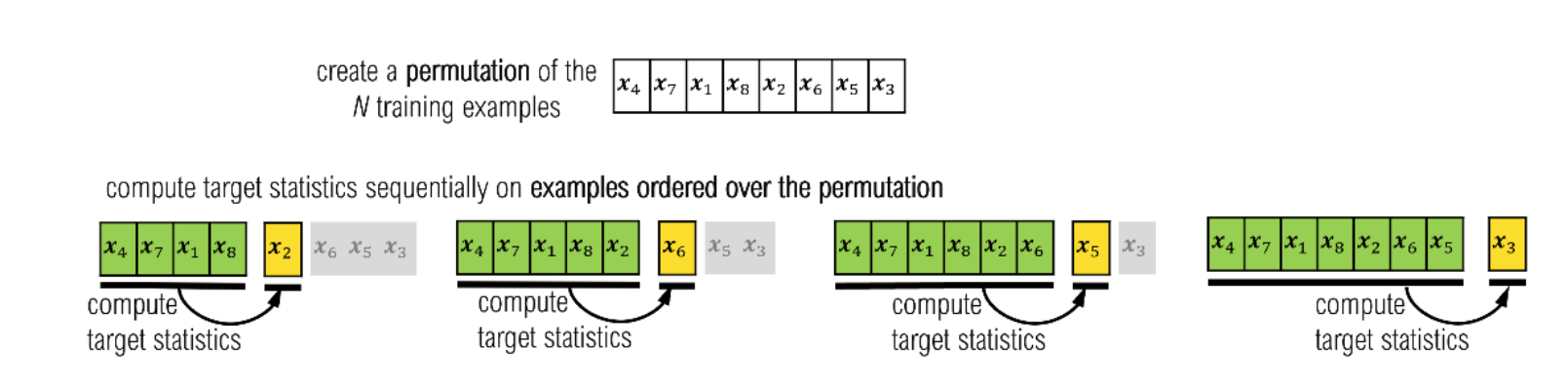
CatBoost's core innovation is a method called Ordered Target Statistics. Instead of using the entire dataset to compute the target mean for a category, it introduces an artificial temporal order. Here's how it works:
- Create a Random Permutation: Before training begins, the training data is shuffled into a random order. This random sequence acts as an "artificial timeline."
- Sequential Encoding: The algorithm then processes the data row by row according to this permutation.
- Calculate Historical Statistics: For any given row, its categorical features are encoded using the target values of only the rows that have appeared before it in the random sequence.
This simple but powerful idea guarantees that a row's own target value is never used to create its features, thus completely avoiding target leakage.
The following StatQuest video provides a fantastic, step-by-step visualization of this process.
CatBoost Part 1: Ordered Target Encoding
This video from StatQuest with Josh Starmer breaks down Ordered Target Encoding into simple, digestible steps.
Watch from the beginning until the explanation of ordered target encoding. The video will first recap the leakage problem and then walk you through a concrete example, showing exactly how the encoded values are calculated sequentially.
The process you just saw is what makes CatBoost so effective. Let's look at a couple of diagrams that reinforce this sequential, expanding window concept.

The Mathematical Formulation
Given your interest in the mathematical underpinnings, let's examine the formula CatBoost uses. For a given row and categorical feature , the encoded value is not just a simple average. It's a smoothed average that incorporates a prior.
Let's break this down:
- The summations run from to , where is the position of the current row in the random permutation. This formalizes the "only look at preceding rows" rule.
- is an indicator function that is 1 if the category in the preceding row matches the category in the current row , and 0 otherwise.
- is the target value of the preceding row .
- is a prior value, typically the average target value of the entire dataset. It's a starting guess for the encoding.
- is a smoothing parameter (a positive number). It controls how much weight is given to the prior.
In essence: The formula calculates the average target value for the given category based on historical data, but it's regularized by pulling it towards the global average target (). This is especially important for the first few occurrences of a category in the permutation, where there's very little "history" to rely on, preventing the encoding from being too noisy.
Why CatBoost Mathematically Outsmarts XGBoost in Multi- ...
This article provides a sharp mathematical perspective on why CatBoost's approach is so effective.
Focus on the sections titled Time-Aware Learning and Ordered Target Statistics. This will reinforce the concepts of historical data definition and the breakdown of the encoding formula.
Robustness Through Multiple Permutations
A single random permutation could introduce its own bias; for example, the first few items in the sequence will always have less precise encodings. To combat this, CatBoost doesn't just use one permutation. During the training of the gradient boosting model, it generates multiple random permutations. The model is trained across these different orderings, making the final model more robust and less sensitive to the initial random shuffle. This acts as a powerful form of built-in regularization.
Implementation in Python
Now, let's move to the practical part of the learning outcome. One of the most appealing aspects of CatBoost is its seamless integration and ease of use. You don't need a separate preprocessing library or complex pipeline steps to apply this encoding. The CatBoostClassifier or CatBoostRegressor handles it internally.
The key is simply to tell the model which of your columns are categorical.
CatBoost Guide: Handling Categorical Data with Gradient Boos
This section of the guide provides a complete, runnable example.
Follow the code under the heading Building a Churn Classifier. Pay close attention to two things: The X DataFrame containing raw string columns like 'Basic', 'Chicago', and 'Credit Card' is passed directly to the model. The cat_features parameter is used in the model.fit() call to inform the classifier which columns to treat with its special encoding logic. Also, review the subsection on Using the Pool Object. For the large-scale MLOps systems you're interested in, wrapping your data in a Pool object is a more memory-efficient and performant approach than passing raw Pandas DataFrames.
Interview & Business Context Alert
Question: "A teammate suggests using standard target encoding on our data before feeding it to XGBoost. You advocate for using CatBoost instead. How would you explain the advantages of CatBoost's approach to handling categorical features?"
Answer Framework:
- Acknowledge the Problem: Start by agreeing that categorical features need special handling and that naive target encoding leads to target leakage.
- Explain the Solution: Describe CatBoost's Ordered Target Statistics. Explain that it creates a random permutation of the data and encodes each row using only the target information from preceding rows. This fundamentally prevents leakage without needing complex cross-validation folds.
- Mention Robustness: Add that CatBoost uses multiple permutations, making the model more robust and acting as a form of regularization.
- Highlight Practicality: Conclude by mentioning the developer experience benefit: you can pass raw string features directly to the model, simplifying the feature engineering pipeline, which means faster iteration and less maintenance—a key goal in any MLOps environment.
To hear this explained by one of CatBoost's creators, you can watch the following short clip from a PyData talk.
Anna Veronika Dorogush: Mastering gradient boosting with CatBoost | PyData London 2019
This is a clip from a talk by Anna Veronika Dorogush, one of the original authors of CatBoost.
In the Q&A session, she gives a concise, expert summary of the technique. Watch the segment from her explanation of how categorical features are processed.
Conclusion
Today we've added a sophisticated and highly practical tool to our feature engineering arsenal. CatBoost's Ordered Target Statistics provide a principled way to encode categorical features that directly addresses the persistent problem of target leakage.
Key Takeaways:
- Ordered Target Statistics: CatBoost's method for encoding categorical features by creating an "artificial timeline" with a random permutation of the data.
- Leakage Prevention: By using only "historical" data (rows preceding the current one in the permutation) for encoding, it systematically prevents target leakage.
- Smoothing and Priors: The encoding is made more stable by using a formula that smooths the calculated statistic towards a global prior value.
- Automated and Integrated: The entire process is handled internally by the CatBoost library, simplifying the ML pipeline by allowing raw categorical features to be used directly in model training.
What's Next?
So far, our advanced categorical encoding methods—WoE and CatBoost—have been target-based. They rely on the relationship between the feature and the target variable. But what if we could create rich, numerical representations of categories without looking at the target at all?
In the next lesson, we will explore exactly that. We will pivot to a technique born from deep learning and NLP: entity embeddings. You will learn how to use a neural network to create dense, low-dimensional vector representations of high-cardinality features, unlocking a completely different and powerful way to capture the intrinsic relationships between categories.