Recommended resources
The freely available resources this lesson will direct you to.
Hello! Welcome to the next lesson in our module on the surgical procedure for implant placement.
In our previous lesson, we explored the biophysics of heat generation during osteotomy and the critical importance of thermal control to preserve bone cell vitality. Having prepared a precise and biologically healthy site, we are now ready to place the implant.
Today, we will focus on the mechanics of that placement. Our learning outcome is to explain the mechanics of implant insertion and the clinical significance of measuring insertion torque as a proxy for primary stability.
This is a topic where your physics background will be particularly useful. We'll be discussing torque, friction, and compressive stress—concepts you're very familiar with—but in a biological context where they have profound implications for healing and long-term success. We will examine why measuring the force required to seat an implant is one of the most critical data points a surgeon collects during the procedure.
1. Primary Stability: The Foundation for Osseointegration
Before we discuss the mechanics of insertion, we must first define its immediate goal: achieving primary stability.
Primary stability (PS) is the mechanical stability of an implant immediately following its placement. It is a measure of the physical interlocking and friction between the implant surface and the surrounding bone. It is purely mechanical and has no biological component.
This initial mechanical stability is the prerequisite for the biological process of osseointegration to occur. It's essential because it prevents micromovements at the bone-implant interface. Studies have shown that micromovements greater than about 150 µm can disrupt the formation of new bone, leading instead to the development of fibrous scar tissue around the implant—a condition known as fibrous encapsulation, which results in implant failure.
Primary stability is distinct from secondary stability, which is the biological stability that develops over weeks and months as new bone grows onto the implant surface (osseointegration). The process involves a temporary dip in total stability as primary (mechanical) stability decreases slightly before secondary (biological) stability takes over and increases.
2. The Mechanics of Insertion and Insertion Torque
The insertion of the implant is a controlled mechanical process. Using a specialized low-speed, high-torque motor or a manual torque wrench, the surgeon drives the implant (which is essentially a highly engineered screw) into the prepared osteotomy.
During this process, the surgeon measures the rotational force required to advance the implant. This measurement is called insertion torque (IT), and its unit is the Newton-centimeter (Ncm).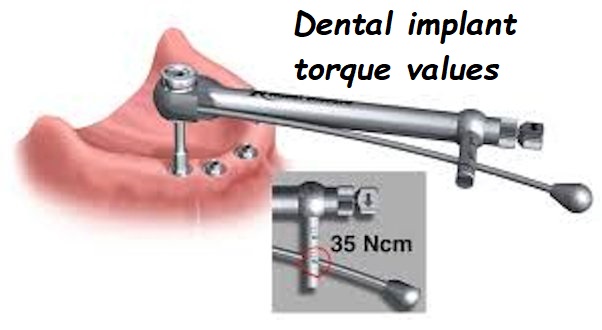
This image illustrates the clinical measurement of insertion torque. The wrench is used to drive the implant, and the gauge provides a real-time reading of the torque being applied, here showing 35 Ncm.
From a mechanical standpoint, insertion torque is a quantification of the total resistance the implant encounters as it is seated. This resistance is a combination of:
- Friction between the implant threads and the walls of the osteotomy.
- Compressive forces as the implant's shape and threads displace and compact the surrounding bone.
The central clinical idea is that this easily measurable force—the insertion torque—can serve as a real-time proxy for primary stability. The logic is that a higher resistance to insertion implies a tighter fit, greater mechanical stability, and thus a lower risk of harmful micromovement.
Let's ground this in the literature.
High Insertion Torque—Clinical Implications and Drawbacks
To formalize these concepts, let's consult the scoping review 'High Insertion Torque—Clinical Implications and Drawbacks'. This paper provides clear definitions and outlines the clinical rationale.
Please read the introduction and Section 3.1, 'Insertion Torque as a Proxy for Primary Stability'. As you read, focus on: The definition of Insertion Torque (IT) as the quantification of frictional force. The role of Primary Stability (PS) in preventing micromovements that hinder osseointegration. The generally accepted 'desirable' IT range (e.g., 20–40 Ncm) for achieving stability.
3. The Clinical Significance: Finding the Biological "Sweet Spot"
The reading makes it clear that achieving a certain level of insertion torque is essential. A value below 20 Ncm is often considered indicative of poor primary stability, increasing the risk of failure. This might prompt a surgeon to change the plan, for instance, by opting for a two-stage submerged healing protocol instead of placing a healing abutment immediately.
However, this does not mean that more torque is always better. There is a significant biological trade-off. Applying excessive torque can damage the very bone we hope will integrate with the implant.
High insertion torque (e.g., > 50 Ncm) can generate excessive compressive stress in the surrounding bone. Bone is a viscoelastic material, but when the strain exceeds its physiological limit, several negative consequences can occur:
- Microfractures: The bone tissue itself can be crushed and damaged.
- Ischemia: The extreme pressure can collapse the microvasculature within the bone, cutting off blood supply to the osteocytes.
- Compression Necrosis: Without a blood supply, the bone cells die. This creates a zone of necrotic bone around the implant, which must be resorbed by the body before new, vital bone can form.
This process of resorption and remodeling due to excessive compression can lead to early crestal bone loss and can paradoxically decrease the implant's stability during the crucial early healing phase.
High Insertion Torque—Clinical Implications and Drawbacks
Let's return to the same review paper, 'High Insertion Torque—Clinical Implications and Drawbacks', to explore the biological cost of excessive torque.
Please read Section 3.2 'High Insertion Torque and Compressive Stress', Section 4 'Clinical Implications', and the final 'Conclusions'. Note the critical trade-off: high IT provides stability but risks 'excessive bone compression', 'ischemia', 'compression necrosis', and 'marginal bone loss'.
This establishes the concept of a torque "sweet spot"—a range that is high enough to ensure mechanical stability but not so high as to cause significant biological damage. This is why a typical target is in the range of 20-40 Ncm.
4. Is Insertion Torque a Flawed Proxy? A Critical View
Given your background in data analysis and modeling, you know that a proxy variable is only useful if it correlates well with the true variable of interest. While IT is the most common proxy for PS, is the correlation perfect?
The following video offers a compelling and more nuanced perspective, challenging the dogma that higher torque always equals higher stability.
How much torque is TOO MUCH?? (Or too little)
The conventional wisdom is now being critically examined. This video from the Stanley Institute for Comprehensive Dentistry presents a strong argument against over-reliance on torque, highlighting situations where torque and stability are decoupled.
Watch the first 5 minutes and 49 seconds (00:00 - 05:49). Pay close attention to: The historical origin of the concern about torque. The comparison with orthopedic surgery, where insertion torque is often not measured for fixation screws. The key 'bone tap' example: This is a crucial thought experiment. How can an implant inserted with very low torque (5 Ncm) have extremely high mechanical stability? This helps differentiate the physics of insertion friction from the state of final stability.
The video makes a critical point: insertion torque measures the resistance to rotation during placement, whereas primary stability is the resistance to any movement after placement.
The bone tap example is illustrative. By pre-cutting threads into dense bone, the surgeon removes most of the friction and compression during insertion, resulting in a very low IT value. However, the implant is perfectly seated in precisely matched threads, resulting in exceptional primary stability. This demonstrates that IT and PS are related but not identical quantities.
5. Factors Influencing Stability Metrics
So, if IT is an imperfect proxy, what factors influence both IT and true primary stability? A recent clinical study helps untangle these variables.
Primary and Secondary Stability Assessments of Dental ...
To see how these factors play out with real-world data, let's examine the paper 'Primary and Secondary Stability Assessments of Dental Implants...'. This paper analyzes data from 102 implants to correlate implant design and bone quality with stability metrics like IT and ISQ (Implant Stability Quotient, a measure derived from resonance frequency analysis).
Please read the 'Introduction' to understand the variables being studied. Then, skim the 'Results' section, paying particular attention to the text discussing correlations and to Figure 3, which compares IT and ISQ for different implant shapes. Finally, read the first four paragraphs of the 'Discussion' and the 'Conclusions'. Focus on: The key factors identified as influencing primary stability (bone quality, implant macro-geometry, drilling sequence). The study's findings on how cylindrical vs. conical implants affected IT and stability. The final conclusion regarding which variables were the most predictive of initial stability.
This paper reinforces several key points and adds quantitative evidence:
- Bone Density: Denser bone leads to higher IT and higher stability.
- Surgical Technique: Modifying the drilling protocol (e.g., under-sizing the osteotomy in soft bone) is a primary method surgeons use to manipulate the final IT value.
- Implant Macro-design: The shape of the implant (e.g., cylindrical vs. conical/tapered) significantly affects the forces generated during insertion and, consequently, the primary stability achieved.
Notably, the study concludes that "Insertion torque is the variable that most influences ISQ on the day of the surgery." This brings us full circle. Despite its limitations, insertion torque remains a powerful and clinically valuable predictor of initial implant stability.
Test your understanding!
A surgeon is placing an implant in the posterior maxilla, a region known for soft, low-density (D4) bone. After drilling the osteotomy according to the standard protocol, they insert the implant and record a final insertion torque of only 10 Ncm.
- What is the primary clinical concern associated with this low torque value?
- What modification to the surgical technique could the surgeon have potentially used to achieve a higher insertion torque in this soft bone?
Show answer
- The primary concern is low primary stability. An insertion torque of 10 Ncm is below the typical desired threshold (e.g., >20 Ncm), suggesting the implant is not tightly engaged with the bone. This elevates the risk of micromovement during healing, which could lead to fibrous encapsulation and implant failure.
- To achieve higher torque in soft bone, the surgeon could have employed an "under-sized" drilling protocol. This means using a final drill that is narrower in diameter than the implant itself. When the wider implant is then inserted, it actively compresses the surrounding soft bone, increasing friction and generating a higher insertion torque and a more stable "press-fit".
Conclusion
In this lesson, we have explored the critical step of implant insertion, focusing on the measurement of insertion torque as a key indicator of success.
Key Takeaways:
- Primary stability (PS) is the immediate mechanical fixation of an implant, essential for preventing micromovement and enabling osseointegration.
- Insertion torque (IT) is the rotational force measured during placement. It is used as a real-time clinical proxy for PS.
- There is a biological "sweet spot" for IT (often cited as 20-40 Ncm). Torque that is too low risks instability, while torque that is too high can cause compression necrosis and subsequent bone loss.
- The correlation between IT and PS is strong but not perfect. Factors like bone density, implant macro-geometry, and surgical techniques (e.g., under-sizing or tapping the osteotomy) all interact to determine the final outcome.
- Despite its nuances, measuring insertion torque remains a cornerstone of implant surgery, providing invaluable data that directly informs clinical decisions about loading protocols and predicts healing outcomes.
Preview of the Next Lesson:
We have now established the principles for creating a biologically sound osteotomy and for seating the implant with adequate primary stability. But how does a surgeon ensure this happens in the exact three-dimensional position that was planned? In our next lesson, we will cover the learning outcome: "Describe how a surgical guide is used to translate the digital plan into a precise osteotomy and final implant position." We will see how digital technology bridges the gap between virtual planning and the physical reality of surgery.