Recommended resources
The freely available resources this lesson will direct you to.
Hello Alex,
Welcome to the second module of your course! In the previous module, we established a strong strategic foundation, looking at how UX aligns with EdTech business goals and revenue models. Now, we're going to zoom in from that high-level view to focus on the individual learner and what truly motivates them.
This lesson introduces a powerful framework for understanding user motivation: Jobs-to-be-Done (JTBD). You'll learn how to go beyond surface-level user needs to uncover the deep, underlying 'job' a user is 'hiring' your product to do. Specifically, we'll focus on mapping the functional, social, and emotional aspects of this job for an EdTech user and deriving metrics that tell us if they're succeeding.
This lesson should take you approximately 55 minutes to complete.
By the end of this lesson, you will be able to:
- Visually map the 'Job' (functional, social, emotional) for a specific EdTech user persona using the Jobs-to-be-Done framework.
- Derive key user success metrics from that map.
Let's begin!
Part 1: What is the "Job to be Done"? (15 minutes)
As designers, we often think in terms of user needs, personas, and features. The Jobs-to-be-Done framework, popularized by Clayton Christensen, offers a shift in perspective: users don't just "buy" or "use" products; they "hire" them to make progress in their lives.
This "progress" is the Job to be Done. Understanding this job helps us see our product from the customer's perspective and understand our true competition.
To get a quick overview of this concept, please watch the following short video.
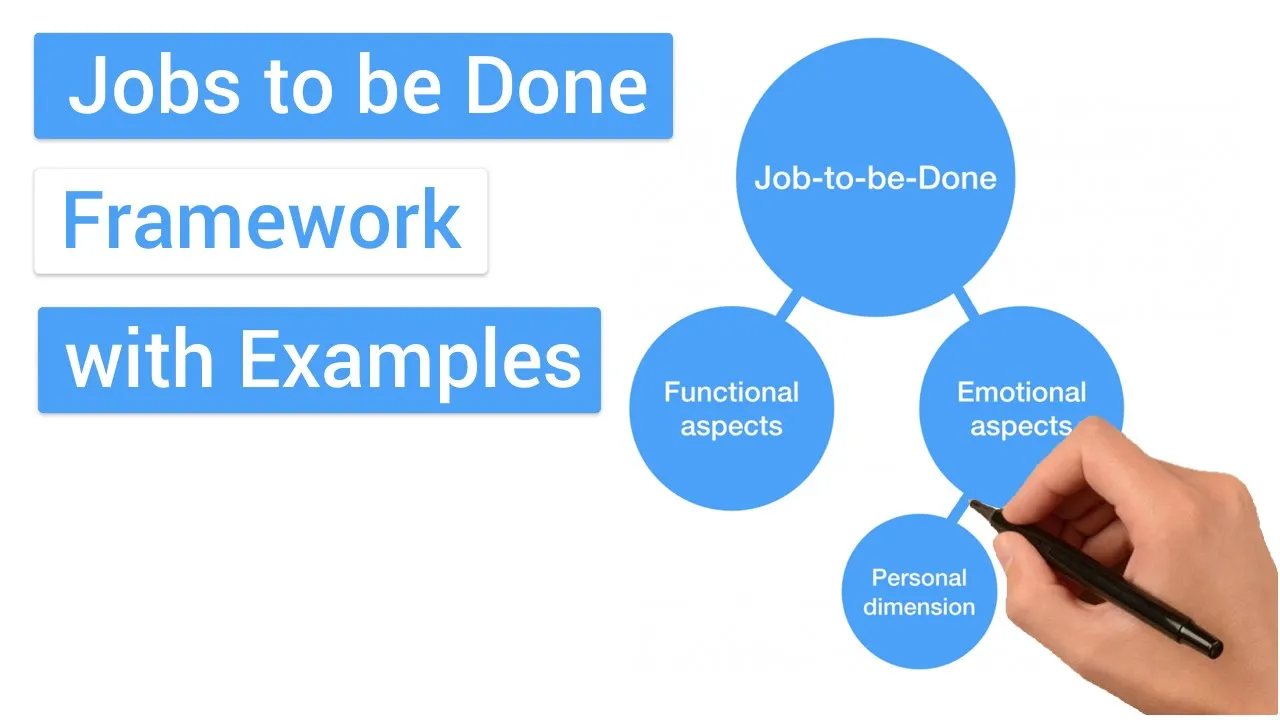
Focus on these key segments:
- 00:00 - 00:36: The core idea of JTBD and why it's important.
- 01:07 - 02:31: The crucial difference between product features and the jobs customers are trying to accomplish, broken down into functional, social, and emotional components.
Now, let's hear from one of the co-creators of the framework, Bob Moesta. In this clip, he uses a simple but brilliant analogy—Snickers vs. Milky Way—to explain how JTBD reveals the true competitive set.

Please watch from 04:53 to 07:32. Pay attention to how he defines competition not by product category (candy bars) but by the "job" the user hires the product for (a quick meal replacement vs. an emotional reward).
Key Takeaway: The JTBD framework shifts our focus from what we are building to why a user would pull it into their life. This 'why' is composed of functional, social, and emotional drivers.
Part 2: Applying JTBD to Education (15 minutes)
How does this apply to EdTech? After all, isn't some education mandatory? Even when there's an element of obligation, students are still trying to make progress. They "hire" education to get to college, to feel competent, or to avoid feeling left behind. The "struggling moment" is the seed of innovation.
To explore this, please read some selected excerpts from the following article, which is a transcript of a discussion with Bob Moesta specifically about education.
Reading Activity:
Please read the sections "Applying JTBD in Education: Student Progress and Consumption" and "Relevancy, Engagement, and the Functional, Social, Emotional Job" in the article below. This should take about 7-8 minutes.
Jobs to be Done in the Education Industry
As you read, focus on:
- How "progress" in a student's life goes beyond just grades.
- The idea that a lack of progress leads to disengagement (a key problem for EdTech products).
- The explicit connection between the functional, social, and emotional jobs and making learning relevant and engaging. The example of designing a water pump is a perfect illustration.
This framework is powerful because it forces us to find the "struggling moments" where a user is frustrated with their current situation and is looking for a new solution. This is where your product has an opportunity to be "hired."
Part 3: How to Visually Map the Job (15 minutes)
Now for the practical application. How do we, as designers, articulate and visualize a Job to be Done? A great starting point is the JTBD statement.
The article Build Products That Solve Real Problems With This ... by Anisha Rathi (Product Lead at Meta) offers a fantastic, practical template used by teams at Facebook and Instagram.
The template is:
When I... (the context or situation)
But... (the barrier or struggle)
Help me... (the goal or what the user wants to do)
So I can... (the desired outcome or progress)
Let's apply this to an EdTech persona.
Persona: Maya
- A 25-year-old marketing associate, one year into her first job.
- She feels her university degree gave her theory but lacks the practical data analysis skills her role demands.
- She's ambitious but feels anxious about appearing incompetent to her manager and peers.
- She works long hours and needs a flexible way to learn.
Maya is experiencing a "struggling moment." Let's formulate her JTBD statement:
When I am trying to prove my value in my new marketing role,
But I feel insecure about my data analysis skills and don't have time for a formal degree,
Help me quickly learn practical, job-relevant data skills in a flexible format,
So I can feel confident, contribute effectively to my team, and advance in my career.
This statement is the foundation for our visual map. We can use a simple canvas to break it down.
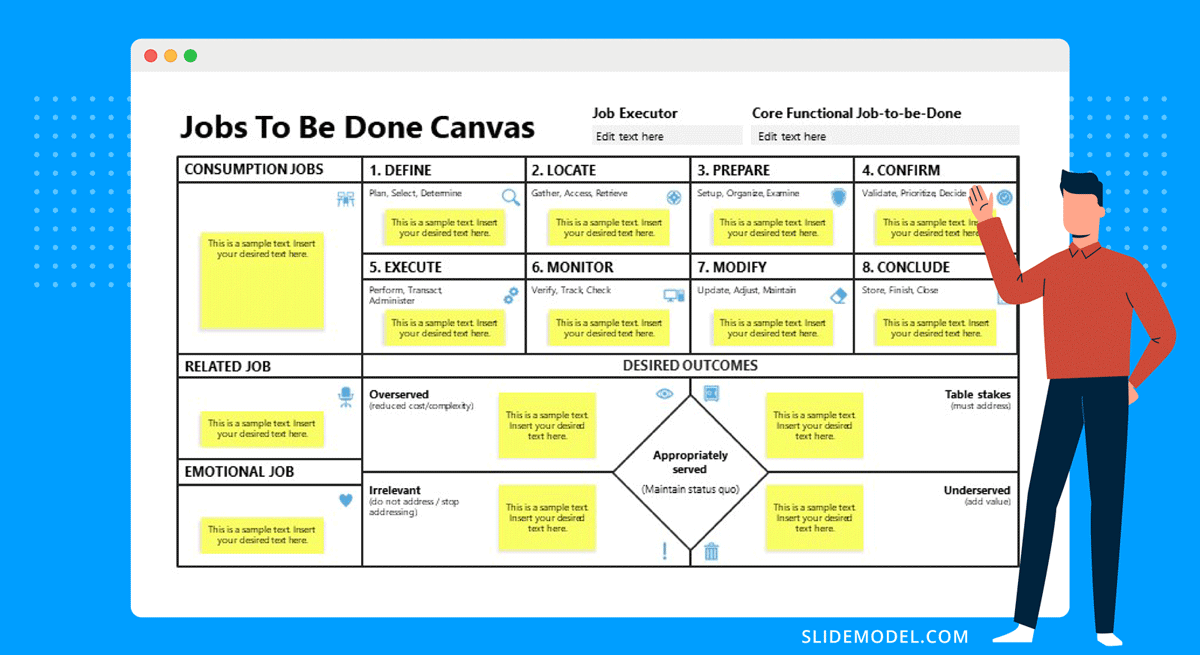 This canvas provides a clear, visual structure for breaking down a user's job into its core components.
Let's populate a simplified version of this canvas for Maya:
| Job Dimension | Maya's Job to be Done |
|---|---|
| Functional Job | • Learn practical data analysis skills. • Apply these skills to real marketing problems. |
| Emotional Job | • From: Anxious, insecure, overwhelmed. • To: Confident, competent, valued. |
| Social Job | • Contribute more effectively in team meetings. • Be seen as a skilled, high-potential employee. • Keep pace with or surpass peers. |
This map gives you a rich, multi-dimensional understanding of your user's motivation. It's not just about learning Excel functions (functional); it's about conquering the fear of looking foolish in a meeting (emotional) and earning respect from colleagues (social).
For a more detailed strategic view, frameworks like Strategyn's can be used, which break down the job even further into consumption and related jobs.
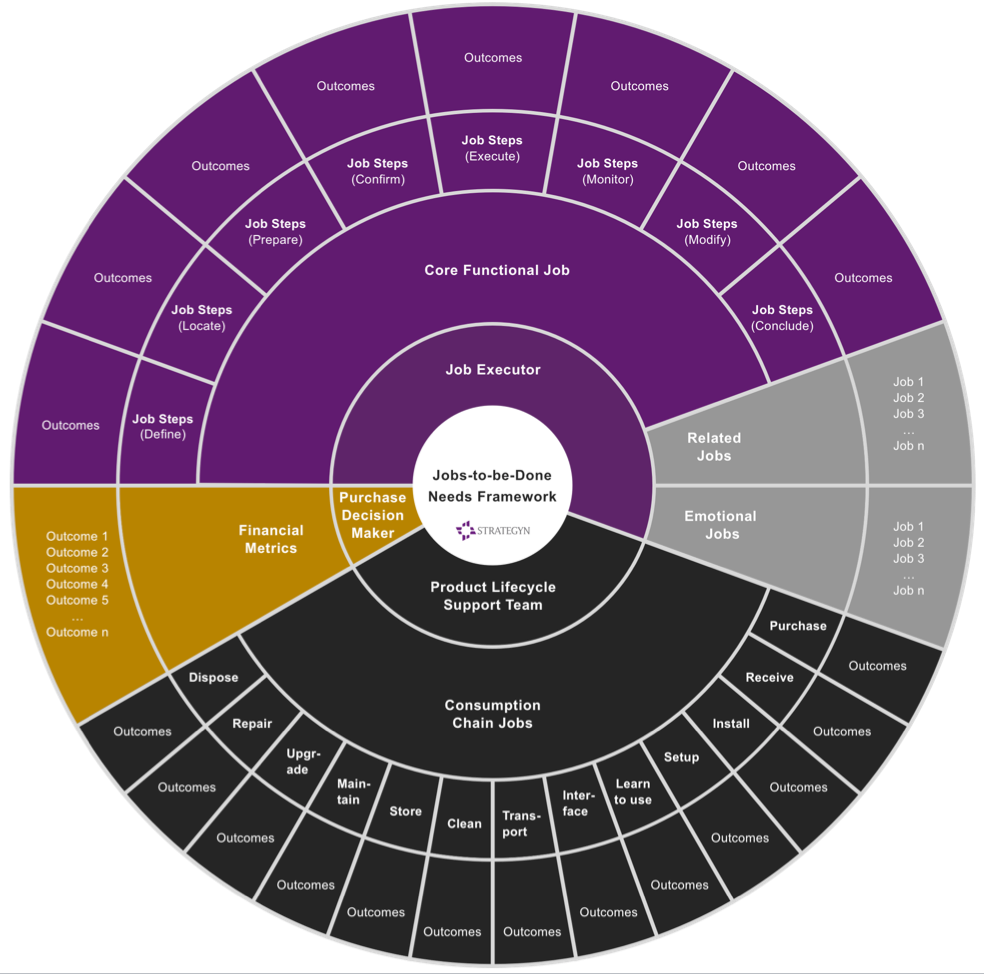 This detailed framework shows how the core job connects to a wider ecosystem of needs, outcomes, and related tasks.
Part 4: Deriving User Success Metrics (5 minutes)
Your visual map isn't just an empathy tool; it's a strategic guide for measuring success. If Maya "hires" your product, how do you know if it's doing its job? You define user success metrics that align directly with the jobs you've identified.
Let's derive some metrics for Maya:
-
Functional Job Metrics:
- Measures: Course completion rate; project submission rate; score on skill application tests.
- Why: These tell us if Maya is successfully acquiring the practical skills.
-
Emotional Job Metrics:
- Measures: Self-reported confidence levels via surveys (e.g., "Rate your confidence in analyzing campaign data from 1-5, before and after this module"); sentiment analysis of user feedback.
- Why: These gauge whether you are alleviating her anxiety and building her confidence.
-
Social Job Metrics:
- Measures: Percentage of users sharing their certificate or project on professional networks (like LinkedIn); testimonials mentioning career impact (e.g., "I was able to lead a new project...").
- Why: These are proxies for whether the product is helping Maya achieve her desired social and professional standing.
These are user success metrics. They measure the progress Maya is making in her life, which is a leading indicator of long-term product success, engagement, and retention.
Conclusion
In this lesson, we've unpacked the Jobs-to-be-Done framework and applied it to an EdTech context.
Here are the key takeaways:
- Users "hire" products to make progress in a specific context. This is their "Job to be Done."
- A Job has functional, emotional, and social dimensions, all of which are critical in EdTech for driving engagement.
- We can articulate this job using a JTBD statement and a visual map to create a shared understanding.
- From this map, we can derive user success metrics that measure what truly matters: whether our product is helping the user make their desired progress.
This deep understanding of the user's "Job" is the bedrock of effective UX design.
Preview of the Next Lesson
Now that we know why a user like Maya would hire an EdTech product, we can analyze the very first impression it makes. In our next lesson, we will critique the onboarding sequence of a popular EdTech application, evaluating how effectively it communicates its value and sets the user up to succeed in the job they've hired it for.