Recommended resources
The freely available resources this lesson will direct you to.
Hello Alex,
Welcome to your next lesson in the "UX refresher for edtech strategy" course.
In our previous session, we explored the Jobs-to-be-Done framework, uncovering the deep functional, social, and emotional "Jobs" that users "hire" an EdTech product to do. We established that the product's core value proposition is its promise to help the user make progress in their life.
Today, we'll focus on the very first moments of the user's experience: the onboarding sequence. This is where a product must quickly and effectively communicate its value proposition and prove it can deliver on its promise. We will examine how successful onboarding doesn't just show features, but skillfully guides and supports the user, setting them up for their first success.
This lesson should take you approximately 55 minutes to complete.
Learning Outcome: By the end of this lesson, you will be able to critique the onboarding sequence of a popular EdTech application, evaluating its effectiveness in communicating the core value proposition and scaffolding the learning experience.
Part 1: A Framework for Onboarding Critique (15 minutes)
As a UX designer, you know that onboarding is more than just a welcome screen. It's a strategic dialogue with the user. To critique it effectively, we need a solid framework that balances user needs with business goals.
Let's start by watching a video that breaks down the core principles of great onboarding, distilled from analyzing over 200 top applications. While not exclusively about EdTech, its principles are universal and highly relevant.

As you watch, please focus on these key segments:
- Step 1: Know Your User (01:25 - 03:25): Notice how personalization starts with understanding and segmenting users from the very beginning. This connects directly to our last lesson on JTBD.
- Step 3: Align Onboarding with Business Model (06:22 - 08:35): Pay close attention to the critique of VSCO. This is a powerful example of how a mismatch between user experience and business goals can create friction and undermine the value proposition.
- The Winning Formula (15:02 - 16:40): This is our core critique framework. Internalize these three powerful principles:
- The "This is just for me" Effect: Personalization that makes the user feel understood.
- The "Just-in-Time" Rule: Progressive disclosure, providing information only when needed to avoid overwhelm. This is the essence of scaffolding.
- The "Make it Feel Good" Factor: Emotional engagement through micro-rewards, progress bars, and positive reinforcement.
These three pillars—personalization, progressive disclosure, and emotional engagement—form the basis for our evaluation of any onboarding flow's effectiveness.
Part 2: Effective Onboarding in EdTech (20 minutes)
Now, let's apply this framework specifically to the EdTech domain. How do leading EdTech companies communicate their value and scaffold the learning experience?
Please read the article below. It analyzes the onboarding flows of several major EdTech companies.
Reading Activity:
Read the sections "Good Onboarding Flows of Big Ed-Tech Companies" and "Onboarding Materials Review" in the following article. This should take you about 10-12 minutes.
Best Practices for EdTech Companies to Onboard Their ...
As you read, consider the following:
- Communicating Value: How do companies like 360Learning and Synthesia immediately guide users toward their first "Aha!" moment (creating a course or video)? This is how they prove their value proposition in action.
- Scaffolding the Experience: Identify the specific UI patterns used for scaffolding, such as
onboarding surveysfor personalization,contextual tipsandinteractive guidesfor just-in-time information,checkliststo structure the journey, andgamificationto "make it feel good."
A well-structured onboarding flow often follows a clear, step-by-step path, as illustrated in this visual comparison of Codecademy and Duolingo.
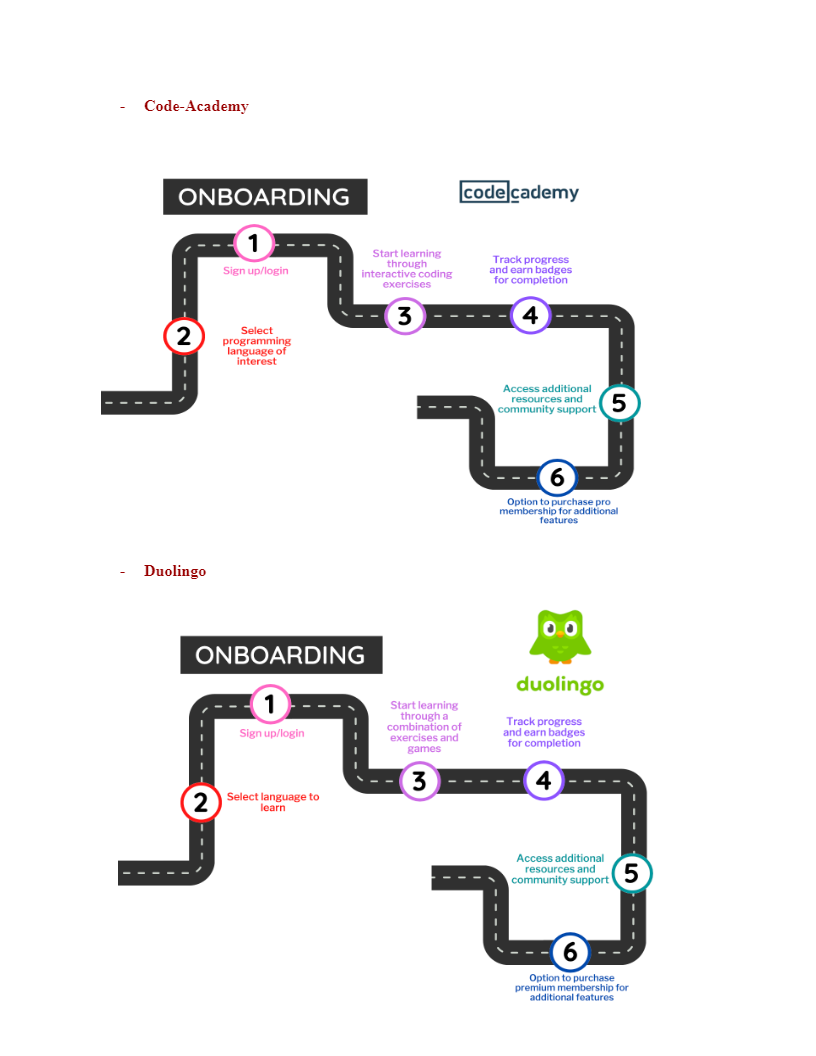 This image visually breaks down the onboarding of two major EdTech platforms, showing the common steps used to guide a new user from sign-up to engagement.
Notice how both platforms start with personalization (selecting an interest/language), move to immediate action (interactive exercises), and then introduce progress tracking and community features. This gradual introduction of complexity is a hallmark of effective scaffolding.
Part 3: What Ineffective Onboarding Looks Like (10 minutes)
Critique requires understanding both what works and what doesn't. Let's analyze an example of an onboarding experience that falls short.
Reading Activity:
Return to the same article and read the section "Not-That-Good Onboarding Flows of Big EdTech Companies," focusing on the critique of W3Schools. This should take about 5 minutes.
Best Practices for EdTech Companies to Onboard Their ...
Using our framework, let's pinpoint the failures:
- Value Communication Failure: The "What's New?" title is confusing, and the immediate request to promote the tool feels misaligned. The product asks for value from the user before providing any.
- Scaffolding Failure: The article notes a near-total lack of guidance—no product tour, no checklist, and unclear instructions when guidance is provided. This violates the "just-in-time" rule and leaves the user to fend for themselves, creating a high-friction experience.
This example clearly shows how poor onboarding can obscure a product's value and frustrate users before they even begin.
Part 4: Your Turn to Critique (5 minutes)
Now it's your turn to apply these concepts. Examine the onboarding screens below for a fictional EdTech app called "SmartyLearn."
 This image shows a series of UI screens for an app's onboarding flow, from a welcome screen to feature highlights and interest selection.
Based on what you've learned, take a moment to critique this sequence. Consider these questions:
- What do you infer is SmartyLearn's core value proposition from these screens?
- How well do these screens apply the "Winning Formula" (personalization, just-in-time info, emotional engagement)? What works?
- What is one specific change you would make to improve this flow and better scaffold the user's journey?
This quick exercise helps solidify the process of moving from observation to critical evaluation.
Conclusion
In today's lesson, we established a robust framework for critiquing EdTech onboarding. You learned to evaluate how effectively an application communicates its core value proposition—its ability to do the user's "Job"—and scaffolds the initial learning experience.
Key Takeaways:
- Onboarding's Goal: To quickly prove the product's value and guide the user to their first "win."
- Critique Framework: Evaluate onboarding based on its effectiveness in communicating value and scaffolding the experience.
- The Winning Formula: Great onboarding excels at personalization ("this is for me"), progressive disclosure ("just-in-time"), and emotional engagement ("this feels good").
- Common Patterns: Effective EdTech onboarding often uses a mix of surveys, checklists, interactive tours, and gamification to create a supportive and motivating initial journey.
Preview of the Next Lesson
Successfully onboarding a user is a critical first step. But how do you keep them coming back? The next challenge is fostering long-term engagement. In our next lesson, we will diagram a UX strategy that applies Self-Determination Theory (autonomy, competence, and relatedness) to understand the psychological drivers that keep learners motivated and reduce churn.