Recommended resources
The freely available resources this lesson will direct you to.
Hello! Welcome back to our study of scaling and universality.
In our last lesson, we formally defined the six standard critical exponents () that provide a quantitative "fingerprint" for a universality class. We noted that the experimental and numerical values for these exponents are not independent, suggesting a deeper underlying structure. Mean-field theory failed to capture these values correctly, but it hinted that thermodynamic quantities are interrelated.
Today, we will formalize this deep connection by introducing the scaling hypothesis. This is a powerful phenomenological idea that assumes the singular parts of thermodynamic functions near a critical point possess a specific mathematical form known as a generalized homogeneous function. This single, elegant assumption will be the key to unlocking the relationships between all the critical exponents. Our goal is to state and understand the scaling hypothesis for the two most fundamental quantities: the singular part of the free energy and the correlation function.
The Scaling Hypothesis for the Singular Free Energy
The failure of mean-field theory suggests we need a new starting point. Instead of trying to calculate the free energy from a specific Hamiltonian, what if we just postulate its mathematical structure near the critical point, guided by the idea of universality? This is the essence of the scaling hypothesis.
Let's begin by watching a portion of a lecture where this idea is developed. The video starts by examining the structure of the free energy in the (failed) saddle-point approximation and then boldly generalizes it into a new hypothesis.
6. The Scaling Hypothesis Part 1
In this segment from MIT OpenCourseWare, Prof. Kardar motivates the scaling hypothesis. He first shows that even in the simple saddle-point approximation of Landau theory, the free energy can be written in a special 'homogeneous' form. He then proposes to discard the details of the saddle-point calculation but keep this general functional form as a new, more powerful assumption.
Please watch from 10:18 to 28:00. Your focus should be on understanding the central assumption being made about the mathematical form of the singular part of the free energy, f_sing.
As you saw in the video, the central idea is that the physics near a critical point, as a function of the reduced temperature and the ordering field , doesn't depend on and independently. Instead, it depends on a specific combination of them.
To formalize this, let's turn to a concise written resource.
[PDF] Statistical Mechanics II: Lecture 6: The Scaling Hypothesis
The following text from Prof. Kardar's lecture notes, 'Statistical Mechanics II', formally states the homogeneity assumption for the singular part of the free energy. It introduces the key components: the scaling function and the gap exponent.
Please read Section III.A, 'The Homogeneity Assumption' (pages 35-37). Pay close attention to Eq. (III.4), which is the mathematical statement of the hypothesis. The text then shows how this single assumption connects the exponents α, β, γ, and δ.
Let's break down the key statement from the reading. The scaling hypothesis for the singular part of the free energy density, , states that it takes the form of a generalized homogeneous function:
Let's dissect this equation:
- The prefactor is chosen deliberately. Since the specific heat , this choice ensures that when we set and differentiate twice, we recover the defining power law for the specific heat, .
- The function is a universal scaling function, with for and for . "Universal" means this function is the same for all systems in the same universality class.
- The argument of the function, , is the crucial scaling variable.
- is a new exponent called the gap exponent. It determines the relative importance of the field and temperature as we approach the critical point.
This hypothesis is a profound statement. It claims that the complex, non-analytic behavior of the free energy near collapses into a dependence on a single variable, . All the complexity is encoded in the shape of the one-dimensional function .
This structure immediately implies that the critical exponents cannot be independent. For example, by taking the derivative of with respect to to find the magnetization , we get:
To find the spontaneous magnetization (exponent ), we take the limit . Assuming is a non-zero constant, we find . But we defined , so we must have:
This is our first scaling relation! It's a direct consequence of the scaling hypothesis. In the next lesson, we will derive the full set of these relations.
The Power of Data Collapse
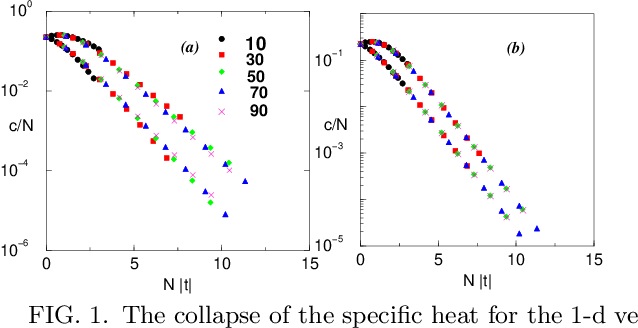
A direct and visually compelling consequence of the scaling hypothesis is the phenomenon of data collapse. The hypothesis implies that if we measure a quantity like magnetization at various temperatures and fields , we can make all the data fall onto a single, universal curve.
Rearranging our expression for , we can write:
(using ). This equation predicts that if we plot the rescaled magnetization against the rescaled field , all our data points, regardless of the original and , will collapse onto the single curve given by . This has been confirmed with stunning precision in countless experiments and simulations.
The Scaling Hypothesis for Correlations
The first hypothesis successfully linked the thermodynamic exponents . But what about the exponents and that describe spatial correlations? This requires a second, related hypothesis about the correlation length and the correlation function .
The physical intuition is that at criticality, the divergence of the correlation length is the ultimate origin of all singularities. becomes the only relevant length scale in the problem, and all singular thermodynamic properties must be governed by it.
Let's explore this idea with the next section of the lecture notes.
[PDF] Statistical Mechanics II: Lecture 6: The Scaling Hypothesis
This next section of the notes extends the scaling idea to the correlation length and the correlation function. It provides a beautiful physical argument for how the free energy's singularity arises from the diverging correlation length.
Please read Section III.B ('Divergence of the Correlation Length') and Section III.C ('Critical Correlation Functions and Self-Similarity') on pages 37-40. Focus on the scaling forms proposed for ξ (Eq. III.18) and Gc(x) (Eq. III.22), and the physical argument connecting f_sing to ξ.
This leads us to two more statements of the scaling hypothesis.
1. Scaling of the Correlation Length
In direct analogy to the free energy, we assume the correlation length is also a generalized homogeneous function of and :
Here, is another universal scaling function. The prefactor is chosen to match the definition of the exponent at . Notice that the scaling variable is exactly the same, with the same gap exponent . This is crucial and reflects the fact that there is a single underlying scaling structure.
The physical argument presented in the notes (and which you may recognize as related to Kadanoff's block-spin picture that we'll see later) is that the number of effectively independent degrees of freedom in a system of volume is . Since the singular part of the free energy density should be proportional to this density of degrees of freedom, we have:
Combining this with our scaling forms for and gives a profound connection, which we will formalize into the Josephson identity in the next lesson.
2. Scaling of the Correlation Function
Finally, we can state a scaling form for the two-point correlation function . For simplicity, let's consider the case . The hypothesis is:
where is yet another universal scaling function.
This form elegantly contains the behavior in the two most important limits:
- At the critical point (): For any fixed distance , the argument . If we assume is a constant, we recover the definition of the exponent : .
- Away from the critical point () for large distances (): The argument is large. In this regime, correlations should decay exponentially. This means the scaling function must fall off very rapidly (e.g., like ) for large , ensuring that decays exponentially for .
This scaling form for the correlation function completes the picture, providing a hypothesis that incorporates all six critical exponents into a single coherent framework.
Test your understanding!
The scaling hypothesis for the free energy is . The critical isotherm is defined by setting . How can this formula describe the behavior at , where the prefactor and the argument of both diverge?
Show answer
This is an excellent question that tests the consistency of the scaling form. As , the argument . For the final result to be independent of (as it must be at ), the scaling function must behave as a power law for large , i.e., as .
Substituting this in, we get:
For this to be independent of , the exponent of must be zero: , which fixes .
The free energy at then scales as . By taking a derivative with respect to , we can find that the magnetization scales as , which by definition is . This gives another scaling relation: . The scaling hypothesis is thus self-consistent across all limits.
Conclusion
Key Takeaways:
- The scaling hypothesis postulates that the singular part of thermodynamic functions and correlation functions near a critical point are generalized homogeneous functions.
- The scaling form for the free energy density is . It depends on a universal scaling function and a single new "gap" exponent .
- The scaling form for the correlation function (at ) is , where the correlation length .
- These hypotheses are not derived from first principles (at this stage) but are phenomenological assumptions justified by their ability to explain experimental observations like data collapse and to relate the critical exponents to each other.
Preview of the Next Lesson:
We have laid the groundwork and stated the powerful hypotheses that govern critical phenomena. In the next lesson, we will put them to work. We will take these scaling forms as our starting point and systematically derive the famous scaling relations—Rushbrooke, Widom, Fisher, and Josephson—that prove that only two of the six critical exponents are independent.