Recommended resources
The freely available resources this lesson will direct you to.
Hello! Welcome to the final lesson in our "Advanced Algorithmic Patterns" module.
In our last lesson, we implemented heap-based solutions for the "Top K Frequent Elements" and "Merge K Sorted Lists" problems. We saw that heaps provide an efficient way to manage a set of high-priority items. You correctly identified their complexities as for time and for space.
Today, we will formalize and expand on this by analyzing the trade-offs between these heap-based solutions and their alternatives, primarily those based on full sorting. We'll also introduce a third contender, QuickSelect, for selection problems. Understanding these trade-offs is not just academic; it's a hallmark of a senior engineer who can justify their choice of algorithm based on system constraints like memory, data size, and latency requirements. This is precisely the kind of reasoning expected in interviews at places like Anthropic.
By the end of this lesson, you will be able to analyze and articulate the time and space complexity trade-offs between heap-based solutions and sorting-based alternatives for "Top K" and merging problems.
1. Case Study: Merge K Sorted Lists
Let's start by revisiting the problem of merging k sorted lists into a single sorted list. This is a common task in distributed systems where results from multiple workers must be combined.
The Brute-Force vs. Heap-Based Approach
There are multiple ways to solve this, each with different performance characteristics. A fantastic video from "take U forward" breaks down three distinct approaches. Let's analyze two of them: the naive brute-force method and the optimal heap-based method we discussed previously.
L25. Merge K Sorted Lists | Multiple Approaches
This video provides a side-by-side comparison of different strategies for merging k sorted lists. We'll use it to contrast the brute-force and heap-based methods.
Please watch the following two segments: Brute-Force Approach (00:37 - 06:22): This section describes the most straightforward solution: collect all elements into one large list and then sort it. Pay attention to the analysis of its time and space complexity. Optimal Heap-Based Approach (15:02 - 28:31): This is a review of the method we covered in the last lesson. It details how a min-heap of size k is used to efficiently find the next smallest element. Focus on the complexity analysis at the end of the segment.
Trade-off Analysis: Merge K Lists
Let's consolidate what we've learned from the video. Let N be the total number of elements across all lists and k be the number of lists.
| Approach | Time Complexity | Space Complexity | Key Characteristics |
|---|---|---|---|
| Brute-Force (Sort All) | Simple to conceive, but highly inefficient in both time and space. Requires loading all N elements into memory at once. |
||
| Heap-Based (Min-Heap) | Time-optimal. Space complexity is a massive win, as it only needs to hold k elements in memory, making it suitable for very large, streaming datasets. |
The difference between and is significant. If you are merging 100 lists (k=100) with a total of 1 million elements (N=1,000,000), while . The heap-based approach is roughly 3 times faster just from the time complexity, not to mention the enormous memory savings ( vs. ). For a system you built like Rudi, which handles high throughput, this difference is the boundary between a functional and a non-functional system.
2. Case Study: Find the Top K Elements
The trade-offs for finding the "Top K" elements are even more nuanced and make for a classic interview discussion. Here, we compare three primary methods.
Method 1: Full Sort
The simplest solution:
- Sort the entire collection of
Nitems in descending order. - Take the first
kelements.
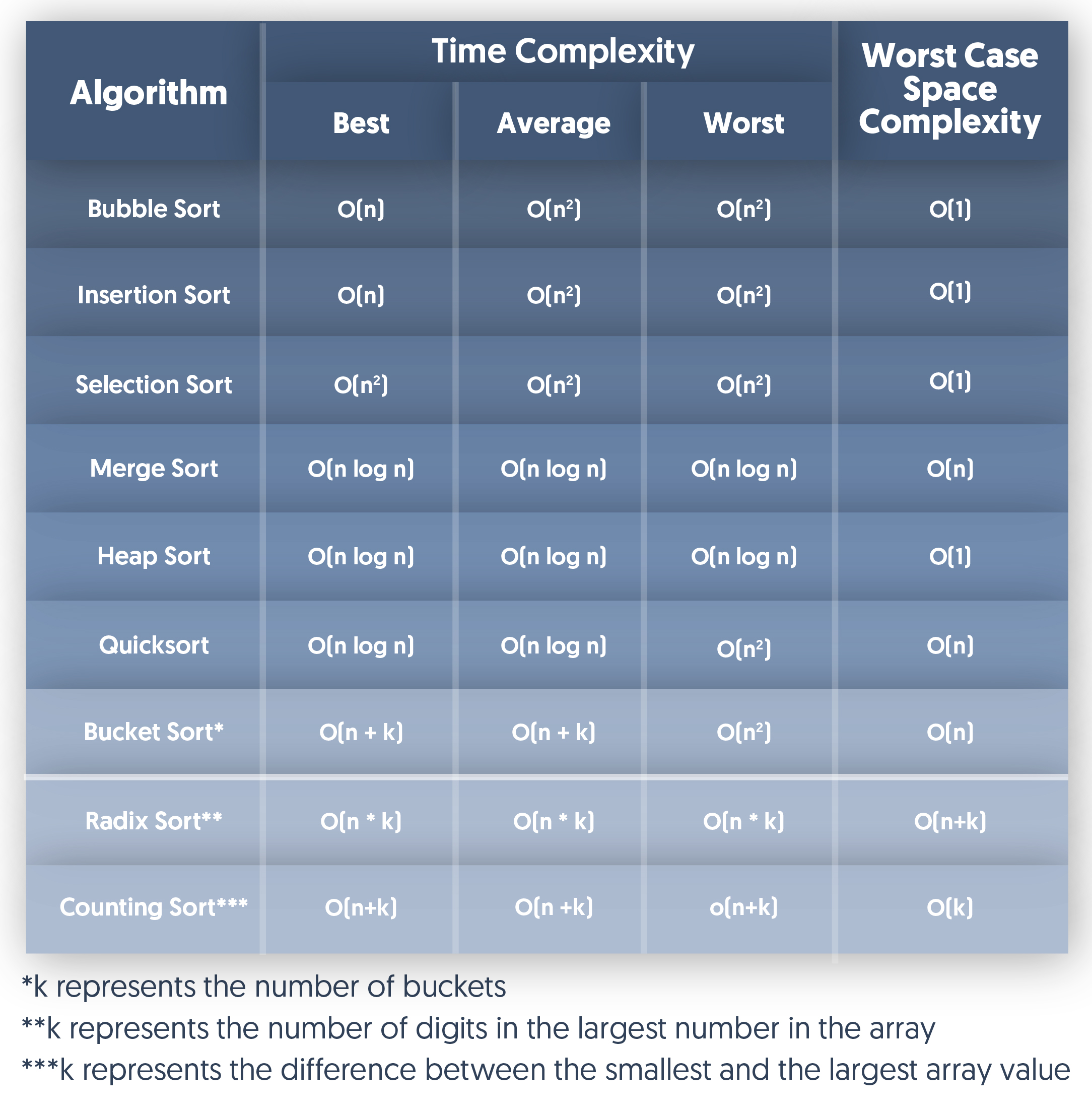
- Time Complexity: dominated by the sort.
- Space Complexity: if using an in-place sort like Heap Sort, or for Quick Sort's recursion stack, or for Merge Sort.
Method 2: Heap (Min-Heap of size k)
This is the approach we implemented in the previous lesson.
- Iterate through the
Nitems. - Maintain a min-heap of size
k. For each item, if the heap has fewer thankelements or the item is larger than the heap's minimum (the root), push the item and pop the minimum if the size exceedsk.
- Time Complexity: . We process
Nitems, and each heap operation takes . - Space Complexity: for the heap.
This is already a significant improvement over full sorting, especially when k is small and N is large.
Method 3: QuickSelect
There's a third, very important algorithm for this category of problems called QuickSelect. It's a modification of the QuickSort algorithm but is used for selection rather than full sorting. Its goal is to find the k-th smallest (or largest) element in an unordered list. Once you find the k-th largest element, you can iterate one more time to find all elements larger than it.
The algorithm works by:
- Choosing a pivot element.
- Partitioning the array around the pivot, so all elements smaller than the pivot are to its left and all elements larger are to its right.
- After partitioning, the pivot is in its final sorted position, say index
p.- If
p == k, we've found our element. - If
p > k, thek-th element must be in the left subarray. Recurse on the left. - If
p < k, thek-th element must be in the right subarray. Recurse on the right.
- If
Because we only recurse on one side of the partition, the algorithm is much faster on average than a full QuickSort.
To better understand this, please read the following article, which directly compares the sorting, heap, and QuickSelect approaches.
Sorting Interview Questions & Tips for Senior Engineers
This guide from interviewing.io is an excellent resource for senior engineers. We'll focus on the section that explicitly discusses how to solve selection problems.
Please read the following two sections: 'Selection Problems' (section starts around 60% of the way down): This section compares the naive sorting solution, the heap-based solution, and the QuickSelect-based solution for finding the k-th largest element. Pay close attention to the complexity analysis for each. 'Not Using Quick Select When Appropriate' (under 'Common Mistakes'): This short section reinforces the trade-offs and explains why defaulting to sorting is often a mistake in an interview context.
Trade-off Analysis: Top K Elements
Now, let's build the ultimate trade-off table for this problem, incorporating QuickSelect.
| Approach | Average Time | Worst-Case Time | Space Complexity | Key Characteristics |
|---|---|---|---|---|
| Full Sort | to | Simple, but inefficient. Only use if you need the entire collection sorted anyway. | ||
| Heap | Best all-rounder. Guaranteed worst-case performance. Perfect for streaming data where N is unknown. Low memory footprint. |
|||
| QuickSelect | Fastest on average. The worst case (from bad pivots) can be a risk for production systems. Not suitable for streaming data as it requires the full dataset for partitioning. |
The Interview Scenario:
If an interviewer at Anthropic asks you to "find the top K most frequent queries," the conversation should not end with one implementation. It should be a discussion of these trade-offs.
- Start with the Heap: "A robust and efficient approach is to use a min-heap of size
k. This gives us a time complexity of and, importantly, a space complexity of only . This is great because it handles large datasets that don't fit in memory and works well for streaming data." - Introduce the Alternative: "However, if we have the entire dataset in memory and average-case latency is the absolute priority, we could use the QuickSelect algorithm. It has a faster average time complexity of ."
- State the Trade-off: "The trade-off is that QuickSelect has a worst-case time of , which could be a concern. The heap approach, with its guaranteed performance, is often a safer choice for a production service. The right choice depends on our specific requirements for worst-case latency vs. average-case throughput."
This level of analysis demonstrates a deep understanding of both algorithms and system design principles.
Conclusion
Today we dissected the performance of heap-based algorithms against their common alternatives. Making the right choice is about balancing multiple factors, a core competency for an experienced software engineer.
Key Takeaways:
- Sorting is a baseline, rarely the optimum: For problems where you only need a subset of ordered data (Top-K, merging), full sorting () is usually outperformed.
- Heaps are the robust workhorse: The time and space of heap-based solutions make them an excellent, safe, and versatile choice, especially for streaming data or memory-constrained environments.
- QuickSelect is the specialized sprinter: For finding the k-th element in a static dataset, QuickSelect's average time is theoretically the fastest, but it comes with the risk of a rare but catastrophic worst case.
- Articulating trade-offs is key: In an interview, demonstrating that you understand these different options and can choose between them based on system constraints is more important than just coding one solution.
Next Lesson Preview
With this lesson, we conclude the "Advanced Algorithmic Patterns" module. You've built a strong foundation in using heaps, monotonic queues, and analyzing their performance trade-offs.
In our next module, "Building Systems Incrementally," we will shift from isolated algorithms to constructing small, practical systems. We'll start by implementing the core GET/SET/DELETE operations for an in-memory key-value store. This will put your data structure knowledge into a practical context that directly mirrors the incremental system-building style of interviews.