Recommended resources
The freely available resources this lesson will direct you to.
- Power Factor Explained - The basics what is power factor pfwww.youtube.com
- Power Factor Explained – Your Electricity Bill Money Drain (Reactive Power)www.youtube.com
- Introduction to power factor What is it and why should we ...library.e.abb.com
- What is AC Power? Active Power, Reactive ...techweb.rohm.com
Hello! Welcome back to our final module on Applied Power Systems.
In the previous lesson, we established the "big picture" of how electricity is delivered, distinguishing between the single-phase systems common in homes and the three-phase systems that form the backbone of industrial power. We saw that for efficiency, power is almost always generated and transmitted in three phases.
Today, we shift our focus from the supply grid to the devices connected to it. This lesson directly addresses the learning outcome: Calculate the real power consumption of various appliances by interpreting their power factor and apparent power ratings. This is a crucial practical skill, bridging the gap between the power supplied by the grid and the power actually used to perform work.
The Three "Powers" of AC Circuits
In DC circuits, power calculation is straightforward: Power (in Watts) is simply Voltage times Current (). However, in AC circuits, especially those with motors or transformers, the story is more complex. The oscillating nature of the current and voltage, and their potential phase difference, gives rise to three distinct but related concepts of power.
- Apparent Power (S): This is the "total" power supplied to a circuit, calculated as the product of the RMS voltage and RMS current: . It is measured in Volt-Amps (VA). This represents the total demand an appliance places on the grid's infrastructure (wires, transformers, etc.).
- Real Power (P): This is the power that performs useful work, such as turning a motor shaft, producing heat in an element, or generating light. It is measured in Watts (W). This is the power that you ultimately get value from. It is also called "active power" or "true power".
- Reactive Power (Q): This is the power that oscillates back and forth between the source and the load, required to create and sustain the magnetic fields (in inductive loads like motors) or electric fields (in capacitive loads). It does not perform any useful work. It is measured in Volt-Amps Reactive (VAr).
A popular analogy is that of a glass of beer. The beer itself is the Real Power (what you want), the foam is the Reactive Power (takes up space but doesn't quench your thirst), and the entire glass is the Apparent Power (what you paid for).
To build on this intuition, the following video provides an excellent visual introduction.
Power Factor Explained - The basics what is power factor pf
The video 'Power Factor Explained - The basics' from The Engineering Mindset uses the beer analogy and clearly introduces the concepts of true power (kW), reactive power (kVAr), and apparent power (kVA).
Please watch the segment from 00:26 to 02:03. Focus on how the three types of power are defined and relate to each other through the beer analogy.
The Power Triangle and Power Factor
These three types of power are not independent; they are geometrically related through the power triangle. Given your background in mathematics, you will recognize this as a direct application of right-angled triangle geometry and vector addition.
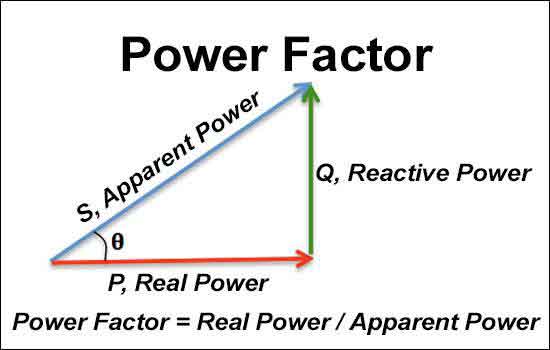
From this triangle, we can state the following relationships:
- By the Pythagorean theorem:
- Using trigonometry: and
The angle is the phase angle between the voltage and current waveforms. This brings us to the central concept for this lesson: the Power Factor (PF).
The Power Factor is defined as the ratio of Real Power to Apparent Power:
From the power triangle, we can see that this is simply the cosine of the phase angle:
The power factor is a dimensionless number between 0 and 1 (or 0% and 100%). It is a measure of efficiency:
- A PF of 1 (or 100%) means all apparent power is being used as real power (). This is a "perfect" power factor, typical of purely resistive loads like an electric heater.
- A PF less than 1 means that some portion of the current drawn by the load is not performing useful work. This is typical of inductive loads like motors. For example, a PF of 0.8 means only 80% of the apparent power supplied is doing real work.
For a more formal definition of these terms and their formulas, the following resource is a useful reference.
What is AC Power? Active Power, Reactive ...
The article 'What is AC Power?' from ROHM Tech Web provides a structured breakdown of active, reactive, and apparent power, including their governing equations.
Skim through this article, paying particular attention to the definitions and formulas for Active Power (P), Reactive Power (Q), and Apparent Power (S), as well as the explanation of the power triangle. You don't need to read every word, but use it to solidify the mathematical relationships we've just discussed.
The Physical Origin of Reactive Power
Reactive power arises because certain components store and release energy rather than dissipating it as work.
- Inductors (like the coils in a motor) store energy in a magnetic field. This process causes the current waveform to fall behind, or lag, the voltage waveform. This creates a lagging power factor.
- Capacitors store energy in an electric field. This causes the current waveform to get ahead of, or lead, the voltage waveform, creating a leading power factor.
Most industrial and household loads (motors, pumps, fans, fluorescent lighting ballasts) are inductive, so a lagging power factor is the most common scenario.
Power Factor Explained – Your Electricity Bill Money Drain (Reactive Power)
The following video explains this physical process very clearly, showing how the storage and release of energy in inductive and capacitive components lead to phase shifts and reactive power.
Watch the segment from 06:24 to 10:38. Focus on the explanation of why inductors cause current to lag and why this results in power flowing back and forth without doing useful work.
Calculating Real Power Consumption
Now we can address the main goal: interpreting an appliance's specifications to find its real power consumption. Appliance nameplates can provide this information in a few different ways. The key is to find enough information to use the formula .
Let's walk through a few scenarios.
Scenario 1: Apparent Power (VA) and Power Factor (PF) are given.
This is the most direct case. An appliance might be rated at 900 VA with a power factor of 0.85.
- Apparent Power (S): 900 VA
- Real Power (P):
This appliance draws 900 VA from the grid, but only 765 W are converted into useful work.
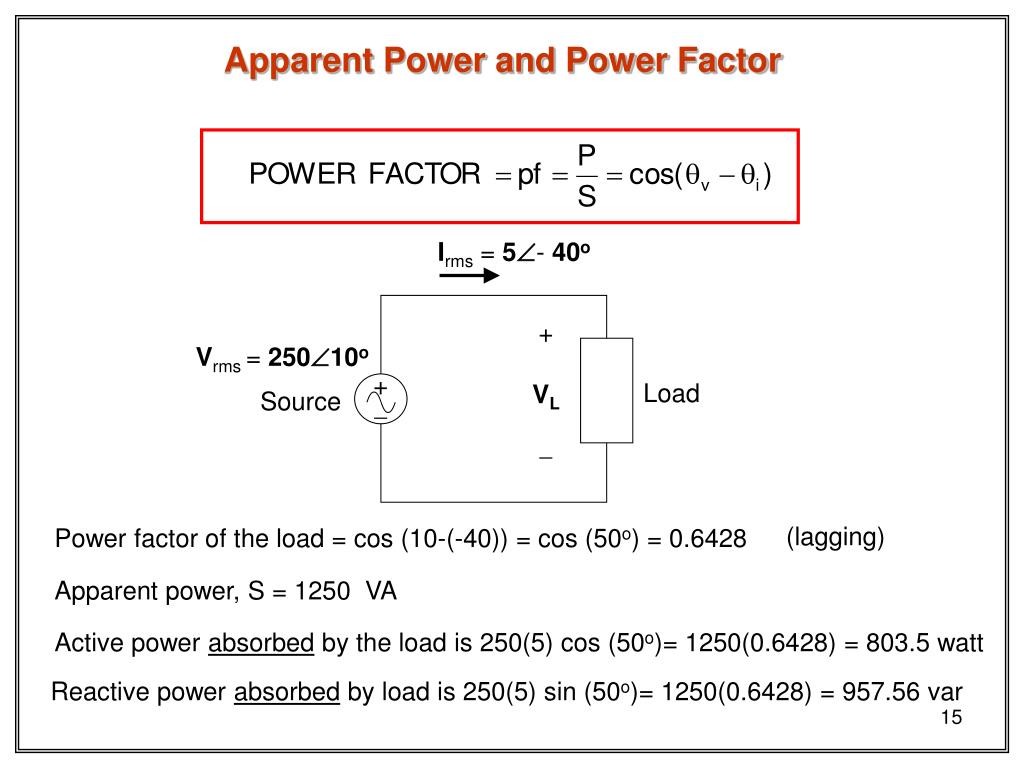
Scenario 2: Voltage (V), Current (A), and Power Factor (PF) are given.
A motor is rated at 240 V, 5 A, with PF = 0.75.
- First, calculate Apparent Power:
- Then, calculate Real Power:
Scenario 3: A Comprehensive Example with Efficiency
For devices like motors, we must also distinguish between electrical power input and mechanical power output. The ratio of these two is the motor's efficiency. Consider a motor with the following specs:
- Output Power: 1 Horsepower (HP)
- Voltage: 120 V
- Efficiency (): 85%
- Power Factor (PF): 0.8 lagging
How much real power does it draw from the grid?
- Convert mechanical output to Watts: The standard conversion is . This is the useful work done by the motor shaft.
- Calculate Real Power Input (P): The motor is not 100% efficient; some energy is lost as heat. The real electrical power it must draw is higher than its mechanical output.
This is the motor's real power consumption. - Calculate Apparent Power Drawn (S): This is the total demand on the grid.
So, to deliver 746 W of mechanical work, this motor consumes 878 W of real electrical power and places a total demand of 1098 VA on the supply circuit.
The following video segment works through a very similar example, which is excellent for reinforcing this multi-step process.
Power Factor Explained – Your Electricity Bill Money Drain (Reactive Power)
Let's return to the video 'Power Factor Explained – Your Electricity Bill Money Drain' for a detailed quantitative example that incorporates horsepower, efficiency, and power factor.
Watch the segment from 10:50 to 12:12. Follow the step-by-step calculation for the single-phase motor to see how all these concepts—efficiency, real power, and apparent power—come together in a practical problem.
Test your understanding!
A workshop air compressor has a motor rated at 240V and draws 15A. Its nameplate indicates a power factor of 0.82.
- What is its apparent power consumption in VA?
- What is its real power consumption in Watts?
- Why is it important for an electrician to know both values?
Show answer
-
Apparent Power (S): or 3.6 kVA.
-
Real Power (P): or ~2.95 kW.
-
An electrician needs to know both values for different reasons:
- The apparent power (3600 VA), which determines the current draw (15A), is used to size the circuit breaker and the wiring. The wires must be thick enough to handle the 15A without overheating.
- The real power (2952 W) represents the actual energy being consumed over time. This is the value that contributes to the work done and, ultimately, the electricity bill (which is measured in kWh, a unit of energy).
Conclusion
Today, we've unpacked the crucial concepts of AC power that govern how appliances consume electricity. Understanding the difference between what's supplied and what's used is fundamental to any practical analysis of electrical systems.
Key Takeaways:
- AC circuits have three power components: Apparent Power (S) in VA, Real Power (P) in W, and Reactive Power (Q) in VAr.
- These components are related by the power triangle, with .
- Power Factor (PF) is the ratio of Real to Apparent Power () and represents the efficiency of power usage. A PF of 1 is ideal.
- Inductive loads like motors create a lagging power factor, meaning they require reactive power to function, increasing their apparent power draw.
- To find an appliance's real power consumption, you can use the formula , making sure to account for any efficiency ratings if you are starting from mechanical output.
Preview of the Next Lesson:
You are now equipped to analyze the power needs of individual appliances. In our next lesson, we will apply this skill to a common practical problem: Evaluate whether a generator can supply a given set of loads, considering its real power (W) and apparent power (VA) limits. This will require you to sum the real and apparent power needs of multiple devices and compare them to the dual-rating (e.g., 5000 W / 6250 VA) of a typical generator.