Recommended resources
The freely available resources this lesson will direct you to.
Welcome back. In the last lesson, you mastered the practical skill of preparing a complete bulletin de paie for a single employee, bringing together all the components of remuneration and deduction into a final, professional document.
Today, we take a crucial step up in scale. We will move from the individual employee to the entire company workforce. Our learning objective is to consolidate payroll data to determine the total monthly social contributions due. This process is the bridge between preparing individual pay slips and fulfilling the company's legal obligation to declare and pay social charges to organizations like the CNSS.
From Individual Slips to a Consolidated View: The Payroll Journal
After calculating the pay for each employee, an accountant's next task is to summarize this information in a single report. This consolidated document is known as the Payroll Journal or Livre de Paie. It provides a bird's-eye view of the company's entire payroll for the month.
This journal is more than just a summary; it is the primary tool for calculating the total social contributions the company must pay. It organizes the data in a way that allows us to calculate the necessary totals, known as salary masses (masses salariales).

To determine the total contributions, we must first calculate two key salary masses from our payroll journal:
- Total Gross Salary Mass (
Masse Salariale Brute Totale): The sum of all gross salaries (salaire brut) for all employees. - Capped Salary Mass (
Masse Salariale Plafonnée): The sum of each employee's salary, capped at the monthly ceiling set by the CNSS (currently, we will use a common reference of 6,000 MAD for our examples).
Understanding Employer Contributions (Charges Patronales)
In the previous lessons, we focused on deductions from the employee's salary (charges salariales). However, the employer also pays a significant portion of social contributions on behalf of the employee. These are called employer contributions (charges patronales). The total amount sent to social organizations is the sum of both the employee's and the employer's shares.
The main employer contributions include:
- CNSS Contributions: For family benefits, social benefits (pension, daily allowances), etc.
- Professional Training Tax (
Taxe de Formation Professionnelle- TFP): A tax to fund professional training, managed by the OFPPT. - Mandatory Health Insurance (
Assurance Maladie Obligatoire- AMO). - CIMR Contributions (if the company participates).
The following resource provides a breakdown of the various contribution rates. Note that these rates and ceilings can be updated annually by law. For our lesson, we will use a consistent set of standard rates for pedagogical clarity. Your professional duty as an accountant is always to verify and apply the rates in effect for the current period.
Charges Sociales Maroc 2025 : Guide CNSS, CIMR, AMO
This guide details the different social charges in Morocco. It provides tables that clearly separate the employer's share from the employee's share, which is essential for our consolidation task.
Review the sections 'Cotisations CNSS 2025', 'Assurance Maladie Obligatoire (AMO)', and 'Formation Professionnelle'. Focus on the tables that show the 'Employeur' and 'Salarié' rates. This will clarify the new concept of 'charges patronales'.
Here is a summary of the standard rates we will use for our examples:
| Contribution | Calculation Base | Employee Rate (Salariale) |
Employer Rate (Patronale) |
|---|---|---|---|
| CNSS - Social Benefits | Capped Salary (6,000 MAD) | 4.48% | 8.60% |
| CNSS - Family Benefits | Total Gross Salary | - | 6.40% |
| AMO | Total Gross Salary | 2.26% | 4.11% |
| TFP | Total Gross Salary | - | 1.60% |
The Consolidation Process: A Worked Example
Let's walk through the consolidation process using a practical example based on a payroll summary. The following document contains an excellent case study that demonstrates this perfectly.
PAIE-ET-DECLARATIONS-FISCALES-ET-SOCIALES.pdf
This document is a detailed guide on payroll and social declarations. We will focus on the section that shows how to calculate total employer contributions from a list of several employees.
Find the sub-section titled 'L’enregistrement des charges sociales (charges patronales)'. You will see a table with four employees (HALIMI, FAHMI, etc.). Study how the total and capped salary masses are calculated and then used to determine the total employer contributions.
Let's replicate and expand on the logic from the resource with our standard rates.
Step 1: Create the Payroll Summary Table
Imagine our company has four employees. We first list their gross salaries and determine the capped portion for each.
| Salarié | Salaire Brut | Salaire Plafonné (à 6,000) |
|---|---|---|
| HALIMI | 5,000 | 5,000 |
| FAHMI | 3,500 | 3,500 |
| MOULAY | 6,600 | 6,000 |
| FAHLAOUI | 12,000 | 6,000 |
| TOTALS | 27,100 | 20,500 |
Step 2: Identify the Salary Masses
From the totals row, we have our two essential figures:
Masse Salariale Brute Totale= 27,100 MADMasse Salariale Plafonnée= 20,500 MAD
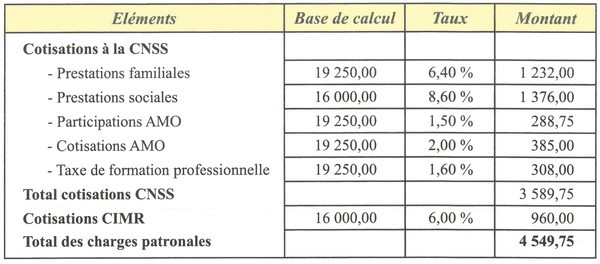
Step 3: Calculate Total Employer Contributions (Charges Patronales)
Now, we apply the employer rates to the correct salary mass.
- CNSS - Family Benefits: 6.40% on total gross salary
27,100 * 6.40% = 1,734.40 MAD
- CNSS - Social Benefits: 8.60% on capped salary
20,500 * 8.60% = 1,763.00 MAD
- Professional Training Tax (TFP): 1.60% on total gross salary
27,100 * 1.60% = 433.60 MAD
- AMO: 4.11% on total gross salary
27,100 * 4.11% = 1,113.81 MAD
The total employer contributions for the month are the sum of these amounts. The image below provides a clean visual summary of this calculation.
Step 4: Determine Total Amount Due to CNSS
The final step is to combine the employer's share with the total employee share (which would be summed from all pay slips) to find the total payment due.
- Total Employee CNSS (summed from pay slips) =
20,500 * 4.48% = 918.40 MAD - Total Employer CNSS (
Famille+Social) =1,734.40 + 1,763.00 = 3,497.40 MAD - Total CNSS payment due =
918.40 + 3,497.40 = 4,415.80 MAD
This final amount, along with the TFP and AMO amounts, is what the company must declare and pay.
Test your understanding!
An SME has three employees. For the month of March, their payroll data is as follows:
- Employee A:
Salaire Brut= 4,500 MAD - Employee B:
Salaire Brut= 7,200 MAD - Employee C:
Salaire Brut= 11,000 MAD
Using the rates provided in this lesson and a CNSS ceiling of 6,000 MAD, calculate:
- The
Masse Salariale Brute Totale. - The
Masse Salariale Plafonnée. - The total amount of employer contributions (charges patronales) for CNSS (Family + Social benefits).
Show answer
1. Calculate Salary Masses:
First, let's create the summary table:
| Salarié | Salaire Brut | Salaire Plafonné (à 6,000) |
|---|---|---|
| A | 4,500 | 4,500 |
| B | 7,200 | 6,000 |
| C | 11,000 | 6,000 |
| TOTALS | 22,700 | 16,500 |
Masse Salariale Brute Totale= 22,700 MADMasse Salariale Plafonnée= 16,500 MAD
2. Calculate Total Employer CNSS Contributions:
-
CNSS - Family Benefits (on total gross salary):
22,700 * 6.40% = 1,452.80 MAD -
CNSS - Social Benefits (on capped salary):
16,500 * 8.60% = 1,419.00 MAD -
Total Employer CNSS Contributions = 1,452.80 + 1,419.00 = 2,871.80 MAD
Conclusion
In this lesson, you have learned to transition from individual pay slip preparation to the consolidated view required for corporate-level reporting. This is a vital function of the payroll accountant.
Key Takeaways:
- Payroll data is consolidated into a Payroll Journal (
Livre de Paie) to get a summary view. - From this journal, we calculate the Total Gross Salary Mass and the Capped Salary Mass.
- Social contributions consist of an employee share (
salariale) and an employer share (patronale). The company is responsible for paying both. - Employer contribution rates are applied to the appropriate salary mass to determine the total
charges patronales. - The total amount due to a social body like the CNSS is the sum of the consolidated employee contributions and the calculated employer contributions.
Preview of the Next Lesson:
Now that you know how to calculate the total social charges due, the next logical step is to report them. In our next lesson, we will learn how to prepare the monthly social security declaration file for submission via the DAMANCOM portal, turning your calculations into an official declaration.