Welcome back. In our previous lesson, we mastered the process of preparing and submitting the monthly social security declaration file (BDS) through the DAMANCOM portal. This is a critical recurring task for ensuring compliance with the CNSS.
Today, we shift our focus from a monthly cycle to an annual one. The objective of this lesson is to learn how to prepare the annual declaration of salaries and wages, known as the État 9421. This declaration is not for social security but for the tax authorities. It serves as a comprehensive summary of all remuneration paid to your employees throughout the year, making it a cornerstone of your year-end responsibilities.
1. The État 9421: Purpose and Importance
While the monthly BDS informs the CNSS about salaries for social contribution purposes, the État 9421 provides a similar summary to the tax administration (Direction Générale des Impôts - DGI).
Key facts about the État 9421:
- Purpose: To declare the total annual remuneration paid to each employee and the corresponding income tax (
Impôt sur le Revenu- IR) that was withheld at the source by the employer. - Recipient: The
Direction Générale des Impôts(DGI). - Scope: It covers the entire calendar year (January 1st to December 31st).
- Deadline: It must be filed before March 1st of the year following the reporting year. For example, the
État 9421for the year 2023 must be submitted before March 1st, 2024. - Importance: This document allows the DGI to verify that the total income tax withheld by the company matches the tax liability of its employees. It is a fundamental document for tax compliance and is always scrutinized during a tax audit (
contrôle fiscal).
2. Deconstructing the État 9421 Form
Let's examine the structure of the declaration. The form consolidates all 12 months of payroll data for each employee onto a single line.
The image below shows a completed État 9421 form. We will walk through its columns to understand the logical flow of calculation.

Let's break down the key columns, moving from left to right.
A. Employee Identification
The initial columns identify the employee:
Nom et Prénom(Last and First Name)N° C.I.N.(National Identity Card Number)N° C.N.S.S.(CNSS Registration Number)Situation de famille(Family status, which impacts tax calculations)
This information is pulled directly from the employee's permanent file in your HR or payroll system.
B. Gross Remuneration (Rémunérations Brutes)
This section calculates the total gross income before any deductions.
Salaire Brut Global: This is the sum of the employee's 12 monthly gross salaries.Indemnités et Avantages: This includes the total of all other taxable cash allowances and benefits in kind received during the year (e.g., housing allowances, non-justified transport allowances).Salaire Brut Imposable(SBI): This is the sum of the previous two columns (Salaire Brut Global+Indemnités). The SBI is the starting point for calculating taxable income.
C. Deductions (Déductions sur Salaire)
This section details the amounts deducted from the SBI.
-
Frais Professionnels(Professional Expenses): Moroccan tax law allows employees to deduct a certain amount from their gross salary to account for work-related expenses.- Rule: This deduction is calculated as 20% of the
Salaire Brut Imposable(SBI). - Cap: There is an annual cap of 30,000 MAD.
- Calculation:
Frais Professionnels= MIN(SBI* 20% , 30,000 MAD) - This is a standard, flat-rate deduction; you do not need to collect receipts for it unless the employee opts for a real-expense regime, which is rare.
- Rule: This deduction is calculated as 20% of the
-
Cotisations Sociales (CNSS/AMO): This is the sum of the employee's share of social contributions withheld over the 12 months. As you learned in previous lessons, this includes contributions to the CNSS (4.48%) and AMO (2.26%). This column represents the total annual amount paid by the employee.
D. Taxable Income and Tax Withheld
Revenu Net Imposable(RNI): This is the final amount upon which the annual income tax is calculated. The formula is straightforward:IR Prélevé(Income Tax Withheld): This final key column shows the total amount of income tax (IR) that was actually withheld from the employee's monthly payslips and paid to the DGI throughout the year. Your annual total must match the sum of the 12 monthly payments you made.
The primary goal of the État 9421 is to present this entire calculation transparently for each employee.
3. Practical Preparation and Submission
In a modern accounting environment, you do not fill this form out by hand. You use a payroll software that automates the consolidation and file generation.
The screenshot below shows a typical software interface for managing État 9421 data for an employee.
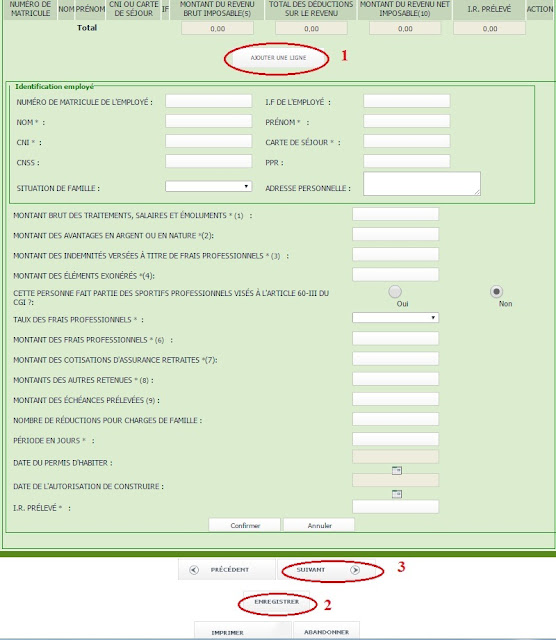
The professional workflow is as follows:
- Finalize December Payroll: Ensure the final payroll of the year is correct and closed.
- Run Annual Consolidation: Use your payroll software's function (e.g., "Générer État 9421") to consolidate the 12 months of data for all employees.
- Verify the Data: Review the generated summary. The software will calculate the SBI, Frais Professionnels, RNI, etc., for each employee. Your role is to spot-check for anomalies (e.g., an employee with an unusually high or low RNI).
- Generate the Declaration File: The software will produce a file in a specific format (usually XML) required by the tax administration's portal.
- Submit via SIMPL-IR: The declaration is submitted electronically through the DGI's portal, called
SIMPL-IR. Similar to the DAMANCOM process, you log in, upload the generated file, and the system validates it. - Save Proof of Submission: Once the submission is successful, you will receive a digital receipt (
récépissé de dépôt). This is your official proof that you have met your legal obligation. It must be archived carefully.
Test your understanding!
An employee at your Moroccan SME has the following annual figures for 2023:
- Total of 12 monthly gross salaries (
Salaire Brut Global): 144,000 MAD - Annual housing allowance (
Indemnité de logement): 24,000 MAD - Total annual employee contributions to CNSS & AMO: 7,526.40 MAD
Calculate the following for the État 9421:
Salaire Brut Imposable(SBI)Frais ProfessionnelsRevenu Net Imposable(RNI)
Show answer
-
Salaire Brut Imposable(SBI):- SBI =
Salaire Brut Global+Indemnités - SBI = 144,000 + 24,000 = 168,000 MAD
- SBI =
-
Frais Professionnels:- First, calculate 20% of SBI: 168,000 * 20% = 33,600 MAD.
- Compare this to the annual cap of 30,000 MAD.
- Since 33,600 > 30,000, the deductible amount is capped.
Frais Professionnels= 30,000 MAD
-
Revenu Net Imposable(RNI):- RNI = SBI -
Frais Professionnels-Cotisations Sociales - RNI = 168,000 - 30,000 - 7,526.40 = 130,473.60 MAD
- RNI = SBI -
This RNI is the basis on which the employee's annual income tax is calculated.
Conclusion
You have now learned how to prepare the État 9421, a critical annual declaration that bridges payroll and tax compliance. This process moves beyond monthly data entry to a comprehensive annual review of employee compensation.
Key Takeaways:
- The
État 9421is the annual declaration of salaries submitted to the tax authorities (DGI) before March 1st. - It consolidates 12 months of payroll data to calculate each employee's
Revenu Net Imposable(RNI). - The key calculation is: RNI = SBI - Frais Professionnels - Cotisations Sociales.
- The
Frais Professionnelsdeduction is 20% of SBI, capped at 30,000 MAD per year. - The submission is done electronically via the
SIMPL-IRportal using a file generated by your payroll software.
Preview of the Next Lesson:
We have now covered the two main external declarations related to payroll: the monthly social security declaration (BDS) and the annual tax declaration (État 9421). However, all these payroll activities also need to be reflected inside the company's own books. In our next lesson, we will learn how to describe the accounting entries required to record salaries, social charges, and income tax, linking our payroll work directly to the general ledger.