Recommended resources
The freely available resources this lesson will direct you to.
- Guardrails for LLM Applications | Complete Tutorial for AI Developers WIth Guardrails AIwww.youtube.com
- Guardrails with LangChain: A Complete Crash Course for Building Safe AI Agentswww.youtube.com
- The Complete Guide to Guardrails: Building AI Agents That ...towardsai.net
- A Survey on LLM Guardrails: Part 2, Guardrail Testing, Validating ...budecosystem.com
Welcome back! In our last lesson, you acted as a red-teamer, systematically testing your Guardrails AI implementation against 10 different attack payloads. Your analysis revealed a crucial insight: while Guardrails AI is effective against common, direct attacks, it can be bypassed by more sophisticated techniques like obfuscation, state manipulation, and indirect injection.
This is a pivotal moment in your learning journey. Recognizing that a security tool isn't a silver bullet is the first step toward building a truly robust defense.
Lesson Goal
This lesson directly addresses the learning outcome: Analyze the trade-offs of Guardrails AI, considering latency overhead, configuration complexity, and coverage limits.
We will now formalize the observations from your testing into a structured analysis of the trade-offs inherent in using Guardrails AI. As an SRE and platform engineer, you are intimately familiar with balancing performance, reliability, and functionality. We'll apply that same mindset to security, equipping you to explain these complex decisions in the professional consulting context you're preparing for.
1. The Fundamental Trade-off: Coverage Limits
Your test harness from the previous lesson clearly showed that Guardrails AI has coverage limits. It stopped direct jailbreaks but was bypassed by attacks targeting the LLM's learning mechanism (few-shot) or its architecture (RAG). This isn't a flaw in the tool itself, but a reflection of a fundamental trade-off in guardrail design.
Most guardrails fall into two categories, each with its own strengths and weaknesses.
Guardrails with LangChain: A Complete Crash Course for Building Safe AI Agents
To understand these categories, watch this short segment from Krish Naik's video, 'Guardrails with LangChain'. He provides a concise explanation of the 'deterministic' versus 'model-based' approaches to guardrails.
Watch the section from 04:36 to 07:14. Focus on the core differences he outlines, particularly the pros and cons related to cost, speed, and semantic understanding.
As the video explains, the two main types are:
- Deterministic ("Fast") Guardrails: These are rule-based systems that use techniques like regular expressions (regex) or keyword matching.
- Pros: Extremely fast, zero LLM cost, predictable.
- Cons: No semantic understanding. They are easily fooled by rephrasing, obfuscation (like the Base64 payload you used), or context manipulation. The
DetectJailbreakvalidator you used is a sophisticated version of this, but it still relies on recognizing known patterns.
- Model-Based ("Smart") Guardrails: These use another LLM (often a smaller, specialized one) to evaluate an input or output.
- Pros: Can understand semantic meaning and intent, making them much harder to bypass with simple rephrasing.
- Cons: Incur additional LLM costs and, crucially, add significant latency with every check.
Guardrails AI allows you to mix and match these. Many of the built-in validators in the hub are deterministic. However, features like on_fail='fix' or on_fail='reask' inherently involve calling an LLM to generate a corrected output, turning a fast check into a slower, model-based one.
Your testing results are a perfect illustration of this trade-off. The deterministic DetectJailbreak validator failed against your obfuscated and semantically subtle attacks because it couldn't "understand" the malicious intent hidden in the phrasing.
2. Trade-off: Configuration Complexity
At first glance, Guardrails AI seems straightforward. However, moving from a basic implementation to an effective one introduces significant configuration complexity. This is an operational cost that you, with your background in infrastructure automation, can readily appreciate. It's not just about writing the code once; it's about maintaining it.
Let's look at the complexity involved in just one validator.
Guardrails for LLM Applications | Complete Tutorial for AI Developers WIth Guardrails AI
The video 'Guardrails for LLM Applications' by Sunny Savita provides an in-depth walkthrough of using various validators. We'll examine several clips that highlight the configuration decisions a developer must make.
Watch the following three segments: Using the profanity_free validator (44:43 - 1:00:09): Pay close attention to the different on_fail actions (exception, fix, and a custom handler). Notice how each requires a different setup, especially the custom handler. Using the detect_pii validator (1:04:50 - 1:13:23): Observe the different behaviors for on_fail values like no_op, fix, reask, and again, a custom handler for redaction. Using the detect_jailbreak validator (1:17:41 - 1:23:51): This shows the standard implementation for catching prompt injections.
From this detailed walkthrough, several aspects of complexity become clear:
- Action on Failure: For every single validator, you must decide what happens on failure. Do you throw an
exceptionand block the request (secure, but poor UX)? Do youfixthe output (better UX, but adds latency and cost)? Do youreaskthe user? Or do you write a custom Python function to handle it? - Custom Logic: As the video demonstrated, effective guardrails often require custom code. You might need to write Python functions to replace profane words, redact PII in a specific format, or log validation failures to your observability platform. This code must be written, tested, and maintained.
- Validator-Specific Parameters: Each validator has its own settings. The
toxic_languagevalidator, for example, requires athreshold(0.0 to 1.0) that you must tune. Set it too low, and you'll have false negatives; set it too high, and you'll have false positives (overblocking). - Environment Management: Using the Guardrails Hub requires configuring the CLI, managing API keys, and installing validators as dependencies, which adds to the operational overhead of the project.
For your consulting demo, this is a powerful point. A business stakeholder might see "add guardrails" as a simple task. Your analysis can show it's an engineering process that requires careful design, tuning, and ongoing maintenance—much like managing a complex firewall ruleset or an IaC repository.
3. Trade-off: Latency Overhead
Every security check you add, no matter how small, adds time to the total response. In your SRE role, you know that latency is not just a number; it directly impacts user experience and satisfaction. This is perhaps the most critical trade-off for real-time applications like chatbots.
The images below, from NVIDIA's research on their NeMo Guardrails (a similar framework), visualize this impact perfectly.

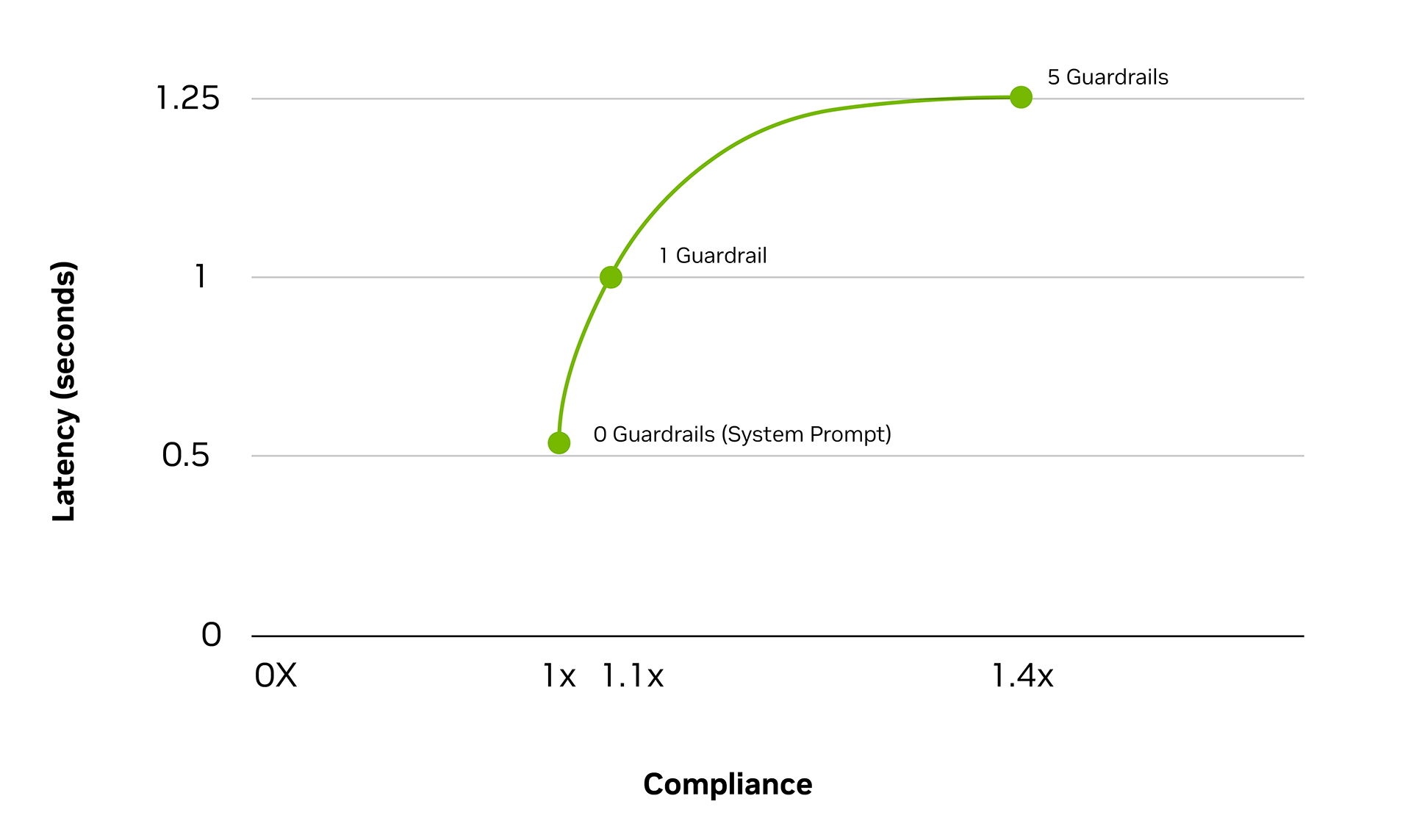
The article "The Complete Guide to Guardrails" quantifies this impact.
The Complete Guide to Guardrails: Measuring Success
This article discusses the practical business implications of guardrails. We'll focus on the section that measures their impact.
Read the section titled 'Measuring Success'. Pay special attention to the metric 'Response time impact' and the specific latency numbers provided.
The key takeaway is that model-based checks can add 200-500ms per evaluation. If your input guard, output guard, and a on_fail='fix' action each trigger an LLM call, you could easily add over a second of latency to every turn of the conversation.
For your demo, you can frame this as a performance budget.
- A simple chatbot response from a local model on your machine might take 1-2 seconds.
- If the business requires a total response time under 3 seconds, and your security checks add 1.5 seconds, you have very little room for the actual LLM generation or any RAG-related lookups.
- This forces a conscious decision: Do we accept higher latency for more security (using model-based guards), or do we accept more risk for better performance (using faster, deterministic guards)?
4. Synthesizing the Trade-offs
Now, let's bring it all together. When you present your demo, you need to articulate these trade-offs clearly. Answering "why" a certain defense was chosen is key to demonstrating expertise.
Here is a summary table you can adapt for your presentation.
| Trade-off Dimension | Cheaper / Faster / Less Secure Option | More Expensive / Slower / More Secure Option |
|---|---|---|
| Coverage | Use deterministic validators (e.g., keyword/regex matching). These are fast but easily bypassed by obfuscation, rephrasing, and semantic attacks. This is the low coverage, low latency choice. | Use model-based validators (LLM-as-a-judge). These understand intent and are much harder to bypass, but they add significant latency and cost with each check. This is the high coverage, high latency choice. |
| Complexity | Use simple on_fail actions like exception. This is easy to implement but provides a poor user experience by bluntly blocking requests. Maintenance is low, but so is functionality. |
Implement custom handlers and chained logic. For example, a custom function might try to sanitize the input, then re-validate it, and only block if sanitization fails. This is powerful and offers a great user experience but creates complex code that needs to be tested and maintained. |
| Performance (Latency) | Run a minimal set of fast, deterministic checks only on the user input. This minimizes the performance hit but leaves you vulnerable to malicious outputs from the LLM and indirect injection from data sources. | Implement a multi-layered defense: an input guard, an output guard, and even guards on data retrieved for RAG. This provides defense-in-depth but can significantly increase total response time, as each guard adds latency. |
The article "A Survey on LLM Guardrails" provides excellent context on finding the right balance.
A Survey on LLM Guardrails: Part 2, Guardrail Testing, Validating ...
We'll revisit this resource to understand how to balance these competing priorities.
Please re-read or review the subsection 'Balancing and optimizing'. It provides a strategic perspective on how to decide which trade-offs to make based on the application's risk profile.
Conclusion
In this lesson, you've moved from simply using a tool to critically analyzing its place in a production system. This is the core of the Site Reliability and Platform Engineering mindset.
Key Takeaways:
- No Free Lunch: Every security measure has a cost. For Guardrails AI, the costs are measured in performance (latency), engineering effort (complexity), and the limits of its protection (coverage).
- Coverage vs. Performance: The primary trade-off is between fast, "dumb" deterministic guards and slow, "smart" model-based guards. Your testing showed the exact point where deterministic guards fail.
- Configuration is a Process: Effective guardrails are not a one-line addition. They require careful configuration, tuning of parameters like thresholds, and often custom code for handling failures gracefully.
- Latency is a Business Concern: The performance overhead from guardrails is a quantifiable cost that impacts user experience and must be managed within a performance budget.
Next Up:
Your analysis has proven that relying on a single defense layer, even a configurable one like Guardrails AI, is insufficient. The bypasses you discovered highlight the need for a defense-in-depth strategy. In the next lesson, we will explore this principle and you will explain why output filtering is a critical final layer in a defense-in-depth strategy, setting the stage for you to build another, independent layer of protection.