Recommended resources
The freely available resources this lesson will direct you to.
- GCSE Maths - What do you do with Negative Powers? (Powers Part 5/6) (2026/27 exams)www.youtube.com
- GCSE Maths - Introduction to Powers/Indices & 3 Basic Rules (Powers Part 1/6) (2026/27 exams)www.youtube.com
- Negative and fractional indices - GCSE Maths Revisionwww.bbc.co.uk
- How Fractional and Negative Indices Work | MathsGeniemathsgenie.co.uk
Hello! Last lesson, you used powers to count repeated factors, roots to work backwards, and index laws to simplify calculations. You stopped at a useful question: what happens when dividing powers gives an index of zero or a negative number?
This lesson answers that question, then shows how fractional indices connect to roots. Allow about 35–40 minutes, including the short videos, reading and practice. Work through the examples in order: each new rule grows out of something you already know.
Why an index of zero gives one
Last time, you divided powers with the same base by subtracting their indices. Consider dividing a power by itself:
The division law gives another way to write exactly the same calculation:
Therefore . The same reasoning works for any non-zero base:
A zero index does not mean “multiply by zero”. It means the powers have cancelled down to one. For example, : the brackets make the base. We leave out of this rule; it is not given a value in ordinary GCSE calculations.
Watch this brief explanation, noticing which whole quantity is raised to the power of zero.
GCSE Maths - Introduction to Powers/Indices & 3 Basic Rules (Powers Part 1/6) (2026/27 exams)
In Cognito’s “Introduction to Powers/Indices & 3 Basic Rules”, this segment states the zero-index rule and gives examples. Use the cancellation argument above to explain why the examples work.
Watch the zero rule. In your own working, use brackets whenever the intended base is a whole expression: (3\times5)^0=1, whereas 3\times5^0=3.
A negative index means a reciprocal
Now let the bottom index be larger. Simplify the same division in two ways:
But cancelling two factors of from the top and bottom leaves
Both expressions describe the same number, so . In general,
The fraction is the reciprocal of . The minus sign in the index tells you to take a reciprocal; it does not tell you to make the answer negative. Thus , not . A base of zero cannot have a negative index because that would require division by zero.
The rule also works when the base is a fraction. The reciprocal of is , so
Here the negative index gives an answer greater than one. Taking a reciprocal does not always make a number smaller.
GCSE Maths - What do you do with Negative Powers? (Powers Part 5/6) (2026/27 exams)
Cognito’s “What do you do with Negative Powers?” shows negative indices on both whole-number and fractional bases. Watch it to reinforce what is inverted before the positive power is calculated.
Watch whole-number bases, then fractional bases. In the second part, focus on why the entire fraction is turned upside down, not just its numerator.
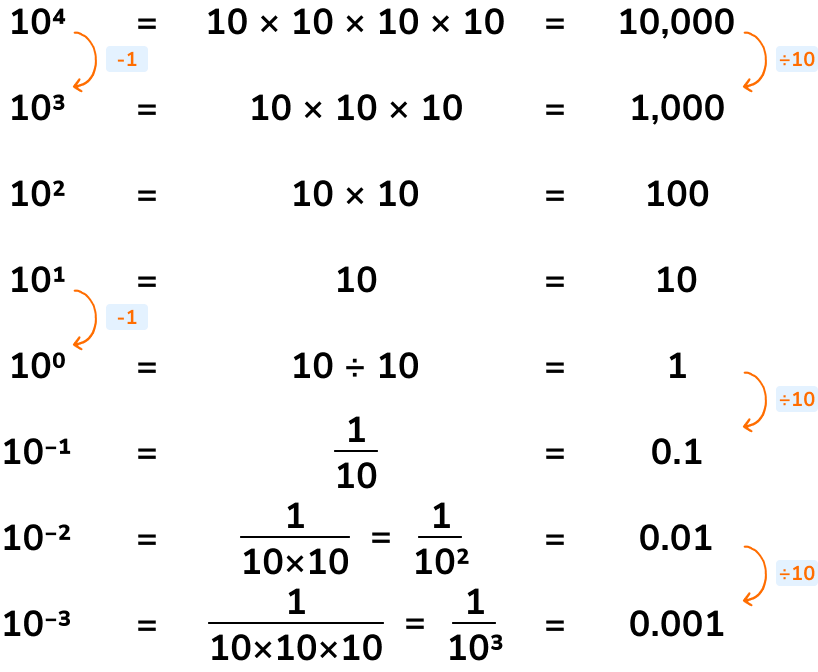
Powers of ten make the rule easy to see. Each time the index drops by one, the value is divided by ten. That pattern continues through to .
A fractional index means a root
A fraction in the index has a different job from a minus sign. Start with . Whatever number this represents, cubing it must give , because raising a power to a power multiplies the indices:
The number whose cube is is . Hence . More generally,
The denominator of the index tells you which root to take. A denominator of means square root; a denominator of means cube root. For a positive base, if the index has a numerator other than , the numerator tells you which power to apply:
Usually, find the root first, then apply the power. For instance,
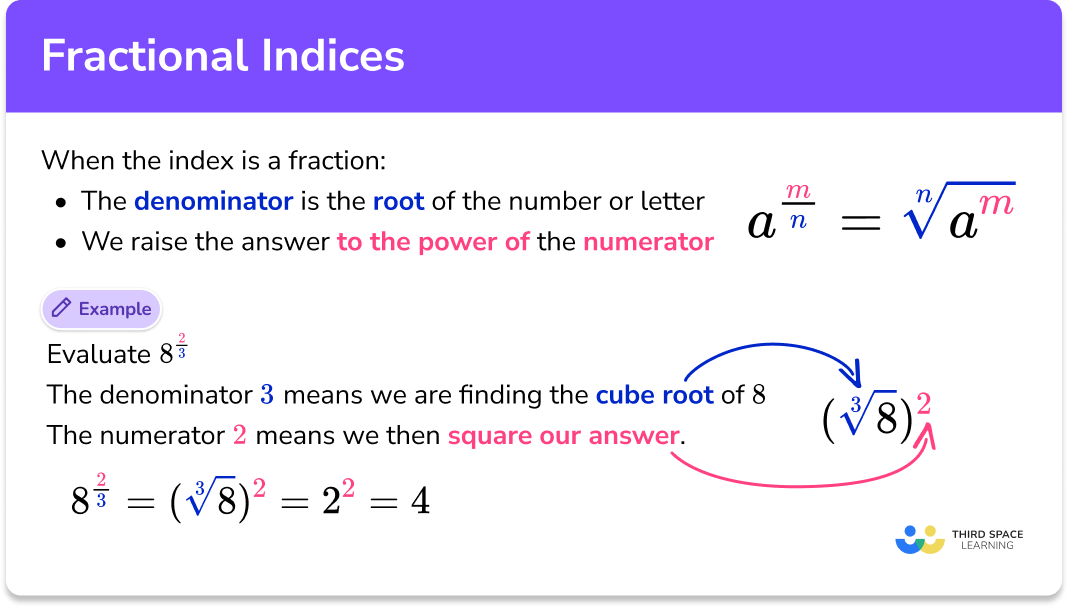
For another example, means “find the square root of , then cube it”:
Read the two GCSE-style examples below to see how the rule is presented in exam questions.
Negative and fractional indices - GCSE Maths Revision
BBC Bitesize’s “Negative and fractional indices” gives worked examples with indices of one half and three halves. Read these to check that you can identify the root and the power without swapping their roles.
In “Higher - What are fractional indices?”, find “Follow the working out below”, then “GCSE exam-style questions”. Read the explanation of 81^{1/2} from the half-power example. Continue to the 25^{3/2} example: read the paragraph beginning “The denominator (2) indicates”, then the next steps, finishing with its answer of 125. Focus on why the denominator selects the root and the numerator selects the power.
The root still has to exist as a real number. For example, , because . But has no real value: no real number squares to . For the remaining examples, we will use positive bases.
When the index is both negative and fractional
Now both ideas are needed. In , the minus sign says take the reciprocal; the denominator says cube root; the numerator says square. Keeping those jobs separate gives:
There is no need to do the steps in your head. Writing the reciprocal first makes it harder to mistake the negative index for a negative answer.
Brackets still matter, just as they did last lesson. Compare
with
In the first expression, is the base. In the second, the power applies to , and the minus sign sits outside it.
Check your understanding
Try these without looking at the answers, starting with the basics. Show at least one intermediate step for questions 3–6 so you can tell where an error occurred.
- Evaluate and .
- Evaluate and .
- Evaluate .
- Evaluate and .
- Evaluate .
- GCSE-style, mixing index laws from last lesson: Evaluate
Answers and mistake checks
- Both equal . If you wrote , remember that a zero index does not make the value zero.
- and . The negative index takes a reciprocal; the negative base in brackets determines the second answer’s sign.
- . Flip the whole fraction before squaring.
- , and . If you used a square root for the second calculation, check the denominator of its index.
- .
- , , and . So the result is . Do not combine indices across the addition or subtraction signs.
If any step is still unclear, pause here rather than pressing on. Share your working to get feedback on the first place it goes wrong.
What to keep
For a non-zero base, a zero index gives , while a negative index gives a reciprocal. In a fractional index, the denominator names the root and the numerator names the power. A negative fractional index combines these rules: take the reciprocal, find the root, then apply the power. Always check which quantity is inside brackets.
Next, you will use powers of ten to write very large and very small numbers in standard form. The pattern you saw in the powers-of-ten image will become especially useful there.