Recommended resources
The freely available resources this lesson will direct you to.
Welcome to the powers and roots module. This lesson starts with what a square or cube means, then uses that idea to simplify calculations involving roots and positive integer indices. The aim is to understand why each rule works, rather than rely on a list of rules you might mix up.
Allow about 40 minutes. Pause at the checks as you go; if a step feels uncertain, revisit it before trying the final questions.
Squares, cubes and index notation
When you multiply a number by itself, index notation gives you a shorter way to write the calculation:
The large number, , is the base. The small raised number, , is the index (also called the power or exponent). The index tells you how many copies of the base are multiplied together. So has two copies of ; it does not mean .
A power of is called a square, and a power of is called a cube:
A base can have a higher positive integer index too. For example, .
Watch Powers and Roots | GCSE Maths from Brainstorm - Maths and Science for a short visual introduction to powers and the roots that undo them.
Watch powers first. Focus on counting copies of the base in 3^4. Then watch roots; listen for the question the speaker asks to find a square root or cube root.
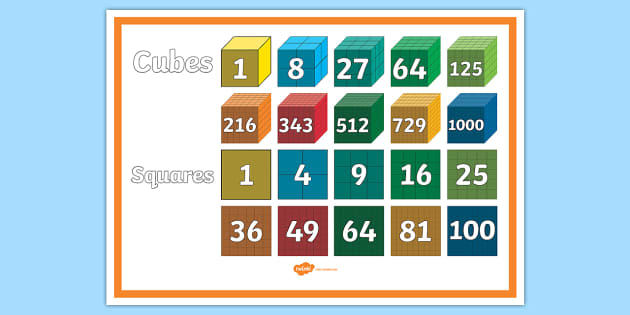
The poster is useful for spotting familiar values, but you can rebuild any of them by multiplication. For instance, , while .
Watch the brackets when the base is negative. They tell you whether the minus sign is part of the number being raised to a power:
In the second expression, the power applies to , then the minus sign is applied. For a cube, three negative factors give a negative result:
Before continuing, make sure you can explain why and have different answers. The brackets, not a special rule about , make the difference.
Roots: working backwards
A root reverses a power. To find , ask: Which non-negative number squares to give ? Because ,
To find a cube root, ask which number cubes to give the value under the root sign. Since ,
The small on a cube-root sign matters: , but .
There is a subtle distinction with square roots. Both and equal , so the equation has two solutions, and . But the symbol means the non-negative square root only: its value is , not “ or ”.
Negative numbers behave differently under the two root signs. No real number has a negative square, so has no real value. A negative number can have a cube root:
A reliable check is to raise your proposed answer to the relevant power. If you think , check that .
Index laws: count the factors
Expanding powers works for small calculations, but it gets cumbersome when the indices grow. The index laws are shortcuts based on counting copies of the same base.
The following BBC Bitesize transcript introduces the three laws used here. Its examples use letters such as and ; each letter simply stands for a base, and the same reasoning works with numbers.
Laws of indices - GCSE Maths Revision - BBC Bitesize
Read the video transcript in BBC Bitesize’s Laws of indices for its explanations of multiplying, dividing and raising a power to a power.
Under “Video – Laws of indices”, open “Video Transcript”. Read the transcript, from the explanation of a base and index through the final bracketed example. Focus on why each operation on the indices matches what happens to the repeated factors.
Multiplying powers with the same base
In , the first power contains three copies of , and the second contains two more. There are five altogether:
So, when multiplying powers with the same base, add their indices:
This does not mean that indices are added whenever you see powers. The bases must be the same, and the operation must be multiplication. For example, is ; you cannot turn it into or . Nor does the multiplication rule apply to : that is .
Dividing powers with the same base
Division cancels matching factors. In this lesson, we will use examples where more copies of the base appear on top than on the bottom:
Two copies cancel, so subtract the bottom index from the top index:
For now, use this when , giving a positive index. The cases where the indices are equal or the bottom index is larger belong to the next lesson.
Raising a power to a power
Brackets show that the whole power is repeated. For example,
There are three groups of two copies of , so multiply the indices:
If an entire bracket contains other numbers, the outside power applies to everything inside it. For example, . It does not mean , which would be .
The useful question is always: What exactly is being repeated? That question will often rescue you if you forget which index law to use.
Simplifying a complete expression
A GCSE-style numerical expression may combine several ideas. Keep the usual order of operations: work inside brackets; evaluate powers and roots; perform multiplication and division; then finish with addition and subtraction. Show an intermediate line so that a minus sign or a bracket does not disappear.
Consider
First, simplify the power raised to a power: . Then divide powers of the same base and evaluate the roots:
Finally, , and subtracting adds :
Notice what we didn’t do: we did not combine indices across the plus or minus signs. The index laws only simplified the parts where their conditions were met.
Check your understanding
Try these in order without looking back. The first checks the basics; the last combines several steps. Keep your working so you can identify a mistake rather than merely spot a different answer.
- Evaluate and .
- Evaluate and . Check each answer using a power.
- Simplify , giving both index form and its value.
- Evaluate and . State why they differ.
- GCSE-style: Evaluate , showing where you use an index law.
Answers for checking: (1) . (2) , since and . (3) . (4) : only the brackets make the base. (5) .
If an answer differs, go back to the first line where your working differs from the explanation. If you cannot yet explain that difference, hold off on the next lesson. You can share your working for feedback and correction before moving on.
What to keep
An index counts copies of a base multiplied together. Squares use two copies; cubes use three. Roots ask you to find the number that produced a given square or cube, with giving the non-negative square root. For the same base, multiplication adds indices, division subtracts them, and raising a power to a power multiplies them. Brackets and the order of operations determine where each rule applies.
Next, you will extend these ideas to zero, negative and fractional indices. Those are not separate tricks: they build on the factor-counting rules you have used here.