Recommended resources
The freely available resources this lesson will direct you to.
Welcome to the next lesson in our Modern C++ module. In our previous session, we explored templates and saw how they provide a blueprint for creating generic, type-safe code. You learned that std::vector<T> and std::array<T, N> are class templates that can manage collections of any data type. Today, we'll see how this same template mechanism is used to solve one of the most persistent problems in C++: manual memory management.
In graphics programming, we constantly create and destroy objects on the heap—meshes, textures, materials, and various other scene components. Managing the lifetime of these objects manually with new and delete is notoriously difficult and a common source of bugs like memory leaks and crashes. This lesson introduces a powerful C++ idiom, Resource Acquisition Is Initialization (RAII), and the smart pointer classes that implement it. You will learn to apply std::unique_ptr and std::shared_ptr to automate memory management, making your code safer, cleaner, and more robust.
The Perils of Manual Memory Management
Before we look at the solution, it's crucial to understand the problem. When you allocate memory with new, you are responsible for freeing it with delete. Forgetting to do so results in a memory leak. Deleting the same memory twice leads to undefined behavior, which often means a crash. This becomes especially tricky when functions can exit early, for example, if an error occurs or an exception is thrown.
The following video masterfully illustrates the common pitfalls of using raw pointers.
unique_ptr: C++'s simplest smart pointer
This video from the mCoding channel provides a fantastic, practical demonstration of why manual memory management with raw pointers is so error-prone.
Please watch the introductory section which shows several ways that seemingly correct code using new and delete can fail, leading to memory leaks or double-deletion bugs.
As you saw, managing ownership and lifetimes manually requires constant vigilance. A single forgotten delete or a premature function return can break your program. Modern C++ provides a much better way.
The RAII Idiom: Automatic and Exception-Safe Cleanup
The solution is a core C++ programming idiom called Resource Acquisition Is Initialization (RAII). The name sounds complex, but the idea is simple and elegant: tie the lifetime of a resource (like heap-allocated memory, a file handle, or a network socket) to the lifetime of a stack-allocated object.
- Acquisition: The resource is acquired in the object's constructor.
- Release: The resource is released in the object's destructor.
Since C++ guarantees that an object's destructor is always called when it goes out of scope—no matter how that happens, even during an exception—the resource is always cleaned up automatically.
Resource Acquisition Is Initialization (RAII) in C++ with ...
This article from SysTutorials gives a concise explanation of the RAII principle and why it is so important for writing robust C++ code.
Please read the first three sections, from the introduction down to "Why RAII Matters". This will solidify your understanding of how tying resources to object lifetime ensures automatic, exception-safe cleanup.
For performance-critical fields like graphics, RAII offers another significant advantage over the garbage collection (GC) found in languages like Java or C#.
Resource Acquisition Is Initialization (RAII) in C++ with ...
Let's return to the same article to understand a key performance implication.
Read the section titled RAII vs. Garbage Collection. It explains that RAII provides deterministic destruction: you know exactly when a resource will be freed. This avoids the unpredictable pauses associated with garbage collectors, which is essential for maintaining smooth frame rates in real-time graphics applications.
Smart pointers are the C++ Standard Library's primary tool for implementing RAII for memory management.
std::unique_ptr: Exclusive Ownership
The std::unique_ptr<T> is a class template that manages a dynamically allocated object and enforces exclusive ownership. This means that at any given time, only one unique_ptr can own the object. When that unique_ptr is destroyed (because it goes out of scope), it automatically calls delete on the raw pointer it manages.
unique_ptr is designed to be a lightweight, zero-cost abstraction. It's essentially just a wrapper around a raw pointer and has the same size and performance. It should be your default choice for managing memory.
Let's watch a brief overview of the different smart pointers, focusing first on unique_ptr.
SMART POINTERS in C++ (std::unique_ptr, std::shared_ptr, std::weak_ptr)
This video from The Cherno gives a great conceptual overview of smart pointers.
Watch the introduction and the section on unique_ptr: Introduction to smart pointers as a way to automate memory management. The unique_ptr, which explains its scoped, unique ownership nature and introduces std::make_unique.
Under the Hood: Building a unique_ptr
To truly understand how unique_ptr works, let's build a simplified version ourselves. This exercise will connect what you've learned about classes, destructors, and templates. Since a unique_ptr cannot be copied, it introduces us to an important concept: move semantics, which allows the transfer of ownership from one unique_ptr to another.
unique_ptr: C++'s simplest smart pointer
We return to the mCoding video, which now walks through building a simple unique_ptr from scratch. This is an invaluable exercise.
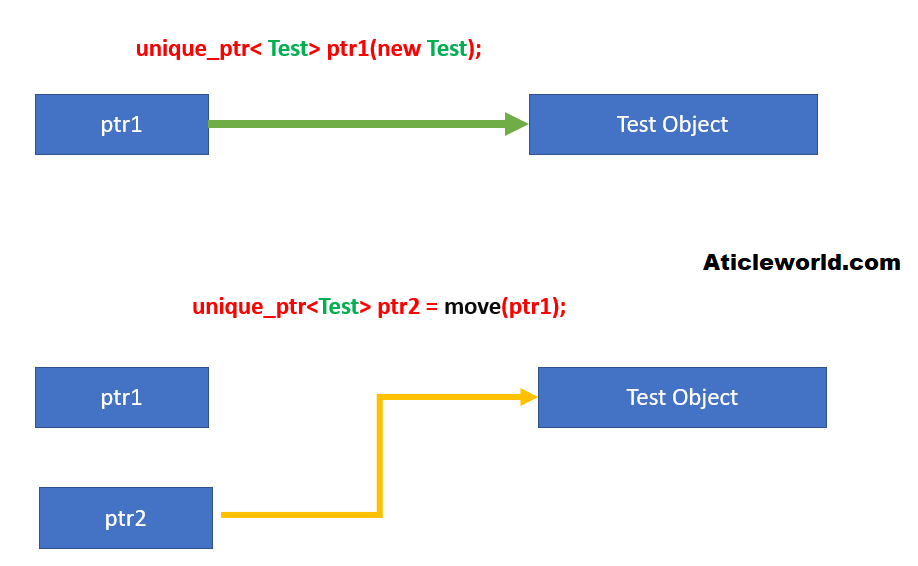
Watch the section where the presenter builds a unique_ptr step-by-step. Pay close attention to these key implementation details: The Destructor: It contains the delete call—this is the core of RAII. Deleted Copy Operations: The copy constructor and copy assignment operator are explicitly deleted (= delete;) to prevent two unique_ptrs from owning the same pointer. Move Constructor & Assignment: These allow ownership to be transferred efficiently from one unique_ptr to another (the "source" pointer is set to nullptr). This is what std::move facilitates.
The transfer of ownership via std::move is a fundamental concept. The image below visualizes what happens when you move from ptr1 to ptr2. ptr1 gives up ownership and is set to a null state, while ptr2 now exclusively owns the Test Object.
Using std::unique_ptr
The best practice for creating a unique_ptr is to use the std::make_unique helper function (available since C++14). It's safer and more concise than calling new directly.
#include <iostream>
#include <memory>

class GameObject {
public:
    GameObject() { std::cout << "GameObject created.\n"; }
    ~GameObject() { std::cout << "GameObject destroyed.\n"; }
    void update() { /* ... */ }
};

void game_loop_scope() {
    // Create a GameObject managed by a unique_ptr.
    // No 'new' is needed in our code.
    std::unique_ptr<GameObject> player = std::make_unique<GameObject>();

    // Use the pointer just like a raw pointer.
    player->update();

    // No 'delete' is needed. 'player' is destroyed automatically
    // when it goes out of scope here, and its destructor calls delete.
} // "GameObject destroyed." is printed here.

int main() {
    game_loop_scope();
    return 0;
}
std::shared_ptr: Shared Ownership
Sometimes, you genuinely need multiple objects to share ownership of a single resource. A common scenario in graphics is having multiple scene nodes reference the same mesh or texture data. If any of those nodes are still using the resource, it must not be deleted.
This is the job of std::shared_ptr<T>. It implements shared ownership using a technique called reference counting.
- A
shared_ptrmaintains a "control block" that stores a counter of how manyshared_ptrinstances are pointing to the resource. - When a new
shared_ptris created by copying an existing one, the reference count is incremented. - When a
shared_ptris destroyed, the reference count is decremented. - When the count reaches zero, the resource is automatically deleted.
SMART POINTERS in C++ (std::unique_ptr, std::shared_ptr, std::weak_ptr)
Let's go back to The Cherno's video to see how shared_ptr and reference counting work.
Watch the section on shared_ptr. He explains the concept of reference counting and why you should prefer std::make_shared. make_shared is more efficient because it can allocate memory for both the object and its reference count control block in a single operation.
The Problem of Circular References and std::weak_ptr
Shared pointers are powerful, but they have a potential pitfall: circular references. If two objects hold shared_ptrs to each other, their reference counts will never drop to zero, even when all external references to them are gone. This creates a memory leak.
To solve this, C++ provides std::weak_ptr<T>. A weak_ptr is a non-owning smart pointer. It can observe an object managed by a shared_ptr but does not increase the reference count. To safely access the object, you must first "lock" the weak_ptr to see if the object still exists. If it does, you get a temporary shared_ptr.
This summary from Microsoft's documentation provides a clear, high-level distinction between the different smart pointers.
Read the section Kinds of smart pointers. Focus on the descriptions of shared_ptr and weak_ptr to solidify your understanding of their roles and the problem weak_ptr is designed to solve.
In practice, you might use shared_ptr for parent-to-child relationships in a hierarchy (where the parent owns the child) and weak_ptr for child-to-parent relationships (where the child just observes its parent without keeping it alive).
Conclusion
You have now learned one of the most important patterns in modern C++ for writing safe and robust code. By embracing RAII and smart pointers, you can eliminate a whole class of common memory management bugs, allowing you to focus on the complex logic of your graphics applications.
Key Takeaways:
- RAII (Resource Acquisition Is Initialization) is an idiom where a resource's lifetime is bound to an object's scope, ensuring automatic cleanup via the destructor.
std::unique_ptrprovides exclusive, lightweight ownership of a resource. It cannot be copied but can be moved. It should be your default choice.std::shared_ptrprovides shared ownership through reference counting. Use it when a resource's lifetime must be tied to multiple owners.std::weak_ptris a non-owning pointer that breaks circular references betweenshared_ptrinstances.- Always prefer the helper functions
std::make_uniqueandstd::make_sharedto create smart pointers.
In our next lesson, we will broaden our view of application stability by looking at other robust error handling mechanisms in C++. You'll see how RAII plays a crucial role in writing exception-safe code, which is a cornerstone of building reliable applications.