Recommended resources
The freely available resources this lesson will direct you to.
- Place of Articulation | Consonant Sounds in English - Phonologywww.youtube.com
- [Introduction to Linguistics] Consonants: Place of Articulation, Manner of Articulation, Voicingwww.youtube.com
- Describing consonantshome.cc.umanitoba.ca
- Introduction to consonants - English Pronunciationwww.englishpronunciationmadrid.com
Hello again. Your baseline recording captured how you speak before making deliberate accent changes. Today you will begin building a way to describe what you hear in it. Rather than judging a consonant as simply “right” or “wrong,” you will learn to ask three questions: Do the vocal folds vibrate? Where is the airflow restricted? How is it restricted?
These questions apply across English accents. They will help you hear contrasts that matter for contemporary RP, while the finer details of producing particular sounds come later in the course. You do not need to know the International Phonetic Alphabet (IPA) yet; the symbols below are labels for sounds, not a memorisation test.
Voicing: is there a buzz? · About 7 minutes
Put two fingers lightly against the front of your throat. Sustain the sound at the start of see: “ssss.” Then sustain the sound at the start of zoo: “zzzz.” Your tongue stays in roughly the same position, but you should feel vibration during “zzzz.” A consonant made with vocal-fold vibration is voiced; one made without it is voiceless.
Listen for that distinction as well as feeling it. The sustained sound in zoo has a buzz that the sustained sound in see lacks. Avoid testing with “suh” and “zuh”: the vowel after each consonant is voiced and can make both attempts feel buzzy.
Introduction to consonants - English Pronunciation
Read the “Voicing” subsection of Introduction to consonants from English Pronunciation Madrid. It explains why sounds can share a mouth position yet differ in vocal-fold vibration.
In the “Voicing” subsection, read the explanation and demonstration, from its opening paragraph through the “From /s/ to /z/” audio example. Play that example and attend to the moment the buzz begins. You can skip its links to other tables for now.
The initial sounds of fan and van offer another pair: both use the lower lip near the upper teeth, but the sound in van is voiced. A brief consonant such as the first sound of pin or bin is harder to sustain, so begin with “s” and “z” when checking your own voicing.
Manner: what happens to the air? · About 9 minutes
Voicing alone cannot distinguish the first sounds of see and tea: both are normally voiceless. The important difference is manner of articulation—what the mouth does to the airflow.
Say the beginning of tea slowly. Your tongue briefly closes the passage through the mouth before releasing it. Now say the beginning of see. Air keeps moving through a narrow gap, making a hiss. That difference between a stop, also called a plosive, and a fricative is something you can often hear even when you cannot see the speaker’s mouth.
Introduction to consonants - English Pronunciation
Return to Introduction to consonants for its “Manner of articulation” section. Read it to connect each kind of airflow with a sound you can listen for.
In “Manner of articulation,” read the manner descriptions, from the opening explanation through “Approximant.” Focus on the physical distinction among plosives, fricatives, affricates, nasals, laterals, and approximants. The comparisons with Spanish pronunciation are not needed for this lesson.
The main listening cues are:
- A stop/plosive briefly blocks air through the mouth, as at the start of pin, day, or go.
- A fricative lets air continue through a tight gap, creating friction, as at the start of fan, see, or shoe.
- An affricate begins with a closure and releases into friction as one consonant, as at the start of chair or judge.
- A nasal blocks air through the mouth but lets it pass through the nose, as at the start of man and no, or at the end of sing.
- An approximant brings parts of the mouth nearer without creating a hiss. The first sounds of we, yes, and red belong here. In l, as in leaf, air passes around the sides of the tongue; it is a lateral approximant.
There is a useful subtlety here: n and d both involve a closure at the same part of the mouth, but air can escape through the nose during n. That is why “closure” does not automatically mean “plosive.”
Place: where is the restriction? · About 13 minutes
Now hold the manner steady and change the place of articulation. Sustain the sound at the start of see, then the one at the start of shoe. Both have fricative airflow, but your tongue makes the narrow passage farther back for shoe. Place names tell you where the relevant lips, teeth, or tongue form a closure or narrowing.
The following video lets you see those locations while hearing examples. Treat it as a guide to consonant anatomy, not as a recording whose whole accent you need to imitate.
Place of Articulation | Consonant Sounds in English - Phonology
Watch selected parts of Billie English’s “Place of Articulation | Consonant Sounds in English – Phonology.” The close-up explanations make the place labels easier to connect to your own mouth movements.
Watch front positions for both lips, lower lip and upper teeth, tongue and teeth, and the ridge behind the upper teeth. Then watch farther back for the sounds in shoe and chair; hard palate for the first sound of yes; soft palate for the sounds in go and sing; and the glottis for h. Finish with two places, showing how the first sound of we involves both rounded lips and the back of the tongue. Pause after a group and try its sounds while noticing which part of your mouth moves.
Here are the place labels in everyday terms. Bilabial uses both lips (pin, bin, man). Labiodental uses the lower lip and upper teeth (fan, van). Dental uses the tongue near the upper teeth (think, this); the tongue does not have to protrude conspicuously. Alveolar refers to the firm ridge just behind the upper front teeth (tea, day, see, no). Postalveolar is just behind that ridge (shoe, chair). Palatal uses the hard palate for the first sound of yes. Velar uses the soft palate farther back (key, go, the final sound of sing). Glottal refers to the opening between the vocal folds, associated with h.
One sound can involve two places at once: the first sound of we combines lip rounding with a movement of the back of the tongue towards the soft palate. You may also encounter slightly different place labels for English r, depending on the speaker’s tongue position. For now, it is enough to recognise it as an approximant made around the alveolar/postalveolar region; its contemporary RP production has a dedicated lesson later.
Put the three questions together · About 11 minutes
A consonant chart is a compact map. Its columns give place, its rows give manner, and paired sounds in a cell differ in voicing. Use the chart below to check a sound after you have tried to hear and feel it. In this chart, the voiced member of a pair is bolded, though the difference may be difficult to see at a small size.
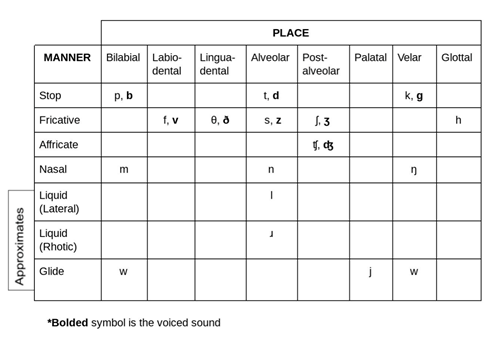
Consider the first sound of zoo. It has vocal-fold vibration, the tongue makes a narrow passage near the alveolar ridge, and air hisses through that passage. Its three-part description is therefore voiced alveolar fricative. Change only the voicing, and you have the first sound of see: a voiceless alveolar fricative. Change the manner instead, and the first sound of day is a voiced alveolar plosive.
For a short listening reference, use the individual sound clips in the table below. The symbols are convenient labels here; the next lesson will teach you how to interpret core consonant IPA systematically.
Introduction to consonants - English Pronunciation
Use Table 2 in Introduction to consonants as an audio reference. Its sound clips let you check whether a contrast you identified by feel is also audible.
Find the paragraph beginning “To describe a consonant”; Table 2 immediately follows it. In that table, play the paired symbols for /s/ and /z/, /f/ and /v/, and /ʃ/ and /ʒ/. Then compare /t/ with /s/, and /m/ with /n/ and /ŋ/. For each comparison, attend to which of the three questions—voicing, place, or manner—accounts for what changes.
When listening to a consonant in a word, pay attention to the consonant itself rather than the vowel beside it. Ask, in order: Is there voicing? Is there a closure, friction, nasal airflow, or a more open movement? Where does it happen? If one answer is uncertain, you can keep the other two. For example, hearing a continuous hiss near the teeth already narrows the possibilities, even before you decide whether there is a buzz.
Your baseline recording can remain untouched today. If you replay a few clear consonants from it, use these labels as observations, not as a score: “I hear a fricative here,” or “I want to check whether this sound is voiced.” Short recordings and the isolated clips above are easier starting points than trying to classify every consonant in continuous speech.
You can now describe a heard consonant along three independent dimensions: voicing tells you about vocal-fold vibration, place identifies the constriction’s location, and manner identifies what happens to the airflow. Together they make precise descriptions such as “voiceless alveolar fricative,” rather than a vague impression that two sounds are different.
Next, you will learn the core IPA consonant symbols used to write those sounds down. Today’s listening and mouth-position work will give those symbols something concrete to represent.