Recommended resources
The freely available resources this lesson will direct you to.
Welcome to your first lesson in our course on Intermediate to Advanced Condensed Matter Physics. Given your background in quantum mechanics and introductory solid-state physics, we'll be able to move quickly to build a robust theoretical foundation for the electronic, optical, and magnetic properties of materials.
This first module focuses on the bedrock of electronic properties: band theory. Today's lesson is about setting the stage for all that follows. We'll explore the geometric space where electrons in a crystal "live"—the reciprocal space. Our goal is to learn how to construct the fundamental unit of this space, the Brillouin zone, and identify its most important locations, the high-symmetry points, for common crystal lattices. Mastering this k-space geometry is essential for understanding and interpreting the electronic band structures that we will calculate in subsequent lessons.
1. From Real Space to Reciprocal Space
As you know from your introductory course, a crystal is defined by a periodic arrangement of atoms called a Bravais lattice. Any point in the lattice can be described by a vector , where are the primitive lattice vectors and are integers.
When we consider wave-like phenomena in a crystal, such as electron wavefunctions (from Bloch's theorem) or lattice vibrations (phonons), it's far more convenient to work in reciprocal space (also known as k-space). Every Bravais lattice in real space has a corresponding reciprocal lattice.
The primitive vectors of the reciprocal lattice, , are defined by the real-space vectors through the relation:
where is the Kronecker delta. This condition ensures that a vector is perpendicular to the plane formed by and , and similarly for the other vectors. You can construct them explicitly using the formula:
A key insight is that each point in the reciprocal lattice, given by a vector (where h, k, l are integers), corresponds to a family of parallel lattice planes in the real crystal, specified by the Miller indices (hkl). This connection is fundamental to understanding X-ray diffraction, where the scattering vector must equal a reciprocal lattice vector for constructive interference (the Laue condition).
The First Brillouin Zone
Just as we define a primitive unit cell in real space (like the Wigner-Seitz cell) that fills space when translated, we can define a primitive cell in reciprocal space. The Wigner-Seitz cell of the reciprocal lattice is given a special name: the First Brillouin Zone (FBZ).
Definition: The First Brillouin Zone is the set of all points in reciprocal space that are closer to the origin () than to any other reciprocal lattice point.
Construction:
- Pick a point in the reciprocal lattice and call it the origin.
- Draw vectors from the origin to all other (nearby) reciprocal lattice points.
- Draw the planes that are the perpendicular bisectors of these vectors.
- The smallest enclosed volume around the origin is the First Brillouin Zone.
Due to the periodicity of the reciprocal lattice, any wave vector outside the FBZ can be mapped back into it by adding or subtracting a reciprocal lattice vector , i.e., . This means the FBZ contains all the unique information about the wave vectors in the crystal.
2. Constructing Brillouin Zones
Let's see how this construction works for some important lattices.
The 1D Case
To build our intuition, let's start with a simple 1D lattice of points with spacing .
E Vs K, Brillouin zones and the Origin of Bands
The video 'E Vs K, Brillouin zones and the Origin of Bands' from the channel 'Introduction to Reciprocal Space' provides a very clear, step-by-step construction of the Brillouin zone for a 1D lattice. This will help solidify the geometric construction principle.
Please watch from 18:20 to 22:43. Focus on how the real-space lattice with spacing 'a' leads to reciprocal lattice points at intervals of 2π/a, and how the Bragg planes (the 1D equivalent of perpendicular bisector planes) at ±π/a define the first Brillouin zone.
As the video shows, for a 1D lattice with constant , the reciprocal lattice has points at . The first Brillouin zone is the region between the first two Bragg planes, which is the interval .
2D Lattices
Now let's move to 2D. The following reading introduces the formal generalization and then applies it to two important lattices.
Two and three dimensional discrete systems
The document 'Two and three dimensional discrete systems' from ETH Zurich formally defines the reciprocal lattice in 2D and provides excellent, clear examples for the square and honeycomb lattices.
Please read sections 4.1 ('Two dimensional discrete systems'), 4.2 ('A simple example: the square lattice'), and the first part of 4.3 ('A honeycomb lattice') up to equation 4.34. Pay attention to the definition of the reciprocal basis vectors b_i and the resulting shape of the Brillouin zone for each lattice.
Let's summarize the key results and introduce the standard notation for the high-symmetry points.
-
Square Lattice:
- Real-space vectors: ,
- Reciprocal lattice vectors: ,
- The reciprocal lattice is also a square lattice.
- The FBZ is a square with corners at .
- High-symmetry points:
- : The center of the zone.
- : The center of a zone edge.
- : A corner of the zone.
The path is often used to plot band structures.
-
Honeycomb Lattice (underlying Bravais lattice is hexagonal):
- This is our first example of a non-Bravais lattice; it's a hexagonal lattice with a two-atom basis. The Brillouin zone is determined by the underlying Bravais lattice.
- As shown in the reading, the reciprocal lattice is also hexagonal.
- The FBZ is a hexagon.
- High-symmetry points:
- : The center of the zone.
- : The corners of the hexagon. These points are particularly important as they are where the famous Dirac cones of graphene appear.
- : The center of an edge of the hexagon.
3D Lattices
In 3D, the Brillouin zones are beautiful polyhedra. Let's look at the most common cubic structures.
-
Simple Cubic (sc):
The real-space lattice is cubic, and its reciprocal is also a simple cubic lattice. The FBZ is a cube with side length .- (center of a face)
- (center of an edge)
- (corner)
-
Face-Centered Cubic (fcc) and Body-Centered Cubic (bcc):
These two are crucial, as many elements (Si, Ge, Cu, Al, Fe) and compounds crystallize in these structures. An interesting duality exists: the reciprocal lattice of an fcc lattice is a bcc lattice, and vice-versa.To get a good look at these 3D zones, we'll consult a video and a reference document.
Module 4.6 Reading Band Diagrams
The video 'Module 4.6 Reading Band Diagrams' will now help us visualize the 3D Brillouin zones for FCC and BCC lattices and understand the standard labeling for their high-symmetry points.
Please watch from 22:07 to 30:30. This part explicitly shows the shapes of the FCC and BCC Brillouin zones and labels the key points like X, L, K for FCC and H, P, N for BCC.
The document below provides static diagrams and the precise coordinates for these points, which is a useful reference.
This PDF, 'Brillouin zone of 3D systems' by Prof. M. S. Suzuki, serves as an excellent, concise reference for the FCC and BCC Brillouin zones. We will use it to reinforce what we saw in the video.
Please review Section 3 ('face-centered cubic (fcc) lattice') and Section 5 ('body-centered cubic (bcc) structure'), focusing on the figures of the Brillouin zones and the coordinates given for the high-symmetry points.
Let's consolidate this information with some clear images.
FCC Lattice: The FBZ is a truncated octahedron.
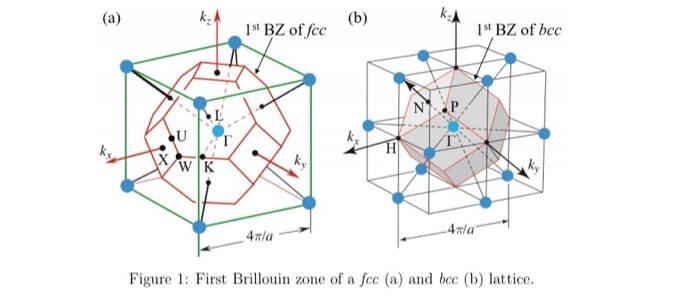
Key FCC points and directions:
- :
- : Along , e.g., . Center of a square face.
- : Along , e.g., . Center of a hexagonal face.
- : A corner where two hexagons and one square meet, e.g., .
BCC Lattice: The FBZ is a rhombic dodecahedron.
Key BCC points and directions:
- :
- : Along , e.g., .
- : Along , e.g., .
- : Along , e.g., .
Test your understanding!
An fcc lattice has a reciprocal lattice that is bcc. The point L in the fcc Brillouin zone is at the center of a hexagonal face, in the direction. What high-symmetry point in the bcc Brillouin zone corresponds to the same direction in reciprocal space?
Show answer
The point P in the bcc Brillouin zone. Both L for fcc and P for bcc correspond to the family of directions in reciprocal space.
3. The Purpose of High-Symmetry Paths
Why do we spend so much time identifying these specific, named points? A full band structure is a function defined over the entire 3D Brillouin zone. Plotting this is impossible on a 2D graph.
Instead, we plot the energy bands along lines connecting the high-symmetry points. These paths, like for an fcc crystal, effectively create a 2D "unfolding" of the most important features of the band structure.
The high-symmetry points are special because, due to the crystal's symmetry, the energy bands often have zero slope () and may be degenerate at these points. This means that band maxima and minima—which determine things like band gaps and effective masses—are very likely to occur at these locations.
The following video provides an excellent summary of why we adopt this convention.
Module 4.6 Reading Band Diagrams
Let's return to 'Module 4.6 Reading Band Diagrams' to see how these concepts come together to create the band structure diagrams you might have seen in textbooks or papers.
Please watch the segments from 0:00 to 8:57 and 15:32 to 22:07. The first part introduces the problem of representing a 3D dispersion on a 2D plot. The second part explicitly shows how the paths between high-symmetry points are used to construct these plots.

By plotting the energy bands along these paths, we get a comprehensive yet readable summary of the electronic structure, allowing us to immediately identify crucial features like whether the material is a metal or an insulator, and the nature of its band gap.
Conclusion
In this lesson, we established the fundamental geometric framework for understanding electron states in crystals.
Key Takeaways:
- For every real-space Bravais lattice, there is a corresponding reciprocal lattice.
- The First Brillouin Zone (FBZ) is the Wigner-Seitz primitive cell of the reciprocal lattice. It contains all the unique wavevectors needed to describe electronic properties.
- We can construct the FBZ for any lattice by finding the perpendicular bisector planes to the vectors connecting the origin to its neighboring reciprocal lattice points.
- We identified the shapes and high-symmetry points (like , X, L, K) for common 2D and 3D lattices (square, honeycomb, sc, fcc, bcc).
- Band structures are conventionally plotted along paths connecting these high-symmetry points to efficiently visualize the most important features of the relationship.
This foundational knowledge of k-space geometry is indispensable. In our next lesson, we will move from geometry to physics by setting up and solving the tight-binding Hamiltonian for simple 1D and 2D lattices. This will allow us to calculate our first band dispersion curves, , and see how they behave along the high-symmetry directions we've learned about today.