Recommended resources
The freely available resources this lesson will direct you to.
Hello! Welcome to the fifth lesson in our module on architecting unified edge security platforms.
In our previous lessons, we've established a solid foundation. We've designed systems for distributing policy to the edge, collecting logs and metrics from the edge, and building a real-time alerting system to observe the edge. Now, we turn our attention to a critical link in the chain: the connection from our edge network back to the customer's application servers.
This brings us to today's learning outcome: Design edge-to-origin security mechanisms, including mutual TLS, origin IP concealment, and connection pooling.
We will architect the "middle mile," the pathway that connects our globally distributed Points of Presence (PoPs) to the origin servers that host our customers' applications. Securing this path is paramount; a failure here can undermine all the sophisticated protections we've built at the edge.
1. Origin IP Concealment: The First and Most Critical Layer
Before we discuss complex cryptographic protocols, we must address the most fundamental principle of edge security: the origin server's IP address must be a secret. If an attacker can discover the origin's true IP, they can send traffic directly to it, completely bypassing our WAF, DDoS mitigation, and bot management systems at the edge.
BreakingWAF Technical Analysis
To understand the severe impact of a compromised origin IP, let's examine a security research report that details this exact problem.
Please read the following sections from this analysis by Zafran Security: Summary: Absorb the core finding: a misconfiguration allows attackers to bypass WAFs and target origin servers directly. Bypassing CDN/WAFs - How Does It Work?: Understand the standard architecture where a CDN reverse proxy hides the origin IP. Matching domains to servers: See the methodology used to discover exposed origin IPs, often by scanning the internet for TLS certificates that reveal the domains they serve. Realities of DoS and DDoS: This section highlights the disparity between the massive protection capacity of a CDN and the minimal default protection of a typical origin server. This explains why a bypass is so dangerous.
As the research shows, hiding the origin is not just a feature; it's the foundation of the entire security model. Let's formalize the architecture.
Architectural Design for Concealment
The core mechanism for origin concealment is DNS.
- A customer configures their domain's DNS
CNAMErecord to point to a hostname provided by our edge platform (e.g.,customer.com->customer.edge-provider.net). - When an end-user's browser resolves
customer.com, it receives the IP address of one of our edge PoPs, typically the one closest to them, thanks to Anycast routing. - The user's browser establishes a connection with our edge PoP.
- Our edge PoP processes the request (applies WAF rules, etc.) and then forwards it to the customer's pre-configured origin server IP address. This connection happens over the "middle mile"—ideally over the provider's private backbone network.
Crucially, the end-user never learns the origin's real IP address.
The X-Forwarded-For HTTP header plays a key role here. Since the origin server sees a connection coming from our edge PoP's IP, it would lose the original client's IP address. Our proxy adds the X-Forwarded-For header containing the actual client IP, allowing the origin application to maintain visibility for logging, analytics, or application logic.
2. Mutual TLS (mTLS): Authenticating the Edge
Origin IP concealment is a powerful defense, but it relies on secrecy. What happens if the origin IP leaks, as the BreakingWAF research demonstrates is often the case? An attacker could then connect directly.
Furthermore, a sophisticated attacker could sign up for our own edge service, configure their own malicious domain to point to the victim's origin IP, and then launch an attack. From the origin's perspective, the traffic would be coming from a legitimate edge IP address, bypassing any IP-based access controls.
This is an authentication problem. The origin server needs a cryptographically secure way to verify that a connection is from a legitimate proxy on our edge network, not an imposter. This is solved with Mutual TLS (mTLS).
How mTLS Works
In standard TLS, only the client verifies the server's identity. In mTLS, both sides verify each other.
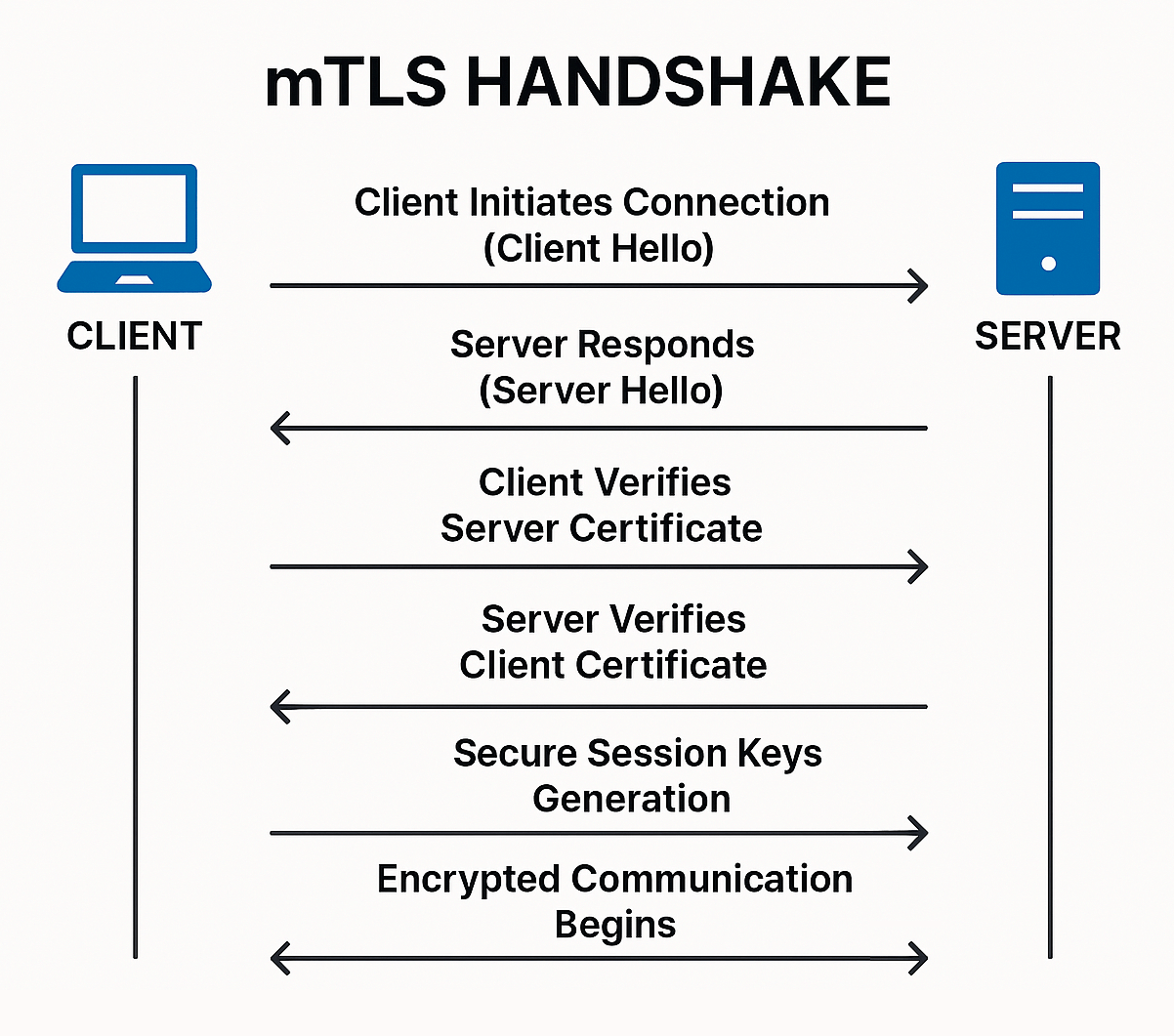
Securely Expose your Homelab Services with Mutual TLS
To build from first principles, let's watch a clear explanation of what mTLS is and the cryptographic concepts behind it.
Please watch these sections from the video by apalrd's adventures: (00:36 - 01:44): Get a high-level overview of mTLS as a stronger alternative to username/password or VPNs for client authentication. (03:32 - 06:53): This is a great refresher on the three types of cryptography in TLS that make mTLS possible: symmetric encryption for data, Diffie-Hellman for key exchange, and public-key cryptography for authentication. (06:53 - 08:08): This part is key. It explains how client certificates work, how they are signed by a Certificate Authority (CA), and how a server can be configured to trust that CA.
Architecting mTLS for Edge-to-Origin
To implement mTLS, we treat our edge proxy as the "client" and the customer's origin as the "server".
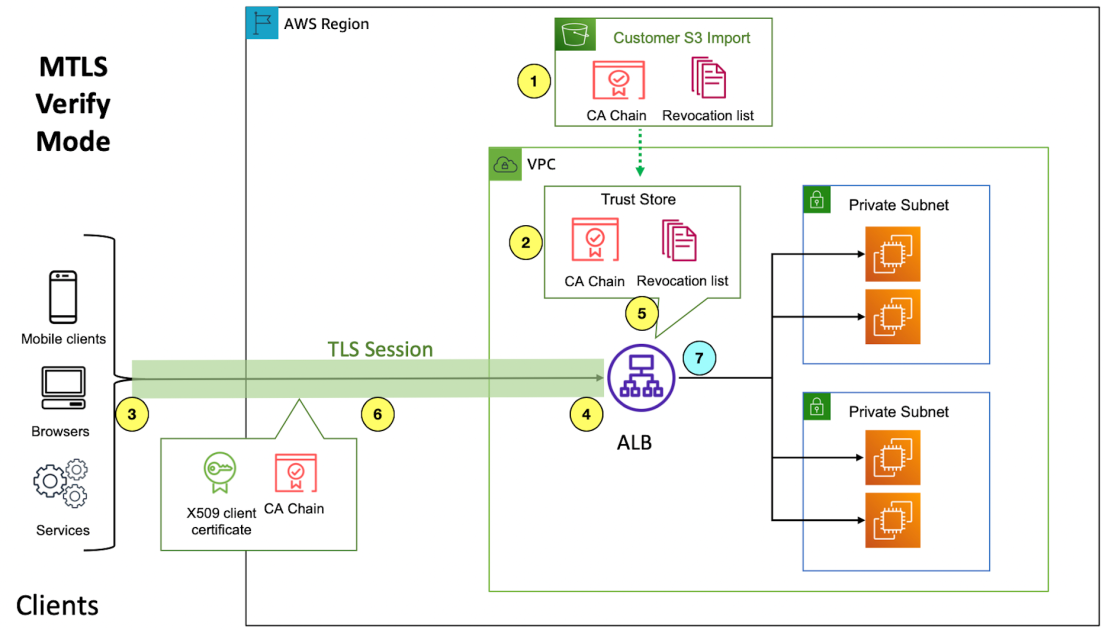
Here's the architectural breakdown:
- Edge Proxy (Client): Each request forwarded from our edge proxy to an origin will present a client certificate. This certificate is issued by a private Certificate Authority (CA) that we, the edge provider, operate. The private key for this certificate is securely stored at the edge and is used to sign the TLS handshake.
- Origin Server (Server): The customer's origin server (or load balancer) is configured to require and verify a client certificate for all incoming connections.
- Trust Store: The customer configures their server's trust store to trust our specific edge provider CA. When our proxy presents its client certificate, the origin server can verify that it was signed by our trusted CA. If a connection attempt is made without a valid client certificate (e.g., from an attacker who found the IP), the TLS handshake fails, and the connection is dropped.
This creates a strong, cryptographically-enforced perimeter around the origin. This practice is often called Authenticated Origin Pulls. As noted in the BreakingWAF article, this is a recommended best practice by providers like Cloudflare, but its implementation is often neglected by customers, leading to the vulnerabilities found in the research.
A final, but important, design consideration is certificate revocation. If a client certificate's private key is ever compromised, you need a way to invalidate it. Common mechanisms include Certificate Revocation Lists (CRLs) and the Online Certificate Status Protocol (OCSP). Designing a scalable revocation system is complex, but it's a necessary component of a robust PKI.
3. Performance and Resilience: Connection Pooling
We have now established a secure, authenticated channel between the edge and the origin. However, performing a full mTLS handshake for every single HTTP request would be computationally expensive and introduce significant latency.
To solve this, our edge proxy will use connection pooling.
Microsoft Azure Front Door Part 1: Architecture and Core Concepts
Let's read about how a real-world edge platform, Azure Front Door, implements this.
Please read these two sections from the in-depth article on Azure Front Door: 'Backend Request Forwarding' > 'Connection Establishment and Pooling': This section explains how the edge maintains and reuses TCP connections to backends, avoiding repeated handshakes. 'Layer 4: Transport Layer Implementation' > 'Connection Multiplexing to Backends': This provides more detail on the benefits and mechanics of reusing connections across multiple client requests.
As the article explains, our edge proxy architecture should maintain a "warm" pool of open, persistent TCP connections to each customer origin. When a new HTTP request needs to be sent to the origin:
- The proxy checks the pool for an available, idle connection.
- If one exists, it sends the HTTP request over this already-established connection.
- If one does not exist, it establishes a new connection (performing the mTLS handshake), uses it for the current request, and then places it back into the pool for future reuse.
This design dramatically reduces latency and CPU load on both our proxy and the customer's origin server by amortizing the cost of the mTLS handshake over many requests.
Case Study: TLS Session Resumption and its Pitfalls
Another related optimization is TLS session resumption, which allows a client and server to quickly resume a prior session using a shared secret, bypassing the most expensive parts of the handshake.
The Cloudflare mTLS vulnerability - A Deep Dive Analysis
For a deep-dive on this, let's look at a fascinating analysis of a real-world vulnerability in Cloudflare's mTLS implementation that was caused by an issue in their session resumption logic. This is a perfect case study for understanding internals.
Please watch these sections from the video by Hussein Nasser: Session Resumption (24:07 - 34:51): This is a fantastic, first-principles explanation of how TLS session resumption works, covering both stateless (session tickets) and stateful (session ID) approaches. Pay attention to the concept of the encrypted session ticket. How the Bug Worked (34:51 - 37:10): This is the critical part. Understand how a separate code path for resumed sessions missed the logic to check the client certificate, effectively creating a bypass for the mTLS authentication. The Fix (37:10 - 40:48): Note the immediate fix (disabling session resumption for mTLS) and the longer-term architectural fix.
This case study is a powerful lesson for any system architect:
- Optimizations Can Create Security Holes: The drive for performance (session resumption) led to a subtle but critical security flaw.
- Code Path Complexity is Risky: The vulnerability existed because there were two different code paths for handling new connections vs. resumed connections. The logic was not applied consistently to both.
- Fail-Safe Design: When the vulnerability was discovered, the immediate reaction was to disable the optimization (fail-safe) to restore security, even at a temporary performance cost.
When designing our connection management system, we must ensure that all security checks, especially mTLS validation, are performed consistently, regardless of whether a connection is new, reused from a pool, or re-established via session resumption.
Conclusion
In this lesson, we have designed a robust, multi-layered security architecture for the critical edge-to-origin communication path.
Key Takeaways:
- Layered Defense: Securing the "middle mile" is not about a single solution but a defense-in-depth strategy:
- Concealment: Use DNS and reverse proxying to hide the origin's IP address.
- Authentication: Use Mutual TLS to ensure the origin only accepts traffic from your trusted edge network.
- Optimization: Use connection pooling and carefully implemented session resumption to achieve high performance without compromising security.
- The Origin is the Inner Sanctum: The ultimate goal is to make the origin server completely inaccessible from the public internet. The only entry point should be through the secure, authenticated channel from the edge proxies.
- Implementation Details Matter: As the Cloudflare vulnerability demonstrates, even with a sound high-level design, a small flaw in the implementation of an optimization can undermine the entire security model. Rigorous testing of all code paths is essential.
In our last few lessons, we've focused on how traffic gets to the edge and how we secure the path from the edge to the origin. In our next lesson, we'll zoom out and look at the global traffic management strategy itself.
In the next lesson, we will Compare DNS-based vs. anycast-based traffic steering for routing requests to the nearest edge PoP. We'll analyze the two primary methods for directing users to the optimal edge location in a global network.