Hello! In our last lesson, we finalized your pre-publishing quality assurance checklist, ensuring every single book you produce is professional, polished, and ready for the marketplace. That process is the final step for launching a single product. Today, we shift our focus from a single product to a sustainable business model.
This lesson is about long-term strategy. Your goal is to earn passive revenue, and while a single successful book can generate income, a book series is what creates a reliable, scalable engine for that income. We will explore how to outline a content strategy for a potential book series to encourage repeat purchases, turning one-time buyers into loyal readers who eagerly await your next release.
Think of it this way: launching one book is like deploying a single, useful software application. Building a series is like creating a product suite. The components work together, creating a "sticky" ecosystem that keeps users engaged and invested in your brand.
1. The Power of a Series: The "Serial-Author Strategy"
Publishing a book on Amazon is not a guarantee of sales. As you've seen from your own experience, getting noticed is a major challenge. A book series is a powerful solution to this problem because it creates a compounding effect.
To understand the business case for writing a series, let's start with an article that introduces this concept.
Writing a nonfiction book series and executing the Serial ...
The article 'Writing a nonfiction book series' from Grammar Factory explains what the author calls the 'Serial-Author Strategy.' It's a long-term approach focused on building a portfolio of related books that grows in value over time. This is the foundation of our lesson today.
Please read the introduction and the section titled 'The compound effect of the serial-author strategy.' Focus on why a series is more effective for building an author business than writing standalone books, especially for a new author.
As the article explains, when a reader enjoys a book, they are highly likely to seek out more books by the same author on related topics. This creates a few key advantages:
- Increased Reader Lifetime Value: A reader who buys one book is a customer. A reader who buys five books in your series is a loyal fan.
- Marketing Efficiency: Every dollar and minute you spend marketing one book in your series indirectly promotes all the others. The Amazon algorithm also favors authors with a larger "backlist," and series pages make it easy for readers to buy the next book.
- Building Authority: A series establishes you as an expert in your niche. A single book makes you an author; a series makes you an authority.
2. Structuring Your Book Series: Three Proven Models
A successful series isn't just a random collection of books. It needs a coherent strategy. The Grammar Factory article you just read outlines three excellent models for non-fiction. Let's explore them in the context of your specific interests.
Writing a nonfiction book series and executing the Serial ...
Let's return to the Grammar Factory article to learn about three distinct strategies for structuring a non-fiction series. Think about how these could apply to your book ideas in business, tech, and mentoring.
Read the section '3 ways to approach the serial-author strategy,' which covers the 'deep-dive,' 'ideal-reader,' and 'reader-segment' series types. Pay attention to the examples provided for each.
Let's break down how you can apply these models:
a) The Deep-Dive Series
You start with a broad, foundational book and then publish shorter, more focused books on specific topics from the original.
- Your Application: You could write a foundational book titled The Startup Operator's Manual.
- Book 1: The Startup Operator's Manual: From Idea to First Revenue (The broad overview).
- Deep-Dive 2: Venture Capital Demystified: A Founder's Guide to Securing Funding.
- Deep-Dive 3: Building Your MVP: A Lean Approach for Tech Startups.
b) The Ideal-Reader Series
You focus on a single type of person (your "ideal reader") and write a series of books that solve their problems sequentially as they move through a journey.
- Your Application: Target a junior IT professional looking for career growth.
- Book 1: The First 90 Days: Thriving in Your First Tech Job.
- Book 2: Beyond the Code: How to Get Your First Promotion.
- Book 3: From Senior Dev to Tech Lead: A Practical Guide to Leadership.
c) The Reader-Segment Series
You write one core book with a central methodology, then adapt and republish it for different, specific audiences ("segments"). This is incredibly efficient, especially with AI.
- Your Application: You create a core methodology in a book called Passive Income with AI.
- Book 1: Passive Income with AI: The Universal Framework.
- Segment 2: AI for Authors: A Guide to Writing and Publishing with Artificial Intelligence.
- Segment 3: AI for Dropshippers: Automating Your E-commerce Business.
Test your understanding!
You've written a successful book titled "Introduction to Digital Marketing." Using the strategies we've discussed, propose one idea for a "Deep-Dive" series book and one for a "Reader-Segment" series book that could follow.
Show answer
- Deep-Dive Idea: A book that takes one chapter from your original book, like "Email Marketing," and expands it into a full guide. For example: The Ultimate Guide to Email Marketing Automation.
- Reader-Segment Idea: A book that adapts your core digital marketing principles for a specific profession. For example: Digital Marketing for Real Estate Agents.
3. Strategies for Fiction and Children's Book Series
The models above work best for non-fiction. For your interests in children's books and comics, the series structure is typically narrative-driven.
- Episodic Series (Ideal for Children's Books): Features the same cast of characters in a series of self-contained adventures. The goal is to create lovable, consistent characters that kids and parents want to revisit. Think of each book as a new episode of a TV show. Your AI prompting skills for character consistency will be crucial here.
- Sequential Saga (Ideal for Comics/Narrative Fiction): Tells one long story over multiple volumes. Each book builds on the last and often ends with a hook or cliffhanger that compels the reader to find out what happens next. This requires planning the entire story arc in advance.
4. Creating Your Content Strategy: A Practical Plan
Now, let's turn these ideas into a concrete content strategy. A good plan involves mapping your topics, creating consistent branding, and building an audience.
Three Smart Strategies for Your Nonfiction Book Series
The article 'Three Smart Strategies for Your Nonfiction Book Series' from Clear Sight Books provides a great framework for planning your series.
Please read the sections 'Strategy 1: Map Out Your Topics,' 'Strategy 2: Create Consistent Branding,' 'Strategy 3: Decide on Your Release Timing,' and 'One Final Benefit of a Book Series.' This will give you a clear, actionable process.
Here is your step-by-step process for outlining your series strategy:
Step 1: Choose Your Series Model and Map Your Topics
- Decide which model fits your idea best: Deep-Dive, Ideal-Reader, Reader-Segment, Episodic, or Sequential.
- Use AI to brainstorm the first 3-5 book titles in your potential series.
AI Prompt Template for Brainstorming a Series:
Act as a bestselling author and publishing strategist. I want to create an [Ideal-Reader/Deep-Dive/Reader-Segment] book series based on my foundational book titled "[Your Book Title]." My target audience is [Your Target Audience].Brainstorm a list of 5 potential book titles for this series. For each title, provide a one-sentence hook that explains its core promise. Ensure the titles feel like they belong to a cohesive series.
Step 2: Plan for Consistent Branding
As the article mentions, consistent branding is what signals to a reader that your books are connected. This includes:
- Titles: A common element (e.g., "...for Dummies," "The Goldfish Series").
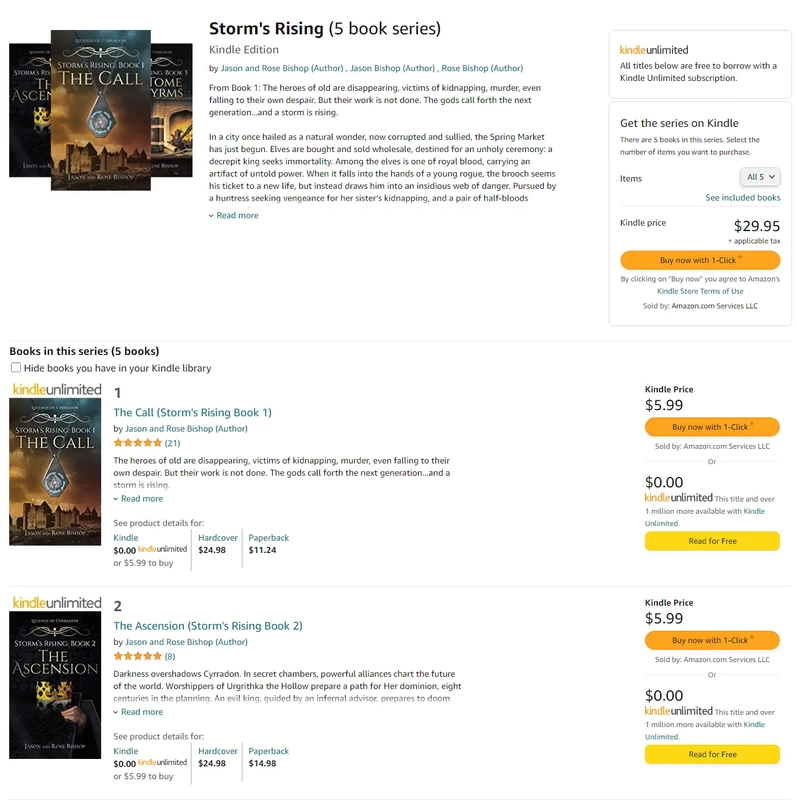
- Cover Design: Using similar fonts, layouts, and color schemes across all books in the series. This creates a visually appealing and recognizable "shelf" on your Amazon author page.
Look at how Amazon presents a well-branded series. It's clean, professional, and makes it incredibly easy for a reader to click "buy" on the next book.
Step 3: Build Your Audience
A series is only successful if you have an audience to sell it to. Simply publishing books and hoping for sales—the "publish and pray" method—is not a strategy. You need to actively build a community.
These two videos explain the essential, long-term work of audience building.
the truth about Selling Books on Amazon KDP as a Beginner
First, let's watch a clip from Maritza M. that powerfully argues why building a brand and an audience is more important than just creating a product.
Watch the sections from 02:48 to 03:58, 06:13 to 07:37, and 08:44 to 09:15. Focus on her core message: build a brand around your passion and use free social media platforms to connect with an audience before you expect significant sales.
Book Marketing Strategies to SELL MORE BOOKS on Amazon KDP
Now, let's look at a specific tactic for audience building mentioned by Rachel Harrison-Sund. This is one of the most powerful strategies for long-term series success.
Watch the segment from 01:57 to 03:15. Pay close attention to her explanation of why building an email list is a crucial long-term strategy for promoting future books and getting initial reviews.
The key takeaway is this: your content strategy isn't just about the books themselves. It's about the platform you build around them. This includes:
- An Email List: The only direct line of communication you have with your readers that isn't controlled by a platform like Amazon.
- Social Media Presence: Creating content on platforms like YouTube, TikTok, or a blog that is relevant to your book's niche. This attracts your ideal readers and builds a community.
Conclusion
Today we've shifted from the mechanics of producing a single book to the strategic thinking required to build an author business. A book series is your most powerful tool for generating sustainable passive income. It turns a one-time transaction into a long-term reader relationship.
Key Takeaways:
- A book series turns marketing for one book into marketing for all your books, creating a compounding effect on sales and discoverability.
- Choose a clear series strategy for your chosen genre: Deep-Dive, Ideal-Reader, or Reader-Segment for non-fiction; Episodic or Sequential for fiction.
- Your content strategy must include consistent branding (titles, covers) to make your series easily recognizable.
- A series thrives on an engaged audience. Building an email list and a social media presence is not optional; it's a core part of the strategy.
Preview of the Next Lesson:
We've just highlighted the critical importance of building an email list to promote your series. But how do you get readers to sign up? In our next lesson, we will design a simple lead magnet (e.g., a bonus chapter, checklist) to include in your book's back matter—the perfect bait to grow your audience.