Recommended resources
The freely available resources this lesson will direct you to.
- Attachment Theory Explained (Psychology)www.youtube.com
- John Bowlby, Attachment Theory and Psychotherapy – Professor Jeremy Holmeswww.youtube.com
- Frontiers | The Neurobiology of Infant Attachment-Trauma and Disruption of Parent–Infant Interactionswww.frontiersin.org
- Infant-parent attachment: Definition, types, antecedents, measurement and outcomepmc.ncbi.nlm.nih.gov
Good to begin the final module by separating a common parenting idea from the scientific construct. Attachment is not simply love, closeness, feeding, or time spent together. In Bowlby’s framework, it is an evolved safety-and-regulation system: when an infant feels threatened, tired, ill, frightened, or separated from a familiar caregiver, the infant is motivated to restore proximity and comfort.
In the previous module, we saw how repeated routines teach an infant what to expect. Attachment applies that learning principle to a particularly important domain: What happens when I am distressed, and this caregiver is the person available to me? Over hundreds of ordinary interactions, an infant learns whether a particular caregiver is likely to be a reliable source of comfort and a secure base for exploration.
This lesson explains Bowlby’s theory, Mary Ainsworth’s Strange Situation experiment, and the developing biology of stress regulation and co-regulation. Your son is eight months old, slightly younger than the usual age for the Strange Situation assessment, but this is a period when stranger wariness, separation protest, and caregiver-specific expectations often become increasingly visible.
Attachment: a safety system, not a parenting scorecard
Bowlby developed attachment theory by combining clinical observation with evolutionary biology and ethology, the study of behavior in natural settings. His central claim was that human infants, who are highly dependent for an unusually long time, possess an inborn attachment behavioral system.
When safety is uncertain, this system promotes proximity-seeking behavior: crying, reaching, crawling toward a caregiver, clinging, calling, or protesting separation. Proximity improves the infant’s chances of protection and, crucially, helps regulate an emotional state that the infant cannot yet regulate alone.
When safety is restored, a complementary exploratory system can operate more freely. The child can look around, play, investigate a toy, or approach a new situation. This gives us two classic attachment terms:
- A caregiver is a safe haven when the child turns to them for comfort under stress.
- A caregiver is a secure base when the child can explore because that person is available if needed.
The key is not that a securely attached infant never cries during separation. In fact, protesting a separation can be entirely normal. The more informative question is what happens at reunion: Can the infant use the caregiver’s return to recover sufficiently and eventually re-engage with the environment?
Infant-parent attachment: Definition, types, antecedents, measurement and outcome
Read this clinical overview to establish a precise definition of attachment and to see how attachment patterns are measured. It is especially useful for avoiding the common mistake of equating attachment with feeding, play, or a single early “bonding” moment.
Start with the “Definition” section. Read the definition and secure-base idea, including the following discussion distinguishing attachment from “bonding.” Then, in “Types of attachment and their antecedents,” read from caregiver-specific expectations through the descriptions and Table 1. Finally, in “Measurement,” read the Strange Situation overview, then continue through the discussion of disorganization. Focus on reunion behavior, rather than treating separation distress by itself as a classification.
Attachment is relationship-specific
An infant can form attachments to more than one regular caregiver. Bowlby’s early concept of monotropy, the idea that there is one uniquely primary attachment figure, has been substantially revised. A child may have an attachment relationship with a mother, father, grandparent, or other consistent caregiver, and the quality can differ across those relationships.
This matters practically. Your son is not merely learning “whether adults are safe” in a general sense. He is learning, in part, what you tend to do when he is uncomfortable, frustrated, frightened, or exhausted. Regular caregiving, comforting, playful interaction, and repair after mismatches all contribute to that specific relationship.
There is also an important distinction between having an attachment and the quality of that attachment. Children generally form an attachment relationship with regular caregivers even when care is imperfect or, in severe circumstances, harmful. Attachment is therefore not a prize that a parent earns by behaving perfectly. The scientific question is how reliably and safely the relationship helps the child manage distress and return to exploration.
Bowlby’s learning model: from repeated care to expectations
Bowlby proposed that children gradually develop internal working models: practical expectations about themselves, caregivers, and relationships. These are not conscious beliefs such as, “My father is responsive 82% of the time.” They are developing predictions embedded in attention, emotion, behavior, and physiology.
For example, if an infant is repeatedly frightened or upset and is usually met with calm, appropriately responsive care, the infant has many opportunities to learn:
- distress can be communicated;
- a familiar person may help make the situation manageable;
- comfort is possible;
- after recovery, exploration can resume.
This is not a guarantee that the child will always be calm, independent, or cheerful. Temperament, hunger, illness, sleep, novelty, and developmental stage still matter greatly. Attachment theory concerns patterns across many interactions, especially interactions involving stress or uncertainty.
A useful way to represent the attachment cycle is:
| Situation | Infant’s likely task | Caregiver’s role |
|---|---|---|
| A familiar, safe setting | Explore, play, attend, learn | Be available without intruding |
| Threat, pain, fatigue, illness, or separation | Seek safety and regulation | Notice, interpret, comfort, protect |
| Reunion or successful comfort | Recover and reorganize | Help the child settle, then permit return to exploration |
The caregiver does not need to prevent every disappointment. In fact, ordinary short frustrations are part of life. What matters is a broadly reliable pattern in which distress is understandable, safety is restored when needed, and the child is not repeatedly left alone with overwhelming fear.
John Bowlby, Attachment Theory and Psychotherapy – Professor Jeremy Holmes
Watch selected parts of Professor Jeremy Holmes’s “John Bowlby, Attachment Theory and Psychotherapy” from The Weekend University. This lecture gives a useful conceptual bridge from Bowlby’s evolutionary account to Ainsworth’s observational research and to modern ideas of emotional co-regulation.
Begin with attachment as protection, which explains why threat and separation activate proximity seeking and why comfort involves shared regulation. Next watch biobehavioral synchrony for the link between coordinated caregiver–infant interaction and emerging self-regulation. Finish with the Strange Situation. Focus on the sequence of disruption, reunion, and return to exploration; treat claims about later outcomes as probabilistic developmental associations, not destiny.
Ainsworth’s Strange Situation: making attachment observable
Mary Ainsworth transformed Bowlby’s broad theory into a carefully structured observational method: the Strange Situation Procedure. It was designed for infants typically aged about 12 to 20 months, when mobility, exploration, wariness of unfamiliar people, and separation responses can be observed clearly.
The procedure lasts roughly 20 minutes and involves a series of brief episodes in an unfamiliar room with toys. In the standard design:
- The caregiver and infant enter the unfamiliar room.
- The infant has an opportunity to explore while the caregiver is present.
- A stranger enters and interacts.
- The caregiver briefly leaves, initially leaving the infant with the stranger.
- The caregiver returns for a reunion.
- A second brief separation occurs, including a period when the infant is alone.
- The stranger returns.
- The caregiver returns for a second reunion.
The separations create manageable stress in a standardized way. The experimenters then code behavior, especially during reunions: approach, contact-seeking, avoidance, resistance, ability to be soothed, and return to play.
The attachment patterns
Ainsworth originally described three organized patterns: secure, avoidant, and resistant. Mary Main and Judith Solomon later developed criteria for disorganized attachment. “Organized” here does not mean “healthy” or “well behaved.” It means that the child’s response shows a relatively consistent strategy for dealing with distress in that caregiver’s presence.
| Pattern | Typical Strange Situation behavior, especially at reunion | Interpretation of the strategy |
|---|---|---|
| Secure | The child may protest separation, seeks or accepts contact on reunion, becomes sufficiently comforted, and can eventually return to play. | The caregiver is usable as a safe haven and secure base. |
| Insecure-avoidant | The child shows little approach or may turn away from the returning caregiver, appearing focused on toys or emotionally restrained. | The child appears to minimize overt attachment behavior. Apparent calm does not necessarily mean low physiological stress. |
| Insecure-resistant or ambivalent | The child may be highly distressed, seek contact but also resist it, remain angry or difficult to soothe, and struggle to return to play. | The child appears to maximize attachment signals while finding comfort uncertain or incomplete. |
| Disorganized | The child shows contradictory, confused, frozen, misdirected, or fearful behavior, particularly in the caregiver’s presence. | The child lacks a coherent strategy for resolving distress in that moment. This pattern warrants careful professional interpretation, never casual labeling. |
Two cautions are essential.
First, these are research classifications, not personality types. A child cannot be reliably classified because they cried at daycare, wanted to be held by one parent, enjoyed independent play, or had a difficult evening during teething.
Second, the Strange Situation is not a home experiment. Brief separations in everyday life are normal, but deliberately reproducing a stressful laboratory protocol would not tell you whether your child is securely attached. Researchers use standardized procedures, trained coders, and the whole pattern of behavior across episodes.
At eight months, your son may begin to show stranger anxiety or separation protest. Those reactions are developmentally expected and do not by themselves signal insecurity. The Strange Situation was intentionally designed for older infants, when the full exploration–separation–reunion sequence can be interpreted more reliably.
What caregiving contributes—and what it does not explain alone
Ainsworth’s naturalistic observations and later research linked sensitive responsiveness with secure attachment. Sensitivity means noticing an infant’s cues, interpreting them reasonably well, and responding in a prompt and appropriate way. It does not mean granting every preference immediately, preventing all crying, or being emotionally perfect.
Broadly, the classic associations are:
- sensitive, dependable responses to distress are associated with secure patterns;
- consistently rejecting or dismissive responses are associated with avoidant strategies;
- inconsistent or unpredictable responses are associated with resistant strategies;
- frightening, frightened, or highly atypical caregiver behavior is one important risk context for disorganization.
These are probabilistic associations, not a simple formula that assigns blame to parents. A child’s temperament, medical needs, sleep, family stress, culture, social support, and the behavior of other caregivers all matter. Moreover, parent and child influence each other over time. A difficult-to-soothe infant may receive more intense parental intervention, while parental stress may in turn affect the interaction.
The practical standard is therefore not “Never miss a cue.” It is closer to:
Be reliably available, respond warmly when safety or distress is involved, and repair the interaction when you misread the situation.
A repair can be very ordinary: you first assume hunger, then realize your son is overstimulated; you reduce stimulation, hold him quietly, and he settles. The original guess was wrong, but the interaction still taught something useful: his signals were noticed, and a caregiver stayed engaged until the need became clearer.
Neurobiology: how a caregiver helps regulate an immature brain
Ainsworth measured behavior, not brain activity or hormones. Later developmental neuroscience has tried to explain why caregiver presence can have such strong effects during stress.
At eight months, your son’s systems for regulating arousal are developing rapidly, but they are far from adult-like. He relies substantially on co-regulation: another person helps bring an activated nervous system back toward a manageable state through voice, facial expression, holding, movement, feeding when appropriate, predictable routines, and protection from threat.
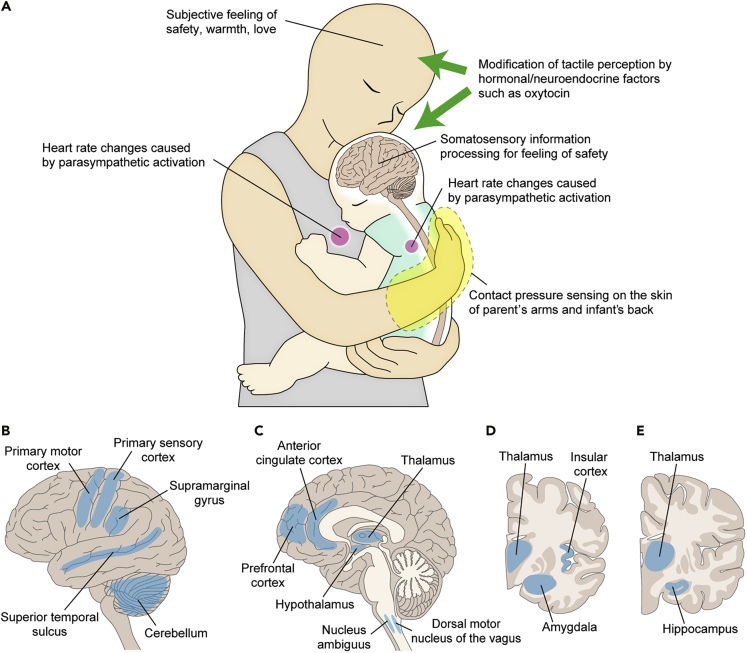
The diagram is useful as a systems-level picture, but it should not be read as a single proven pathway that works identically in every parent–infant interaction. Its main lesson is that attachment is embodied: touch, warmth, smell, voice, heart-rate changes, attention, and emotion are biologically relevant signals.
Social buffering
One central mechanism is social buffering: the presence of a trusted caregiver can reduce a child’s stress response to threat.
The stress system commonly discussed here is the HPA axis, involving the hypothalamus, pituitary gland, and adrenal glands. Under threat, this system contributes to release of stress hormones. In humans, the principal hormone is cortisol; in rodent research, the comparable hormone is corticosterone, often abbreviated CORT.
Caregiver presence can influence this system. When a young child encounters something uncertain or frightening but has access to a familiar, responsive caregiver, the child may show less physiological stress than if left to face it alone. This does not mean a parent must eliminate every stress response. It means the caregiver can help keep stress within a range that the child can recover from.
Read these selected passages from a Frontiers in Behavioral Neuroscience review for the evolutionary logic of attachment and the evidence behind “social buffering.” The article focuses heavily on trauma and rodent models, so use it to understand mechanisms and limits, not to interpret ordinary parenting mishaps as traumatic.
In the early discussion of attachment learning, begin where attachment as learned and relationship based. Then go to the subsection “Parental Reduction of Threat-Induced Stress Increase (I.E., Social Buffering) Is Reduced in Infants With Adversity-Rearing.” Read from the definition of social buffering, then continue through the subsection and its Figure 3. Focus on the distinction between causal rodent experiments and the more limited inferences available in human developmental studies.
Amygdala, stress hormones, and caregiver presence
The amygdala is involved in detecting and learning about emotionally significant events, particularly potential threat. In animal studies, researchers can manipulate hormones and neural circuits in ways that are not possible in human infant research. This makes such studies valuable for causal mechanism, while also requiring caution when generalizing to a human baby.
The Frontiers review describes rodent evidence that, at particular developmental stages:
- stress-hormone levels help determine whether threat engages amygdala-based fear learning;
- maternal presence can reduce the pup’s stress-hormone response;
- this reduction can suppress amygdala-dependent fear learning during a limited developmental window.
This is powerful evidence that social context can alter developing brain function. But it does not mean that an adult human caregiver literally switches an infant’s amygdala off, nor that every brief stressful event causes damage unless a parent is physically present.
Human research does support the broader claim that trusted caregivers can buffer stress, and that this buffering is relevant to attachment quality and anxiety. Yet human development is influenced by many interacting factors, and the size of the buffering effect depends on the child’s age, relationship history, context, and type of threat.
Oxytocin and synchrony: important, but not “the love hormone”
Oxytocin is often described in popular media as “the love hormone.” That phrase is too simple. Oxytocin participates in childbirth, lactation, touch, social attention, and affiliative behavior, but its effects depend strongly on context and on the individual. A single oxytocin level cannot diagnose a healthy relationship, and no supplement or one-time skin-to-skin event creates secure attachment by itself.
A more useful concept is biobehavioral synchrony: repeated coordination between caregiver and infant in gaze, vocal timing, touch, movement, and arousal. For instance, a father might notice that his son is shifting from curious fussing to overload, soften his voice, reduce stimulation, pick him up, wait for his breathing and body tension to settle, and then reintroduce play at a slower pace.
Over time, these interactions may support the gradual development of self-regulation. At first, regulation is largely shared; the infant repeatedly experiences a caregiver helping organize distress. Later, the child increasingly uses learned expectations and developing brain systems to regulate more independently.
What this means for your relationship with your son now
At eight months, attachment is being built in ordinary moments, not through a special test or a flawless technique. Three implications follow directly from the science.
1. Treat distress as communication before treating it as behavior
When your son cries, clings, becomes wary of a new person, or protests your leaving the room, begin with a needs-based interpretation:
- Is he tired, hungry, uncomfortable, ill, overstimulated, or frightened?
- Is this a normal protest at a transition?
- Does he need protection, calming contact, or simply a quieter environment?
This does not require you to respond identically every time. It means that when attachment needs are activated, you aim to be understandable and reassuring rather than dismissive or punitive.
2. Support exploration without forcing independence
A secure base does not mean constantly entertaining or hovering. It means being predictably available. If your son is safely exploring nearby, you can let him investigate. If he periodically looks back, reaches up, or seeks contact, responding briefly and warmly may help him return to exploration.
The pattern is not dependence versus independence. In Bowlby’s model, dependable proximity and exploration are complementary systems.
3. Build your own caregiver-specific relationship
Your partner may soothe your son in one way, while you develop a somewhat different but equally reliable style. You might use calm holding, a familiar phrase, a short walk, a song, or quiet playful distraction after he has begun to settle. What matters most is not copying another caregiver exactly; it is becoming predictable, emotionally available, and safe in your own interactions with him.
If you ever have persistent worries about your son’s development, unusually intense fear, feeding, sleep, or caregiving stress, a pediatrician or qualified infant mental-health professional is a better source of assessment than attachment-style content online. Attachment patterns require careful interpretation in context.
Key takeaways
Bowlby viewed attachment as an evolved behavioral system that keeps a vulnerable infant close to caregivers under threat. A caregiver functions as a safe haven during distress and a secure base that supports exploration once safety is restored.
Ainsworth’s Strange Situation made attachment patterns observable through brief separations and reunions in an unfamiliar setting. Its central evidence comes from reunion behavior, not simply whether a child cries during separation. Secure, avoidant, resistant, and disorganized patterns are research descriptions of relationship-specific strategies, not permanent personality labels or parenting verdicts.
Neurobiologically, caregiver presence can support co-regulation and social buffering, influencing physiological stress responses and, in animal research, developmental amygdala-based fear learning. Touch, voice, attention, predictable care, and repeated repair all help make safety biologically and behaviorally meaningful.
The next lesson examines the HPA axis more directly: how stress hormones are regulated in infancy, why prolonged or severe stress can be disruptive, and why supportive caregiving can buffer rather than erase a child’s normal stress responses.