Recommended resources
The freely available resources this lesson will direct you to.
- InBrief: The Impact of Early Adversity on Children's Developmentwww.youtube.com
- How childhood trauma affects health across a lifetime | Nadine Burke Harris | TEDwww.youtube.com
- [PDF] Transforming How We Think About the Body's Response to Stress in ...developingchild.harvard.edu
- Annual Research Review: Early adversity, the HPA axis, and child psychopathology - PMCpmc.ncbi.nlm.nih.gov
Welcome back. In the last lesson, we examined how attachment provides an infant with a safe haven during distress and a secure base for exploration. We also introduced co-regulation: at eight months, your son still depends heavily on caregivers to help move from high arousal back toward calm.
This lesson makes that biology more precise. You will learn how the hypothalamic–pituitary–adrenal, or HPA, axis coordinates part of the stress response; why cortisol is useful rather than simply “bad”; and why severe, frequent, prolonged stress without reliable support can influence the developing architecture of the brain and body. The central scientific distinction is between a stress response that is activated and then restored and one that is repeatedly activated with too little opportunity for recovery.
The HPA axis: a hormonal system for meeting challenge
A stress response begins when the brain and body detect a challenge that may require extra resources. For an infant, that challenge might be physical, such as pain, illness, hunger, cold, or exhaustion. It can also be social or psychological: an unfamiliar environment, separation from a caregiver, intense conflict nearby, or a situation that feels unpredictable and overwhelming.
Not every response involves fear in the adult sense. The relevant issue is whether the infant’s developing systems register a demand that exceeds their current capacity to manage it alone.
The HPA axis is one major stress-regulation system. Its name identifies its three main components:
- The hypothalamus, a small brain region that integrates information about the body and environment.
- The pituitary gland, which sits just below the brain and releases hormones into the bloodstream.
- The adrenal cortex, the outer part of the adrenal glands above the kidneys, which releases cortisol.
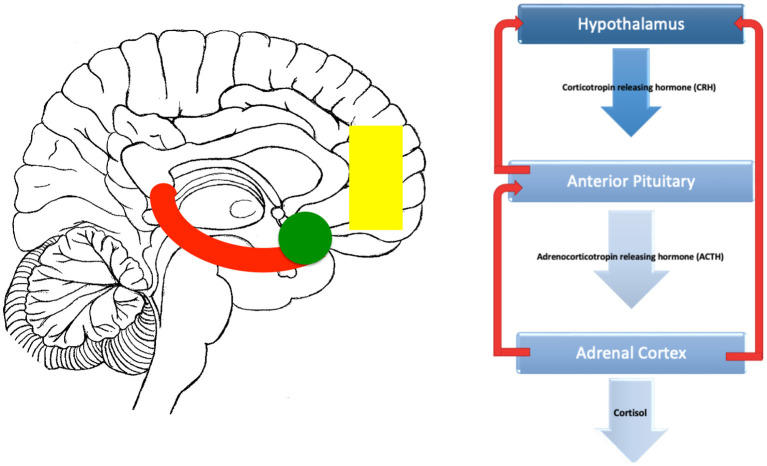
The cascade works through chemical signals:
- When the hypothalamus, particularly a region called the paraventricular nucleus or PVN, receives enough activating input, it releases corticotropin-releasing hormone (CRH). It also releases arginine vasopressin, which can amplify the signal.
- CRH travels through a specialized local blood-vessel system to the anterior pituitary.
- The pituitary releases adrenocorticotropic hormone (ACTH) into the general bloodstream.
- ACTH acts on the adrenal cortex, stimulating cortisol release.
- Cortisol circulates throughout the body and enters many cells, including cells in the brain.
The brain does not hand the hypothalamus a simple “danger” signal. The PVN receives information from multiple systems. Signals about the body’s internal condition arrive through brainstem pathways. Information about psychological or social challenge is processed through interacting networks that include the amygdala, prefrontal cortex, and hippocampus.
These regions have somewhat different roles:
- The amygdala helps identify emotionally significant and potentially threatening events.
- The hippocampus contributes context: where, when, and under what conditions something happened. It also helps modulate the overall tone of HPA activity.
- The prefrontal cortex, which matures slowly over childhood and adolescence, contributes to regulation, attention, planning, and interpretation of situations.
For an eight-month-old, these systems are highly active but immature. That is one reason caregiver presence, predictability, touch, voice, and protection from actual danger can influence stress physiology so strongly.
Annual Research Review: Early adversity, the HPA axis, and child psychopathology - PMC
Read this scientific review’s opening account of HPA physiology. It gives the full pathway from brain inputs, through CRH and ACTH, to cortisol, then explains why cortisol has broad effects throughout the body.
In the opening HPA-physiology discussion, begin with the paragraph that starts “The HPA axis, however, is one of the core stress systems” and read the core mechanism. Focus especially on the PVN, the CRH–ACTH–cortisol sequence, and the distinction between mineralocorticoid and glucocorticoid receptors. The final paragraphs explain why cortisol can alter gene transcription over minutes to hours rather than functioning merely as an instant alarm signal.
Cortisol is not a toxin
Cortisol has acquired a bad public reputation, but it is essential for normal life. It is a steroid hormone with receptors throughout the body. During challenge, it helps mobilize longer-term energy resources, modulates immune activity, and influences attention and learning about important events.
A simplified formulation is:
Cortisol helps make a demanding event biologically meaningful. If a child encounters a genuinely unsafe or painful situation, it would be maladaptive for the brain to treat it as irrelevant. The problem is not the existence of cortisol, or even a temporary high level. The problem is a stress system that is activated too strongly, too often, or for too long without sufficient recovery and support.
The HPA axis also has a built-in brake: negative feedback. As cortisol rises, it binds to receptors in the pituitary and hypothalamus and tends to suppress further activity of the axis. In a well-regulated response, cortisol eventually moves back toward its baseline level.
Negative feedback is not an instant off-switch. If a threat is severe or continues, activating inputs to the hypothalamus can temporarily override the brake. That is useful in a sustained emergency. It becomes costly when the body is repeatedly required to operate as though an emergency is ongoing.
Two systems, different tempos: HPA and fight-or-flight
The HPA axis is often described loosely as “the fight-or-flight system,” but that is incomplete. The body coordinates several interacting stress systems.
The fastest bodily changes in an acute challenge are often associated with the sympathetic-adrenomedullary system, or SAM system. This system helps release adrenaline, also called epinephrine, and contributes to rapid changes such as increased heart rate, alertness, blood flow to muscles, and availability of energy.
The HPA axis has overlapping but different functions. Its cortisol-mediated effects include slower changes in metabolism, immunity, and gene expression. These systems influence each other, but they do not always rise and fall in perfect synchrony.
This matters when interpreting a baby’s behavior. A suddenly startled infant may cry, stiffen, breathe faster, or cling. Those immediate changes do not prove that cortisol is high, nor does a calm-looking infant necessarily have no physiological stress. In attachment research, for example, some infants display restrained outward distress while still showing stress-related physiological activation.
A single cortisol measurement is also not a verdict on a child’s well-being. Cortisol normally varies across the day, varies with sleep and illness, and responds to the particular context. Researchers therefore look at patterns: baseline levels, daily rhythms, how cortisol changes in response to a challenge, and how efficiently it returns toward baseline.
From useful activation to allostatic overload
The body constantly regulates its internal state, a process called homeostasis. During challenge, it may need to move temporarily outside its usual resting range. This active adjustment is called allostasis.
For example, a brief rise in heart rate and alertness when an infant is startled is an allostatic adjustment. Once safety is restored, the system can settle again. This is not damage; it is normal physiology.
The cost emerges when adjustments become excessively frequent or prolonged. The cumulative “wear and tear” of repeated stress-system activation is called allostatic load or, in more severe cases, allostatic overload.
Developmental scientists often distinguish three broad situations:
| Type of stress response | Typical pattern | Developmental meaning |
|---|---|---|
| Positive stress | Mild to moderate, brief activation with support and recovery | A normal part of development |
| Tolerable stress | More serious but time-limited challenge, with protective adult support | Can be managed without necessarily disrupting development |
| Toxic stress response | Strong, frequent, or prolonged activation without adequate buffering support | Raises risk for disruption to developing systems |
“Toxic stress” does not mean that a child must never cry, become frustrated, protest a separation, or encounter novelty. Those ordinary experiences can be manageable, especially when a familiar adult helps the child recover.
Instead, the phrase refers to a pattern of physiological overload associated with severe adversity, especially when it is unpredictable, prolonged, difficult to control, and not buffered by reliable supportive relationships. Examples may include chronic neglect, violence, abuse, profound instability, or severe caregiver impairment without adequate alternate support.
InBrief: The Impact of Early Adversity on Children's Development
Watch the Center on the Developing Child at Harvard University’s short visual explanation, “InBrief: The Impact of Early Adversity on Children’s Development.” It illustrates how prolonged developmental stress can affect neural structure while also emphasizing that early support can change developmental pathways.
Watch brain architecture for the visual contrast between typical prefrontal neurons and neurons affected by prolonged developmental stress. Then watch plasticity and intervention. Treat its images as an illustration of risk and developmental plasticity, not as a literal diagnostic picture of any individual child’s brain.
How prolonged stress can shape brain architecture
Earlier in the course, you learned that early brain development involves rapid synapse formation, selective pruning, and myelination. These processes are not neutral construction work carried out in a vacuum. Developing circuits are continually shaped by signals about the environment.
A simplified developmental principle is:
The brain allocates resources toward the demands it repeatedly expects.
In a reliably safe and responsive environment, developing circuits repeatedly practice attention, exploration, social engagement, learning, and recovery after manageable distress. In a chronically threatening or chaotic environment, the brain may adapt toward rapid threat detection and defensive responding.
Such adaptations can be useful in the short term. A child who becomes highly alert to anger, unpredictability, or danger may be responding appropriately to their circumstances. Yet those adaptations can become costly when the child is later in a safer setting, because ambiguous events may still be interpreted as threatening.
The Harvard review summarizes several possible developmental consequences of a prolonged toxic stress response in the first years of life:
- Regions involved in fear, anxiety, and impulsive responding may develop an excess of certain neural connections.
- Regions more involved in reasoning, planning, and behavioral control may develop fewer connections.
- Circuits that activate and regulate the stress response may become more easily triggered or harder to turn off.
- Prolonged cortisol elevation can affect brain regions important for learning and memory, while also influencing immune, metabolic, and cardiovascular systems.
[PDF] Transforming How We Think About the Body's Response to Stress in ...
This Center on the Developing Child at Harvard University report connects HPA physiology to the developmental idea of allostasis: stress systems protect the child when activation is temporary, but repeated overload can alter brain and body systems. Read the selected passages for a careful account of this distinction.
In “React, Adapt, Restore: How the Stress Response Works” (p. 5), read cortisol's role. Then, on p. 7, read the passage beginning “Multiple developing systems” through allostatic overload. Next, in the “Influencing organ systems that affect lifelong physical and mental health” discussion on p. 13, read developing stress circuits. Finally, on p. 14, read the opening paragraph before “Shaping how the body manages energy,” especially whole-body effects. Focus on the report’s language of increased risk rather than inevitability.
“High cortisol” is not the only stress signature
A frequent oversimplification is that chronic adversity always produces permanently high cortisol. Research does not support such a simple rule.
In some children, particularly earlier in the course of chronic adversity, researchers observe elevated cortisol activity or heightened reactivity. In others, especially after prolonged exposure, cortisol patterns can become blunted: lower morning levels, a flatter daily rhythm, or reduced response to a laboratory stressor.
A blunted response should not automatically be interpreted as resilience or calm. It may represent a stress system adapting to persistent activation. Think of it less as a system becoming “stronger” and more as a control system changing its operating settings under sustained demand.
This variation is scientifically important for three reasons:
- Children differ. Temperament, genes, prenatal conditions, health, sleep, and the caregiving environment all contribute.
- Stressors differ. Threat, deprivation, family conflict, neglect, and unpredictability may affect development through overlapping but non-identical pathways.
- Timing matters. Prenatal life and early postnatal years appear particularly sensitive for HPA development, but the system remains plastic throughout life.
Research also investigates epigenetic mechanisms, including DNA methylation of genes involved in cortisol signaling. This is promising work, but it requires caution. Epigenetic findings from blood, saliva, or placental tissue do not automatically tell us exactly what happened in a child’s brain, and they do not amount to a fixed destiny.
The most defensible conclusion is not “early stress permanently damages the brain.” It is:
Severe, prolonged, poorly buffered adversity during periods of rapid development can increase the probability of enduring changes in stress regulation, learning, emotion, behavior, and physical health. Risk is real, but outcomes remain variable and development remains open to repair and support.
What this means for an eight-month-old
For your son, ordinary stress is unavoidable and often developmentally useful. He will experience frustration when a toy is out of reach, uncertainty around unfamiliar people, protest during a brief separation, tiredness before sleep, and disappointment when an activity ends. The goal is not to engineer a life without these experiences.
The more useful goal is to help establish a repeated pattern:
- A challenge or distress signal occurs.
- A caregiver notices and checks safety and basic needs.
- The caregiver offers an appropriate form of co-regulation: calm voice, holding, reduced stimulation, feeding if appropriate, or simply nearby availability.
- The child has an opportunity to settle and re-engage with the world.
That sequence gives the stress system repeated experience of activation followed by recovery. It is the biological foundation of the broader attachment idea that distress can be communicated and that safety can be restored.
A few practical implications follow:
- Brief separation distress is not toxic stress. At this age, protest when a parent leaves can be a normal sign that attachment and expectation are developing. What matters is the overall pattern of reliable care and reunion.
- You do not need perfect responsiveness. Misreading a cue is ordinary. Repairing the mismatch matters: pause, observe again, adjust, and remain emotionally available.
- Caregiver well-being is part of infant stress biology. If family stress, depression, conflict, financial strain, or exhaustion is making responsive care difficult, seeking support is not a parenting failure. It is a protective act for both parent and child.
- Persistent, severe stressors deserve practical intervention. When a baby is exposed to violence, severe instability, neglect, frightening caregiving, or a caregiver unable to provide safe care, the priority is to reduce the source of threat and mobilize reliable support. A pediatrician can help connect families with appropriate services.
The important point is that loving interaction does not “cancel” every hardship through a single hormone. Rather, a dependable relationship can buffer stress repeatedly, across thousands of ordinary moments, while the child’s regulatory circuits are still being built.
Key takeaways
The HPA axis is a hormonal stress-regulation system involving the hypothalamus, pituitary, and adrenal cortex. It uses CRH, ACTH, and cortisol to mobilize resources during challenge.
Cortisol is necessary for normal adaptation. Its negative-feedback loop helps return the stress system toward baseline once the challenge has passed. The developmental concern is not brief cortisol elevation, but strong, frequent, or prolonged activation with inadequate recovery.
Prolonged, poorly buffered adversity can produce allostatic overload. During early development, it may alter stress-regulation circuits and influence brain regions involved in threat processing, learning, memory, planning, and behavioral control. Effects are probabilistic, variable, and potentially modifiable; they are not a diagnosis or destiny.
For an eight-month-old, reliable co-regulation helps make ordinary stress manageable. The next lesson turns this principle into observable interaction: serve-and-return exchanges and evidence-based ways to support healthy brain development through everyday caregiving.