Recommended resources
The freely available resources this lesson will direct you to.
Hello! Welcome to the final lesson in our module on DeFi integration and liquidity.
In our previous lessons, you've successfully brought your token to life. You've created it, provided it with liquidity on a decentralized exchange, incentivized liquidity providers through staking, and even learned to trade it programmatically. Technically, your token is now a fully-fledged participant in the on-chain economy.
However, for a project to succeed, it must be discoverable and trusted by the community. This is where data aggregators come in. Today, your learning goal is to explain the process of listing a token on information platforms like CoinGecko and CoinMarketCap. This is less about writing code and more about understanding the crucial "go-to-market" process that gives your project visibility and credibility.
Why List on CoinGecko and CoinMarketCap?
CoinGecko (CG) and CoinMarketCap (CMC) are the two largest and most respected data aggregators in the crypto space. It's important to understand what they are and what they are not:
- They are NOT exchanges: You cannot buy or sell tokens directly on their platforms.
- They ARE data aggregators: They collect, organize, and display data about crypto assets from thousands of sources, including exchanges and blockchains. They provide information on price, trading volume, market capitalization, on-chain metrics, and project details.
Getting listed is a critical milestone for any new token because:
- Visibility: It puts your project in front of millions of potential users and investors.
- Credibility: A listing on these platforms acts as a stamp of legitimacy, showing that your project has met a certain set of criteria.
- Integration: Many wallets (like Trust Wallet) and dApps pull token information, logos, and prices from CG and CMC. A listing here will automatically populate your token's data across the ecosystem.
The Core Principles of Listing
Both CoinGecko and CoinMarketCap evaluate projects based on a similar set of core principles. Understanding these will help you prepare a strong application.
How To List Token On CoinMarketCap
Let's start by understanding the mindset of these platforms. This video on listing with CoinMarketCap introduces their three main evaluation principles.
Watch from 00:50 to 01:55. Pay attention to the three principles mentioned: Credibility, Verification, and Methodology. These are the pillars of the entire listing process.
As the video highlights, the entire process hinges on:
- Credibility: Your project must be legitimate. This involves having a clear use case, a transparent team, a professional website, a detailed whitepaper, and an active community.
- Verification: All information you provide must be independently verifiable. This is where public on-chain data, a functioning block explorer, and evidence of trading activity become essential.
- Methodology: You must follow their specific application rules and provide data in the format they require.
The Application Process: A High-Level View
Before diving into the specifics of each platform, let's look at the general process, which is remarkably similar for both. The most important rule is to only use the official application forms provided on their websites.
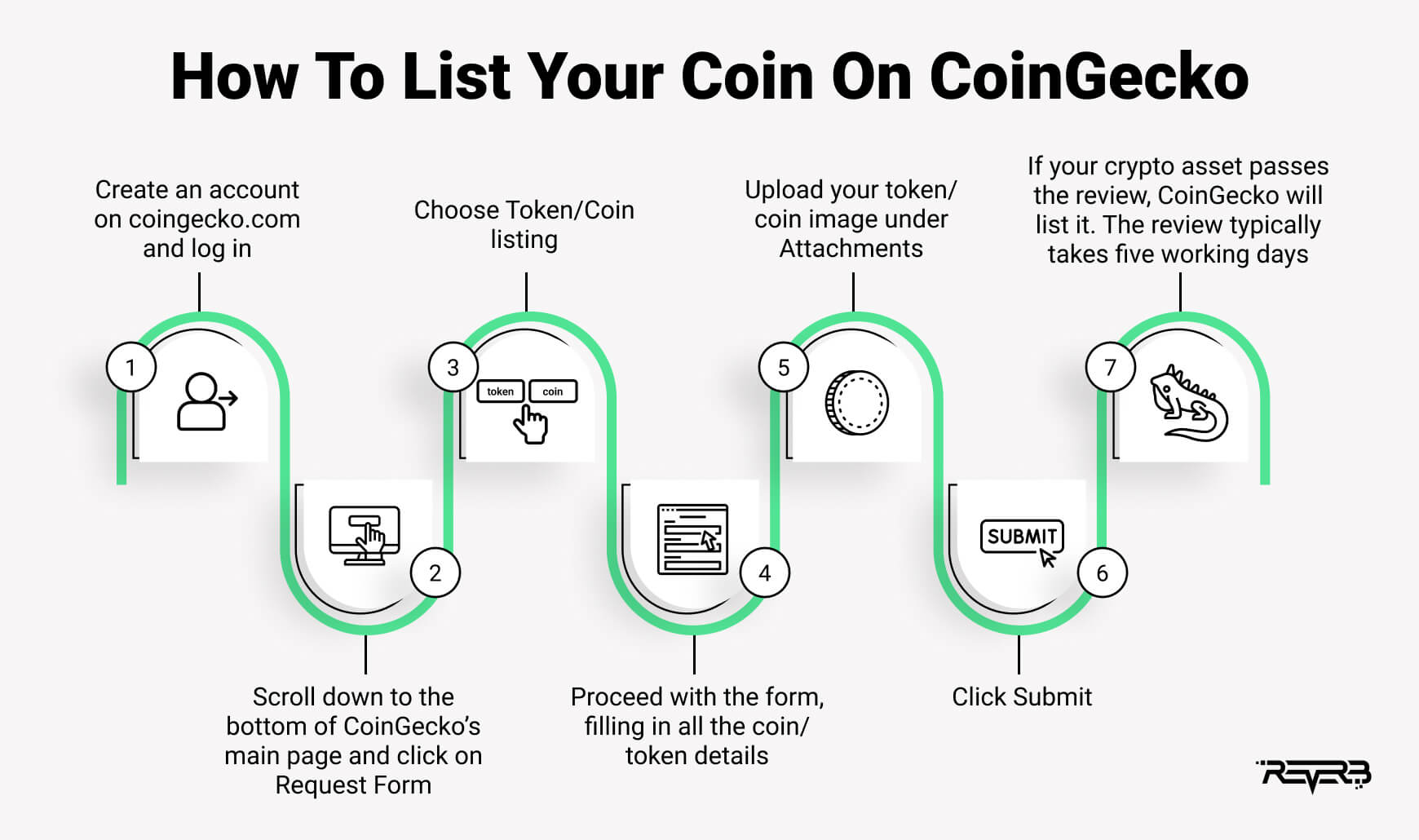
General Steps:
- Meet Prerequisites: Before you can even apply, your project needs to have some traction.
- Prepare Your Materials: Gather all necessary links and documents (website, whitepaper, social media, contract address, etc.).
- Fill Out the Online Form: Complete the detailed application form accurately and truthfully.
- Wait for Review: The platform's team will review your submission. This can take anywhere from a few days to several weeks.
One of the biggest misconceptions is that listing costs money. Listing on both CoinGecko and CoinMarketCap is free. Any offer to "expedite" or "guarantee" your listing for a fee is a scam.
Deep Dive: CoinMarketCap (CMC) Listing
CoinMarketCap provides a detailed document outlining their criteria. Meeting these guidelines is the first step.
Let's review the official guidelines from CoinMarketCap. These are the rules you need to play by.
Read 'Section B: Guidelines for 'Tracked Listings'' to understand the basic requirements. Then, skim 'Section C: Evaluation Framework' to see the other factors they consider, like community interest and team strength.
As you can see, the prerequisites aren't just a simple checklist. You must have:
- A functional website and block explorer.
- The token must be actively traded on at least one exchange that is already tracked by CoinMarketCap. For your token, this would mean creating a liquidity pool on the Ethereum mainnet version of Uniswap and generating sufficient trading volume.
- A designated contact person for communication.
Beyond these basics, they perform a holistic review, considering your team's background, community engagement, and the project's overall progress.
The video below gives a practical walkthrough of the actual application form, showing the level of detail required.
How To List Token On CoinMarketCap
Now let's see what the application form actually looks like. This video walks through each section of the CoinMarketCap request form.
Watch from 03:12 to 10:25. You don't need to memorize every field, but get a feel for the kind of information you need to provide. Notice the emphasis on team transparency, social links, and detailed project descriptions.
Deep Dive: CoinGecko (CG) Listing
CoinGecko's process is very similar. They also have a set of requirements that focus on proving your project has achieved a minimum level of market traction.
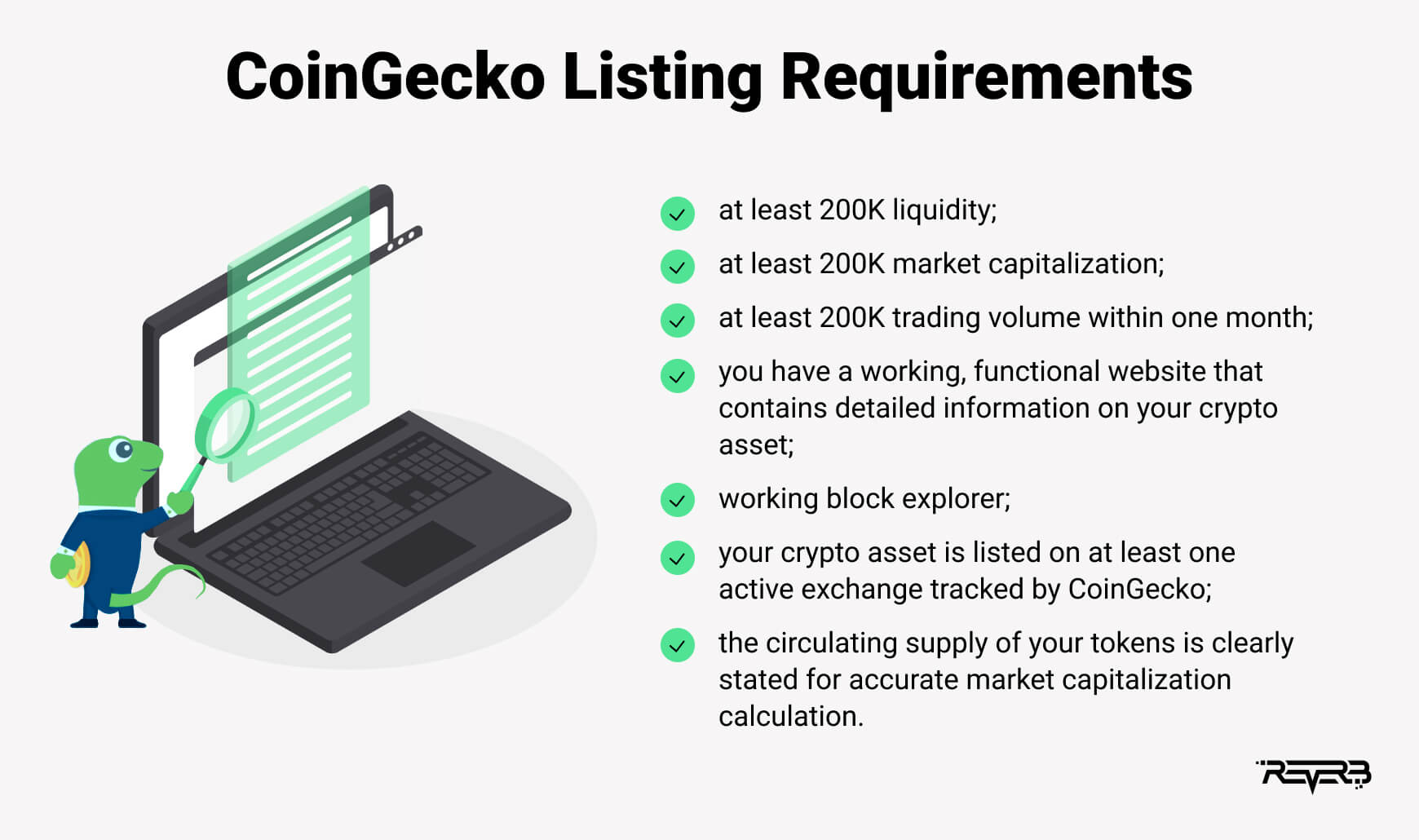
While the exact numbers in the image might change over time, they illustrate the key metrics CoinGecko looks for:
- Sufficient Liquidity and Trading Volume: This proves there is a real market for your token.
- Working Website & Block Explorer: Essential for transparency and verification.
- Listing on a Tracked Exchange: Same as the CMC requirement.
- Clear Supply Information: Necessary for calculating market capitalization.
The application is also done through an official form on their website and is free of charge.
The Technical Requirement: The Supply API
This is where your backend development background becomes a significant advantage. Both platforms need to track your token's supply to calculate its market cap accurately. While they can read the totalSupply from your contract, the circulating supply is more complex.
To solve this, they often require projects to provide a simple API endpoint that returns these values. Let's clarify the terms.
How to Write a Token Data API to Get Listed on Coinmarketcap and Coingecko
This article clearly defines the key supply metrics and then outlines how to build the required API. It's a perfect resource for someone with your technical skills.
First, read the section 'Definitions of Key Terms'. Focus on understanding the precise difference between 'Total supply', 'Max Supply', and especially 'Circulating Supply'.
To summarize:
- Max Supply: The maximum number of tokens that can ever be created. This is often a hardcoded constant in your contract.
- Total Supply: The number of tokens that have been minted so far, minus any tokens that have been permanently burned. This can usually be read directly from the contract's
totalSupply()function. - Circulating Supply: This is the crucial one for market cap. The formula is:
Circulating Supply = Total Supply - Locked Tokens
"Locked Tokens" include tokens held in team wallets, the project treasury, vesting contracts, or any other address that is not part of the free-floating supply available to the public.
Building the API
Since you are a backend developer, creating this API should be straightforward. Here is the conceptual flow, which you can implement in TypeScript, Python, or Java:
- Set up a simple web server (e.g., using Express.js in the Node.js ecosystem).
- Create two endpoints, for example:
/api/total-supply/api/circulating-supply
- In the endpoint logic:
- Use a web3 library (like
ethers.js) to connect to an Ethereum node (e.g., via an Infura or Alchemy API key). - Instantiate your ERC-20 token contract object.
- For
/total-supply, call thetotalSupply()function and return the number. - For
/circulating-supply, calculate it by taking thetotalSupply()and subtracting the sum of balances of all known locked wallets (team, treasury, etc.).
- Use a web3 library (like
- The API should return only the raw number, not a JSON object. For example, a request to
/api/circulating-supplyshould simply return15000000000000000000000000.
The article you just reviewed provides a full example project in Node.js if you want to see a concrete implementation.
Test your understanding!
Your project's token has a totalSupply of 100 million. The team holds 20 million tokens in a treasury wallet for future development, and 10 million tokens are in a vesting contract for early investors. What is your token's circulatingSupply? Which API endpoint would you build to report this number to CoinGecko?
Show answer
The circulatingSupply is 70 million tokens (100M total - 20M treasury - 10M vesting). You would create an API endpoint, for example https://api.yourproject.com/circulating-supply, that programmatically calculates this value and returns 70000000000000000000000000 (70 million with 18 decimals).
Conclusion
You now understand the process and requirements for getting your token listed on the world's leading crypto data platforms. This is a vital step in transforming a piece of code on the blockchain into a recognized project with a place in the wider crypto market.
Key Takeaways:
- CoinGecko and CoinMarketCap are data aggregators that provide visibility and credibility. Listings are free but not guaranteed.
- The application process centers on Credibility, Verification, and Methodology. Honesty and transparency are paramount.
- Prerequisites are key: You must have a functional project with a website, whitepaper, and active trading on an already-tracked exchange before applying.
- The application is done exclusively through official online forms. Anyone asking for payment is a scammer.
- You will need to provide detailed information about your project, team, and tokenomics.
- Your backend skills are valuable for creating the supply API that is often required to report
circulatingSupplyandtotalSupply.
Preview of the Next Lesson:
Congratulations on completing this module! Your token is now designed, built, secured, liquid, and discoverable. The focus now shifts from initial creation to long-term sustainability. How will you manage the project's treasury? How will protocol changes be decided? In the next module, "Governance & Upgradability," we will explore the tools and strategies for decentralized decision-making, starting with the core concepts of on-chain and off-chain governance.