Recommended resources
The freely available resources this lesson will direct you to.
Introduction
In our last lesson, we explored how competition acts as a relentless engine for progress in a market economy, pushing producers to make things better, faster, and cheaper. We saw that the rivalry between firms benefits consumers through lower prices, higher quality, and greater innovation. This raises an important question: are there certain types of goods that even a highly competitive market struggles to provide effectively?
This lesson confronts that challenge by introducing the concept of public goods. You will learn the specific economic definition of a public good and, more importantly, understand the logical reasons why free markets might fail to produce them in sufficient quantities. This concept is a cornerstone of economic theory and represents one of the most significant and enduring arguments for the existence of government, making it a crucial topic for anyone rigorously evaluating libertarian ideas.
Classifying Goods: Rivalry and Excludability
To understand what makes public goods unique, we first need a framework for classifying all goods. Economists do this using two key characteristics: rivalry and excludability.
A short video from the Conservation Strategy Fund provides an excellent introduction to these two concepts.
This video, "Public vs. Private Goods," clearly defines the two characteristics we use to categorize goods.
Please watch from the beginning of the explanations. Focus on grasping the meaning of excludability and rivalry (which the video also calls subtractability).
Let's quickly summarize those definitions:
- Excludability: A good is excludable if it is possible to prevent people who have not paid for it from consuming it. For example, a concert is excludable because you need a ticket to get in. A radio broadcast is non-excludable because anyone with a radio can listen for free.
- Rivalry (or Rivalrous in Consumption): A good is rivalrous if one person's consumption of it prevents or diminishes another person's ability to consume it. An apple is rivalrous because if I eat it, you cannot. A scenic view is non-rivalrous because my enjoyment of it doesn't stop you from enjoying it too.
The Four Categories of Goods
By combining these two characteristics, we can sort all goods into a four-quadrant matrix. This framework is a fundamental tool in microeconomics.
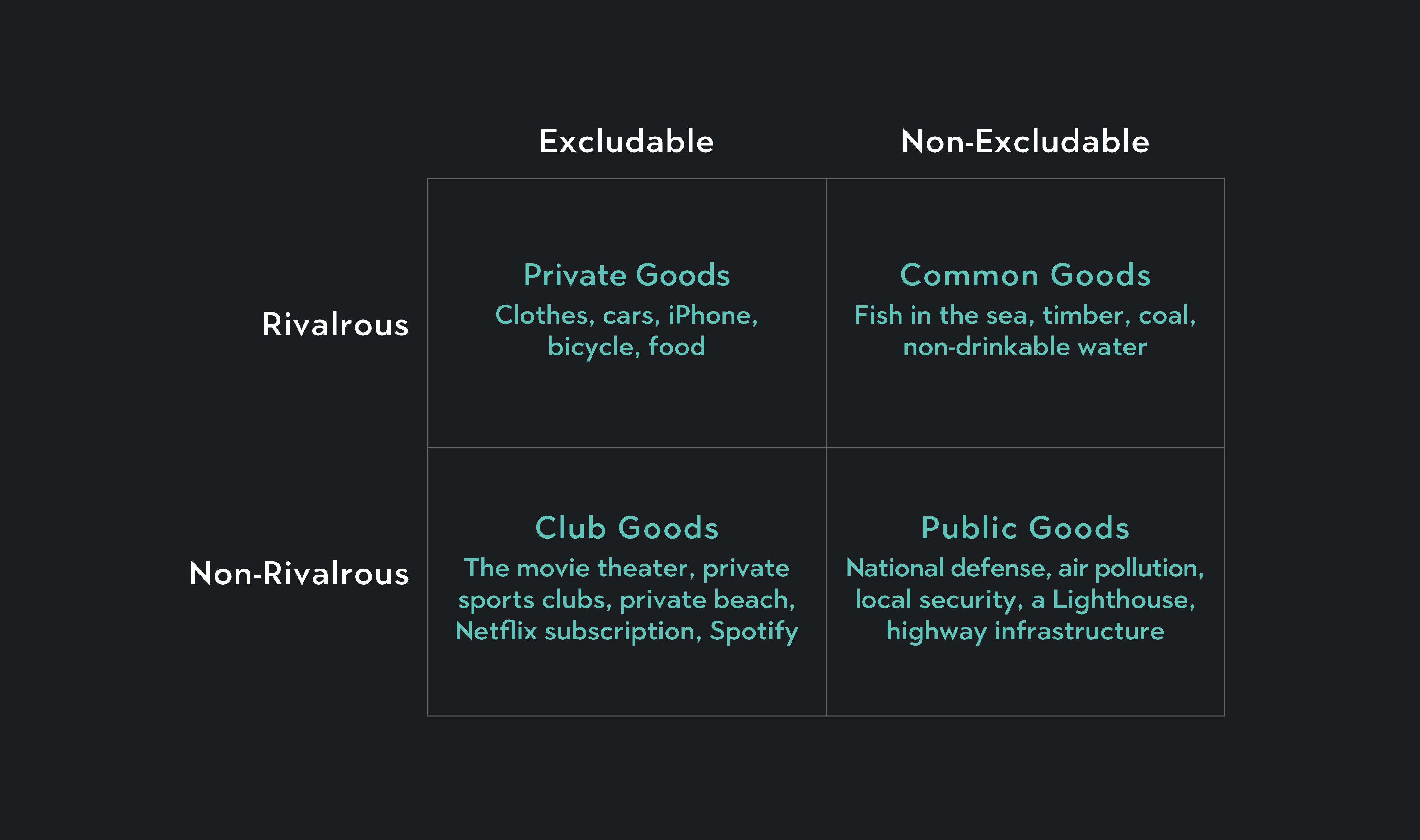
Let's walk through each category:
- Private Goods (Rivalrous & Excludable): These are the goods we most commonly think of, like clothes, cars, and food. They are rivalrous (if you're wearing a shirt, I can't) and excludable (you have to buy it from a store to own it). Markets are exceptionally good at providing private goods.
- Club Goods (Non-Rivalrous & Excludable): These are goods that many people can enjoy at once without diminishing the experience for others, but you still have to pay to access them. Examples include a Netflix subscription, a private golf club, or a movie theater.
- Common Goods / Common-Pool Resources (Rivalrous & Non-Excludable): These goods are available to everyone (non-excludable) but are finite (rivalrous). Think of fish in the open ocean or timber in a public forest. If I catch a fish, that's one less fish for you to catch. We will return to this category in the next lesson, as it is central to the concept of externalities and the "tragedy of the commons."
- Public Goods (Non-Rivalrous & Non-Excludable): This is our focus for today. A public good is defined by its two technical characteristics: it is both non-rivalrous and non-excludable. Classic examples include national defense, clean air, and streetlights. My benefit from a missile defense system doesn't reduce your benefit, and it's impossible to protect my house with it while excluding my neighbor's house.
The Free-Rider Problem
The non-excludable nature of public goods creates a significant challenge for market provision known as the free-rider problem.
The following article from Outlier provides a clear and concise explanation of what a free rider is and how this phenomenon leads to market failure.
What Is the Free Rider Problem? [With 5 Solutions] | Outlier
This article introduces the core issue with providing public goods through markets.
Please read the first two sections, starting with What Is a Free Rider? and continuing through What Is the Free Rider Problem?.
As the article explains, a free rider is someone who consumes a good without paying for it. Because public goods are non-excludable, it is easy for people to become free riders. If a private company tried to fund a lighthouse by asking for voluntary payments from ship captains, each captain would have an incentive to refuse to pay, hoping that others will foot the bill. If enough people make this rational choice to free ride, the company won't raise enough money to build or operate the lighthouse in the first place. The good will be underprovided, or not provided at all. This is a classic example of market failure.
The video below from Marginal Revolution University uses the example of national defense to further illustrate this dynamic.
This video, "A Deeper Look at Public Goods," explains why the characteristics of public goods challenge market provision.
Watch the segment from the discussion of national defense. Pay close attention to how non-excludability creates the free-rider problem and how non-rivalry means it's inefficient to exclude anyone anyway.
To summarize the challenge that public goods pose to markets:
- Non-excludability makes it difficult to charge people, leading to the free-rider problem.
- Non-rivalry means the cost of providing the good to one more person is zero. Therefore, from a social perspective, excluding anyone from using the good is economically inefficient.
Because of this, public goods are often provided by governments and funded through compulsory taxation, which solves the free-rider problem by forcing everyone to contribute.
A Point of Contention: What Is a "Public Good"?
It is crucial to be precise with our terms. In economics, "public good" is a technical term defined by non-rivalry and non-excludability. It is not a synonym for "a good provided by the public sector."
This next clip makes this distinction very clearly.
This final clip from "A Deeper Look at Public Goods" clarifies a common point of confusion about the definition.
Watch the short segment from the final point on terminology.
As the video notes, if the government started producing jeans, that wouldn't make jeans a public good. Conversely, a good can be a public good even if the government doesn't provide it.
This brings us to a critical debate that is highly relevant to our study of libertarianism. The definition we've been using, formulated by economist Paul Samuelson, is the standard textbook definition. However, it is not without its critics.
Some thinkers, particularly on the libertarian side, argue that very few "pure" public goods actually exist and that private markets are more creative at overcoming the free-rider problem than economists often admit (e.g., funding a lighthouse through port fees). Others argue that the Samuelson definition is far too narrow and that "public goods" should be understood more broadly as things a society collectively decides it needs.
The following resource explores this debate in detail, showing how the very definition of a public good is contested.
[PDF] Public Goods in Everyday Life - Boston University
This PDF from Boston University offers a critical perspective on the standard economic definition of public goods, which is essential for understanding the full scope of the political debate.
Please read Appendix 2, which is divided into three key parts. Start with section 9.1, "The Mid-20th Century Definition of Public Goods," which summarizes the Samuelson definition we've discussed. Then, read section 9.2, "Critiques of the Standard Definition," which explains how libertarians and others have challenged this definition. Finally, read section 9.3, "Pluralist Commentary," which presents alternative ways of thinking about public goods.
This reading highlights a key takeaway for your goal: the debate over public goods is not just about whether markets can provide them, but also about what even counts as a public good in the first place. This definitional debate has profound implications for how one views the proper size and role of the state.
Conclusion
In this lesson, we have moved from the strengths of markets to one of their potential weaknesses. We have seen how the unique characteristics of public goods can lead to market failure, providing a powerful rationale for government action.
Here are the key takeaways:
- Two Key Characteristics: Goods can be classified based on whether they are rivalrous in consumption and whether they are excludable.
- Definition of a Public Good: A public good is strictly defined in economics as a good that is both non-rivalrous and non-excludable.
- The Free-Rider Problem: Because public goods are non-excludable, individuals have an incentive to consume the good without paying for it. This can lead to the good being underproduced or not produced at all by the market.
- A Contested Concept: The standard economic definition of a public good is not universally accepted. The debate over how to define public goods is central to the larger political debate about the legitimate functions of the state.
We have now established a clear case for why markets might fail to provide certain goods. However, the story of market failure doesn't end here. Sometimes, the production or consumption of a good affects third parties who were not involved in the transaction. These spillover effects, known as externalities, are another form of market failure and will be the topic of our next lesson.