Recommended resources
The freely available resources this lesson will direct you to.
- Ragas for beginners - Yaman | VoxGuru ft. Shivani Mirajkarwww.youtube.com
- The Alaap Series - Raag Yaman | Learn simple techniques | Shubha's Tutorial #63www.youtube.com
- Making friends with ragas – Let’s start with Yaman (Part I)www.ragasphere.com
- [PDF] संगीत में यमन राग की महत्वपूर्ण भूममका - IJCRT.orgijcrt.org
Introduction
Welcome to our first deep dive into a specific raga! In the last module, we explored the psychology and neuroscience of music, culminating in an exercise where you observed your own physiological and emotional responses to different musical genres. You began to see how elements like tempo, rhythm, and melody can directly influence your inner state.
Today, we transition from these general principles to the highly specific world of Indian classical music. We will analyze our first raga: Yaman. The goal of this lesson is to analyze the structure and serene character of Raga Yaman, noting its use of all shuddha swaras (except teevra Ma). Think of this as moving from understanding the general physics of materials to studying the precise architecture of a specific, beautiful building. You'll learn to see a raga not as an arbitrary collection of notes, but as a sophisticated and intentional framework designed to evoke a particular state of being—in this case, one of serenity and peace, which aligns directly with your goal of cultivating shanta rasa and bhakti bhav.
The Character of Raga Yaman
Before we dissect the anatomy of Raga Yaman, let's get acquainted with its personality. Yaman is one of the most fundamental and widely performed ragas in Hindustani music. It is typically performed during the first prahar (three-hour period) of the night, from 6 PM to 9 PM.
Its emotional character is overwhelmingly described as peaceful, majestic, and serene. It can evoke feelings of gentle romance (shringar) and deep devotion (bhakti), but its foundational mood is one of profound tranquility.
Ragas for beginners - Yaman | VoxGuru ft. Shivani Mirajkar
To get a first impression, watch this brief introduction from the VoxGuru channel. The presenter offers a clear and concise description of Yaman's feeling and context.
Pay attention to the descriptive words used in the first 30 seconds (from the start), such as "peace," "calm," and "romantic love." This will give you an intuitive feel for the raga before we look at its mechanics.
The image below provides a convenient summary of Raga Yaman's key attributes. We will be unpacking each of these elements throughout the lesson.
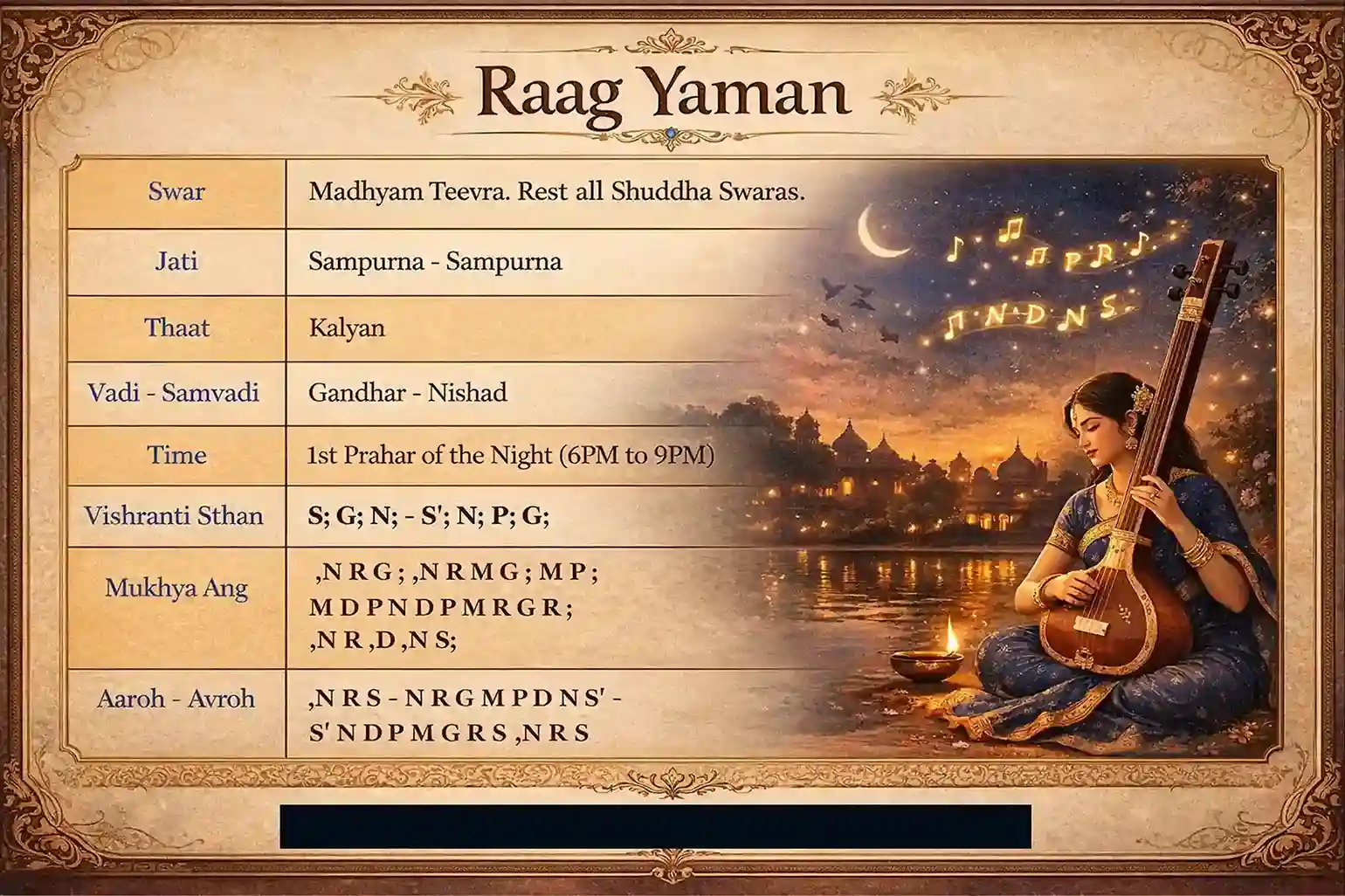
The Structure of Yaman: A Musical Blueprint
A raga's emotional power comes from its specific structure. This structure is a set of rules—a kind of grammatical and syntactical system for melody. For a software developer like yourself, it might be helpful to think of the parent scale (thaat) as a base class that defines a set of available attributes (the notes), while the raga itself is a specific instance of that class, with its own unique methods (melodic rules like aaroh, avroh, pakad) that define its behavior and personality.
Let's break down the "source code" of Raga Yaman.
Making friends with ragas – Let’s start with Yaman (Part I)
This article from RagaSphere provides a clear, beginner-friendly breakdown of Yaman's theory.
Please read the section that begins with the theory. This section covers the raga's parent scale (thaat), the specific notes (swaras) it uses, its most important notes (vadi/samvadi), and its ascending/descending scales (aaroh/avroh).
As you just read, here are the core components:
-
Thaat (Parent Scale): Yaman belongs to the Kalyan Thaat. This thaat is defined by the use of a Teevra (sharp) Madhyam (Ma), with all other six notes being Shuddha (natural). This is the single most important identifying feature of Raga Yaman.
-
Swaras (Notes):
- Sa, Re, Ga, Ma (Teevra), Pa, Dha, Ni.
- The presence of the bright, sharp Ma amidst all natural notes is what gives Yaman its characteristic bright, open, and majestic feel, distinguishing it from the melancholic moods often created by komal (flat) notes.
-
Jati (Classification): It is a Sampurna raga, meaning it uses all seven notes.
-
Aaroh-Avroh (Ascent-Descent): This is where a raga truly distinguishes itself from a simple scale.
- Aaroh:
Ṇi - Re - Ga - Ma(teevra) - Dha - Ni - Sá - Avroh:
Sá - Ni - Dha - Pa - Ma(teevra) - Ga - Re - Sa - Notice a crucial detail: In the ascent, the tonic
Saand the fifthPaare often skipped or used very weakly, creating a characteristic leaping motion likeṆi-Re-GaorGa-Ma-Dha. This avoidance of the most stable notes in the ascent creates a gentle forward momentum.
- Aaroh:
-
Vadi-Samvadi (King-Minister Notes):
- Vadi (King):
Ga(Gandhar) - Samvadi (Minister):
Ni(Nishad) - The entire melodic structure gravitates around these two notes.
Gais a point of arrival and rest. The frequent emphasis on this stable, peaceful note is a primary reason for Yaman's serene character.
- Vadi (King):
From Structure to Serenity: The Alaap
Knowing the rules is one thing; seeing how they generate the final output is another. The alaap is the opening, un-rhythmic section of a raga performance where the musician explores the raga's notes and phrases, slowly painting its emotional landscape. It is here that the serene character of Yaman is most clearly established.
The following video provides an exceptionally detailed guide to building an alaap in Yaman, demonstrating how the structural rules we've discussed are applied to create specific melodic phrases (chalan).
The Alaap Series - Raag Yaman | Learn simple techniques | Shubha's Tutorial #63
This tutorial by Shubha Chaki, in Hindi and English, is a masterclass in how to think in Raga Yaman. She breaks down the raga into its constituent phrases before assembling them into a complete alaap.
First, watch the initial explanation of the raga's rules from 1:46 to 3:46. The instructor explains the importance of phrases like Ni-Re-Ga (instead of Sa-Re-Ga) and Ga-Ma-Dha in the ascent, reinforcing the rules we just covered. Next, focus on how she demonstrates phrases that emphasize the Vadi swara, Ga. Watch from 3:55 to 5:58 and again from 6:55 to 7:44. Notice how the melody repeatedly returns to Ga for rest and stability. This is the structural reason for the raga's peaceful feeling. Then, observe the demonstration of the "Kalyan Ang" from 12:16 to 14:46. The key phrase here is the jump from Pa to Re (Pa-Re), often with a subtle touch of Ma. This specific melodic signature is a hallmark of the Kalyan family of ragas and contributes to Yaman's identity. Finally, listen to the complete free-flowing alaap from 15:00 to 17:52. As you listen, try to identify the phrases you just learned. See if you can hear the emphasis on Ga, the Ni-Re-Ga movements, and the Pa-Re jumps. This is where you can connect the intellectual analysis to the direct aesthetic and emotional experience.
The Science of Serenity
So, why does this specific combination of notes feel "serene"? Let's connect back to the psychoacoustics from our last module.
- Expectation and Fulfillment: Yaman's structure, with its clear vadi and well-defined melodic paths, creates a predictable and stable melodic environment. The music consistently fulfills the expectations it sets up, leading to a sense of resolution and calm, rather than the tension or surprise that might arise from more complex or dissonant structures.
- Lack of Agitation: The complete absence of komal (flat) notes, which are often associated with sadness or introspection, contributes to Yaman's bright and positive emotional valence.
- Entrainment: The slow, flowing nature of a Yaman alaap encourages slower, deeper breathing and a calmer heart rate, a direct example of the entrainment you learned about.
Scientific studies have attempted to quantify these emotional responses. The heatmaps below show median emotional ratings from listeners for the alaap (unmetered opening) and gat (rhythmic composition) sections of musical performances. While the study included multiple ragas, the profile for a raga like Yaman consistently shows high ratings for emotions like 'Calm', 'Happy', 'Romantic', and 'Devotional', and very low ratings for 'Sad', 'Tensed', or 'Angry'.
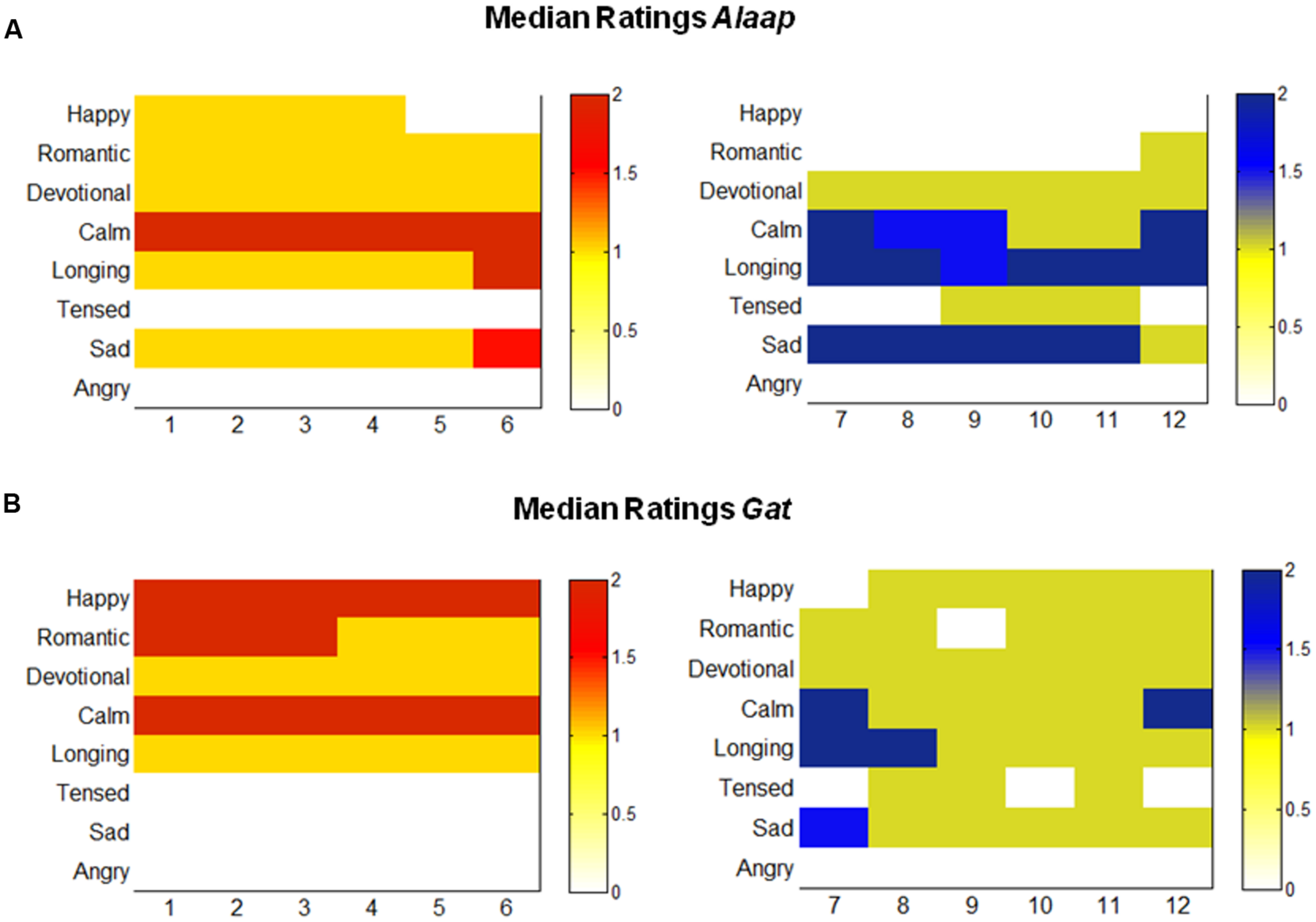
This provides a powerful bridge between the ancient artistic tradition of raga and modern scientific inquiry, validating the intended emotional impact (rasa) that has been passed down through generations of musicians.
Conclusion
In this lesson, you have conducted your first analysis of a raga's architecture. You've seen how Raga Yaman's specific set of rules—its membership in the Kalyan thaat, its unique use of a teevra Ma with all shuddha swaras, its Ga-vadi, and its characteristic melodic phrases—all work together to construct its signature mood of serene, majestic peace.
Key Takeaways:
- Raga Yaman's Structure: It belongs to the Kalyan thaat, using a teevra Ma and shuddha swaras. Its vadi is
Gaand samvadi isNi. - Structure Creates Character: The emphasis on the stable note
Ga, the bright quality of teevra Ma, and the well-defined, flowing melodic phrases (chalan) are the direct causes of Yaman's serene and peaceful character. - More than a Scale: A raga is defined not just by its notes, but by its specific melodic grammar—aaroh, avroh, vadi, and pakad—which guides the emotional journey of the listener.
You have now analyzed your first musical "engine" designed for contemplation. You can see how, with a deep enough understanding, one could begin to "craft exact notes to trigger bhakti bhav," as you aspire to.
In our next lesson, we will continue our case studies by analyzing Raga Bhairav. Bhairav presents a stark contrast to Yaman; it is a morning raga that uses komal (flat) Re and Dha. By comparing Bhairav's structure and its solemn, introspective character to Yaman's, you will gain a deeper appreciation for how subtle changes in the musical code can produce a vastly different emotional and spiritual experience.