Recommended resources
The freely available resources this lesson will direct you to.
Introduction
In our last lesson, we explored the serene and majestic world of Raga Yaman, an evening raga built on a foundation of mostly natural (shuddha) notes. We saw how its structure, particularly the use of teevra Ma and the emphasis on the stable Gandhar (Ga), creates a feeling of peace and tranquility. This lesson takes us to the opposite end of the daily cycle and the emotional spectrum. We will now turn our attention to the dawn.
Our focus today is to analyze the structure and solemn character of Raga Bhairav, noting its use of komal Re and Dha. If Yaman is a musical architecture of peaceful grandeur, Bhairav is one of ancient, introspective solemnity. It is considered one of the oldest and most revered ragas, traditionally performed in the profound stillness of the Brahma Muhurta, the pre-dawn hours. By contrasting Bhairav with Yaman, you will gain a much deeper appreciation for how specific changes in the musical "source code"—in this case, the flattening of just two notes—can generate a completely different and spiritually potent state of being.
The Character of Bhairav: Solemnity and Awakening
Bhairav is not just a raga; it is a cornerstone of the Hindustani musical tradition. Its name is an epithet for Lord Shiva in his fierce, ascetic form, and the raga carries this weight of gravitas, antiquity, and spiritual intensity. While Yaman feels expansive and welcoming, Bhairav is introspective and profound. It doesn't aim for pleasantness but for a deep, soul-stirring experience.
The mood it evokes is not one of sadness, but of serious contemplation, devotion, and a touch of detachment (vairagya). It's the sound of the universe slowly awakening from slumber.
This article from HindiGeet provides a wonderfully evocative description of Bhairav's unique character and its spiritual significance. It will give you an intuitive feel for the raga before we examine its technical details.
Read the entire article. As you read, pay close attention to the descriptive language. Focus on the section The Tension of Awakening, which explains how the use of flat notes creates a "tense" or "sharp" quality. Also, note the ideas presented in the final section, Why Bhairav Matters, which frames the raga as a vehicle for spiritual transformation, aligning perfectly with your goals.
As the article beautifully describes, the experience of Bhairav is "psychologically demanding." It uses tension not to create anxiety, but to focus the mind and awaken a deeper state of awareness, making it a powerful tool for sadhana (spiritual practice).
The Structure of Bhairav: A Blueprint for Introspection
Now, let's dissect the musical grammar that produces this profound emotional effect. The structure of Bhairav is defined by the very elements that give it its solemn character.
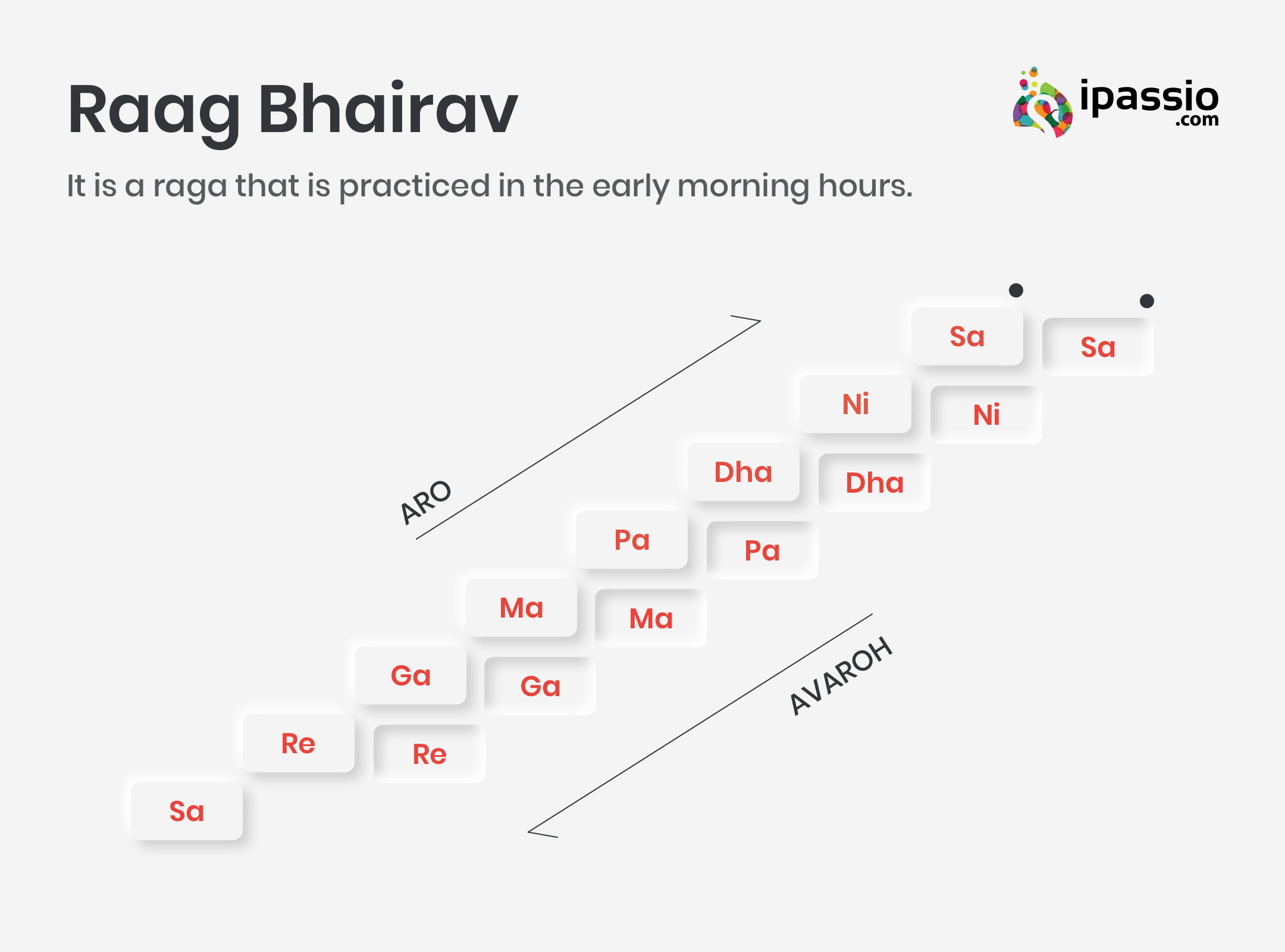
The following reading, from the esteemed Rajan Parrikar Music Archive, offers a deep and scholarly analysis of the raga's structure.
Bhairav - The Primordial Sound - Rajan Parrikar Music Archive
This article provides a masterclass on Raga Bhairav, covering its history, spiritual context, and detailed musical structure.
Begin by reading the introductory sections to understand the raga's deep roots, from the introduction. Next, focus intently on the section that breaks down the swara set and the core melodic ideas, starting from Bhairav's signature phrases. Pay special attention to the mention of "andolita komal rishab" (oscillated flat 'Re'). This is the single most important performance nuance. Continue to the next two paragraphs, under "The lakshanas", which detail the specific melodic movements and the subtle use of other notes. Finally, review the essential sketch which summarizes the key phrases.
Let's consolidate what you've just read. Here are the core components of Raga Bhairav, which stand in stark contrast to Raga Yaman:
- Thaat (Parent Scale): Bhairav Thaat. Its defining feature is the use of a komal (flat) Rishabh (Re) and a komal (flat) Dhaivat (Dha).
- Swaras (Notes): Sa, Re (komal), Ga, Ma, Pa, Dha (komal), Ni. These two komal notes are the primary source of the raga's grave and introspective character.
- Aaroh-Avroh (Ascent-Descent):
- Aaroh:
Sa - re - Ga - Ma - Pa - dha - Ni - Sa - Avroh:
Sa - Ni - dha - Pa - Ma - Ga - re - Sa
(Note: These are the basic scales; the actual performance involves much more complex, non-linear movements, as you'll see.)
- Aaroh:
- Vadi-Samvadi (King-Minister Notes):
- Vadi (King):
dha(komal Dhaivat) - Samvadi (Minister):
re(komal Rishabh)
The entire melodic center of gravity revolves around these two flattened notes, reinforcing the solemn mood.
- Vadi (King):
- The Crucial Technique: Andolan
As highlighted in the Parrikar article, a defining characteristic of Bhairav is the Andolan—a slow, controlled oscillation—on komal Re and komal Dha. This is not a rapid vibrato but a gentle, heavy swing on the note. This technique is what imbues the raga with its characteristic feeling of gravity and depth. A straight, unadorned rendering of komal Re and Dha would not produce the true Bhairav rasa.
From Theory to Practice: The Gayaki Ang
Knowing the notes is like knowing the alphabet. Understanding how they are combined into words and sentences is the art of gayaki (the singing style). The following video provides an excellent demonstration of the specific melodic phrases and performance nuances of Bhairav, showing how the theoretical rules are brought to life.
Raag Bhairav Parichay, Mukhya Swar Sangatiyan with Gayaki Ang | Siddhant Pruthi
In this video, instructor Siddhant Pruthi explains and demonstrates the essential phrases (swar sangatiyan) and singing style (gayaki ang) of Raga Bhairav. The explanations are in Hindi, which will allow you to connect with the material directly.
First, familiarize yourself with the basic structure as he explains it from 1:12 to 1:49. He correctly points out that simply singing the scale plainly is not Raga Bhairav. Now, the most important part. Watch the section on Swar Sangatiyan (note combinations) from 10:33 to 17:34. This is where he demonstrates the soul of the raga. Pay extremely close attention to: The demonstration of Ga-Ma-re-Sa. Listen to how re is approached and held (approx. 12:43). The treatment of komal dha. He explains how dha is oscillated (andolan) and approached with a glide (meend) from Ni (approx. 14:40). Listen to these short segments multiple times. Your goal is not to reproduce the sound, but to aurally recognize how the andolan on re and dha is what gives Bhairav its unique, solemn flavor.
Experiencing Bhairav: A Listening Exercise
You have now studied the theory, character, and performance style of Raga Bhairav. The final step is to immerse yourself in a pure rendition and allow the music to work on your consciousness.
The Rajan Parrikar article you read contains links to many historical recordings. A performance in the Dhrupad style, one of the oldest and most austere forms of Hindustani music, is ideal for experiencing the core essence of Bhairav.
Please return to the article Bhairav – The Primordial Sound and find the section "We turn now to the Classical department." Locate the first audio link, a performance by Nasir Aminuddin Dagar. Listen to the first 2-3 minutes. As you listen, don't try to analyze. Simply observe the feeling it evokes. Notice the slow, deliberate pace. Feel the gravity of the oscillated komal Re and Dha. This is the sound that has been used for centuries to accompany the transition from the darkness of night to the first light of dawn, a powerful aid for meditation and spiritual awakening.
Conclusion
Today we have journeyed into the profound and ancient world of Raga Bhairav. By contrasting it with Raga Yaman from our previous lesson, we've seen a powerful demonstration of how musical structure directly engineers emotional and spiritual experience.
Key Takeaways:
- Bhairav's Structure: It belongs to the Bhairav thaat, defined by the use of komal Re and komal Dha. These two notes are also its samvadi and vadi, respectively, making them the raga's undisputed center.
- The Power of Andolan: The solemn and profound character of Bhairav is not just due to the komal notes themselves, but their execution with a slow, heavy oscillation known as andolan.
- Structure Creates Character: The combination of the pre-dawn performance time, the use of grave komal swaras, and the introspective andolan technique all converge to create Bhairav's signature mood of solemnity, devotion, and deep contemplation.
You are now building a mental map of how different ragas, with their unique combinations of notes and rules, can serve as distinct tools for influencing consciousness. You've experienced a raga for peace (Yaman) and now one for profound introspection (Bhairav).
In our next lesson, we will continue this exploration by analyzing Raga Malkauns. This raga presents yet another strategy for crafting a mood. Instead of altering notes from natural to flat, Malkauns creates its deeply meditative and otherworldly character by removing certain notes from the scale entirely, venturing into the realm of pentatonic scales.