Recommended resources
The freely available resources this lesson will direct you to.
Hello! Welcome to the final lesson in our module on Advanced Agent Architectures.
In our last lesson, we built a two-agent system where a router delegated tasks to specialized workers. While powerful, that was a self-contained system with only two agents and no external tools. As you can imagine, building a system with dozens of agents that need to interact with hundreds of different APIs, databases, and filesystems presents a much larger challenge.
This brings us to today's topic. This lesson will address the learning outcome: Explain the problem of tool integration at scale that Model Context Protocol (MCP) aims to solve. We will diagnose the key pain points that arise when building complex, tool-heavy agentic systems and introduce the architectural concept designed to resolve them.
1. The Challenge of Scaling Tool Integration
When you move from a simple agent to a complex system, the primary difficulty isn't just managing the agents themselves, but managing their access to tools and data. Without a standardized approach, developers face a combinatorial explosion of complexity.
As a software engineer, you've likely encountered this pattern before. Imagine building a large-scale application with dozens of microservices, but with no API gateway, service discovery, or standardized communication protocol. Each service would need a custom, hardcoded integration for every other service it talks to. This would be incredibly brittle, difficult to maintain, and impossible to scale.
This is precisely the problem in the world of AI agents. It's often called the "N×M integration problem."
- You have M different LLM-powered applications or agents (the clients).
- You have N different tools, APIs, or data sources (the services).
To connect every client to every service, you would need to write and maintain N×M unique integrations. Adding a new tool requires updating every agent. Adding a new agent requires integrating it with every existing tool. This is not a sustainable model.
To get a concise overview of this core problem, please watch the first minute of the following video.
Why Everyone’s Talking About MCP?
This video from ByteByteGo introduces MCP by immediately framing it around the core problem of fragmented, custom integrations that don't scale.
Watch from the beginning to 01:02. Focus on how it describes the situation 'Before MCP' and the issue of requiring custom implementations for each new data source.
The article below further clarifies this issue, introducing a great analogy.
What Is the Model Context Protocol (MCP)? A Practical Guide to AI ...
This guide from Databricks explains the N×M problem and introduces a helpful way to think about the solution.
Read the 'Introduction' section. Pay close attention to the definition of the 'N×M integration problem' and the analogy of MCP as a 'USB-C port for AI systems'.
2. The Symptoms of an Unscalable System
The "N×M" issue is the root cause, but it manifests as several practical problems that slow down development and make agents less efficient.
Symptom 1: Excessive Token Consumption
As we've discussed throughout this course, an LLM's context window is a finite and valuable resource. In a naive tool-using system, the agent needs to be aware of all the tools it might use. This is typically done by including the definitions, or schemas, of every available tool directly in the system prompt.
For one or two tools, this is manageable. But what happens when an agent has access to hundreds or thousands of tools across different services?
Code execution with MCP: building more efficient AI agents
This engineering blog post from Anthropic, the creators of MCP, provides a detailed, practical look at the specific problems developers face when scaling tool usage. It gives concrete examples of how tool integration can overwhelm an agent.
Read the section titled 'Excessive token consumption from tools makes agents less efficient'. Focus on the two sub-points: 'Tool definitions overload the context window' and 'Intermediate tool results consume additional tokens'. Notice the examples provided for each.
As you just read, the two main issues are:
- Tool Definitions Overload Context: The schemas for all available tools can consume tens or hundreds of thousands of tokens, leaving little room for the actual user request and reasoning. This increases latency and cost, as the model must process this mountain of information on every turn.
- Intermediate Results Consume Context: When chaining tools, the full output of one tool must often be passed back into the context window, just to be fed as input to the next tool. For large pieces of data, like a long document or a database query result, this is incredibly inefficient and can even exceed the context window limit, breaking the workflow.
Symptom 2: Brittle, Duplicative Work
The origin story of MCP itself highlights the developer frustration that comes from this lack of standardization.
The Model Context Protocol (MCP)
In this clip from an Anthropic discussion, one of the co-creators of MCP explains the simple, personal pain point that sparked the idea.
Watch the short segment from 03:12 to 03:53. This anecdote about copying and pasting between applications is a perfect, low-tech illustration of the problem MCP is meant to solve at a systemic level.
This manual "copy and paste" is the human equivalent of writing duplicative, one-off code to pipe data between systems. Every new connection is a custom job, leading to a fragmented ecosystem where tools are siloed and developer effort is constantly repeated.
3. The Solution: A Standardized Protocol
The solution to these problems is not a better library or a faster model, but a change in architecture. This is where the Model Context Protocol (MCP) comes in.
MCP is an open standard for communication between AI agents and external systems.
By establishing a universal protocol, MCP decouples the agent (the client) from the tools (the servers).
- A tool developer implements an "MCP Server" for their API or database just once.
- An agent developer implements an "MCP Client" in their application just once.
This transforms the N×M problem into an N+M problem. Any MCP client can now talk to any MCP server without any additional integration work. This creates a "plug-and-play" ecosystem for tools.
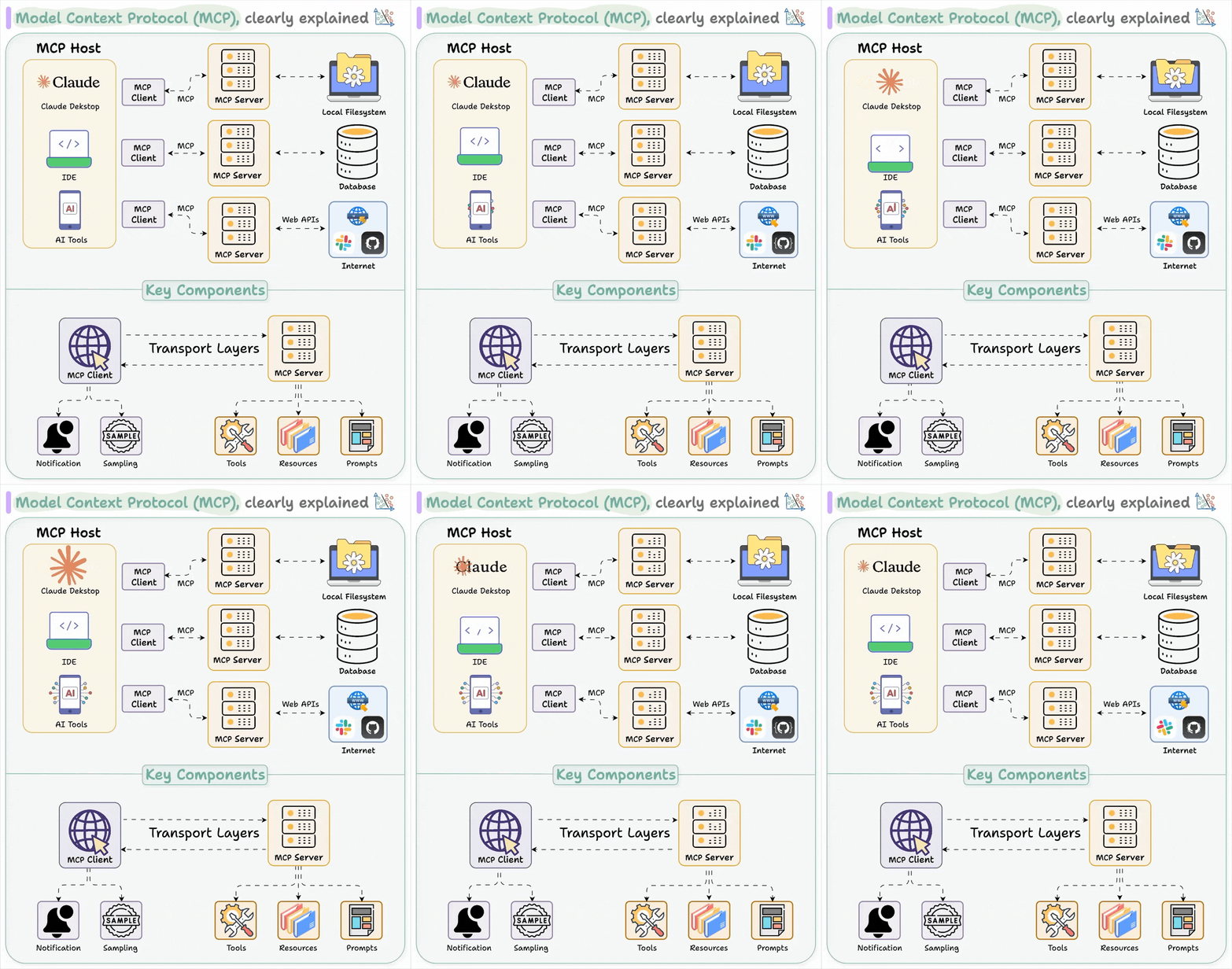
This standardization directly addresses the problems we've identified:
- It eliminates brittle, custom integrations. Developers build to the standard, not to each other's specific implementations.
- It enables more efficient context management. Because there's a standard way to communicate, clients can dynamically discover what tools a server has at runtime, rather than needing every definition upfront. More advanced patterns, like the "code execution" model described in the Anthropic blog, allow the agent to only load the tools it needs for a specific task and handle large data payloads "off-model," preventing them from ever touching the context window.
The decision to make MCP an open standard was a strategic one, designed to reduce friction across the entire AI industry and accelerate innovation.
The Model Context Protocol (MCP)
This final clip explains the rationale behind open-sourcing MCP, framing it as a way to focus the industry on building better models and workflows, rather than on solving the same integration problems over and over.
Watch from 08:25 to 09:21. Listen for the explanation of how a closed ecosystem creates friction, while an open standard allows the community to build a shared foundation.
Conclusion
In this lesson, we explored the significant challenges that arise when attempting to integrate AI agents with a large and diverse set of external tools. You learned that without a common standard, development becomes unscalable and agent performance suffers.
Key Takeaways:
- The Core Problem: The primary challenge of tool integration at scale is the N×M problem, where connecting M agents to N tools requires a combinatorial number of custom integrations.
- Key Symptoms: This problem leads to practical issues like context window overload from tool definitions and inefficient data handling where large intermediate results bloat the context.
- The Conceptual Solution: The Model Context Protocol (MCP) solves this by providing an open, standardized communication layer. It decouples agents (clients) from tools (servers), turning the N×M problem into a more manageable N+M problem.
- The USB-C Analogy: MCP's goal is to be the "USB-C port for AI," creating a universal, plug-and-play ecosystem for tools and data.
You now understand why a protocol like MCP is necessary. In our next lesson, we will examine the protocol itself more closely, describing the MCP architecture and the roles of its key components: the Host, Client, and Server.