Recommended resources
The freely available resources this lesson will direct you to.
Hello! Welcome to the first lesson in our module on Advanced Agent Architectures.
In the previous module, we mastered the art of fine-tuning a single LLM to specialize it for a specific task. We saw how modifying a model's weights can significantly improve its performance. Now, we're going to shift our perspective from enhancing a single entity to orchestrating a team of them.
Just as modern software engineering often favors microservices over monolithic applications to gain modularity, scalability, and specialization, the field of AI is increasingly using multi-agent systems to solve complex problems that are beyond the scope of a single agent.
This lesson addresses the learning outcome: Describe common multi-agent collaboration patterns (e.g., hierarchical, debate). We will explore why we need multi-agent systems and break down the fundamental architectural patterns that govern how these agents interact.
1. Why Not Just a Single, Super-Agent?
Before diving into complex architectures, it's fair to ask: why not just build one, highly capable agent and give it all the tools it needs? As you might expect from your experience in software design, this monolithic approach has its limits.
To understand these limitations and the benefits of a multi-agent approach, please watch the beginning of the following video from LangChain.
Conceptual Guide: Multi Agent Architectures
This video provides a concise conceptual guide to multi-agent systems. The first part clearly explains the challenges that arise when you try to scale a single agent.
Watch the segment from 00:00 to 02:33. Focus on the three main issues identified with single-agent systems and the corresponding benefits of using multiple agents.
As the video highlighted, single-agent systems can struggle with:
- Tool Overload: An LLM's ability to reason effectively about which tool to use degrades as the number of available tools increases. A sweet spot is often cited as being under 10-15 tools.
- Context Complexity: As the number of interactions and tool calls grows, the conversation history can overwhelm the LLM's context window, leading to poor performance and forgotten information.
- Lack of Specialization: A single, general-purpose prompt struggles to be an expert in multiple domains simultaneously (e.g., a math expert, a creative writer, and a code generator).
By using multiple agents, we gain:
- Modularity & Specialization: Each agent can be an expert in one domain, with its own specific prompt and a small, curated set of tools. This makes the system easier to develop, test, and maintain.
- Scalability: You can add new capabilities by adding a new specialized agent, rather than re-engineering a single massive one.
- Control: You can explicitly define how agents communicate and coordinate, giving you fine-grained control over the application's workflow.
2. Common Collaboration Patterns
So, how do we make these agents work together? Just like in software architecture, several established patterns have emerged for orchestrating agent collaboration. Let's explore the most common ones.
The following resources provide an excellent overview of these patterns. We'll use them as a foundation for our discussion.
AI Agent Orchestration Patterns - Azure Architecture Center
This article from the Azure Architecture Center provides a professional, engineering-focused breakdown of agent orchestration patterns. It's a great reference that frames these concepts in a way that will be familiar to you.
Skim through the sections on 'Sequential orchestration', 'Concurrent orchestration', 'Group chat orchestration', and 'Handoff orchestration'. You don't need to read every word, but get a feel for the definition, diagram, and use case for each pattern. We will discuss them in detail.
Multi-Agent Systems and Collaboration Patterns
This page offers a more concise summary of similar patterns, with a direct link to how they can be implemented in LangChain's LangGraph framework, which we'll encounter later.
Read the section 'Common Collaboration Patterns'. This provides clear, brief definitions for the Hierarchical, Sequential, Debate, and Shared Workspace patterns.
Let's synthesize and expand on these patterns.
A. Hierarchical (Supervisor/Manager-Worker) Pattern
This is one of the most intuitive and widely used patterns. A central "supervisor" or "manager" agent acts as an orchestrator, breaking down a complex problem and delegating sub-tasks to specialized "worker" agents.
- How it works: The supervisor receives the initial request. It analyzes the request and routes it to the appropriate worker (e.g., the "researcher agent"). The worker executes its task and returns the result to the supervisor. The supervisor then decides the next step: maybe it sends the research to an "analyst agent" or a "writer agent," or it determines the task is complete and synthesizes the final answer.
- Analogy: A project manager assigning tasks to different team members (developer, QA, designer) and integrating their work.
- When to use: Excellent for well-defined workflows that can be decomposed into clear steps. It provides strong, centralized control over the process.
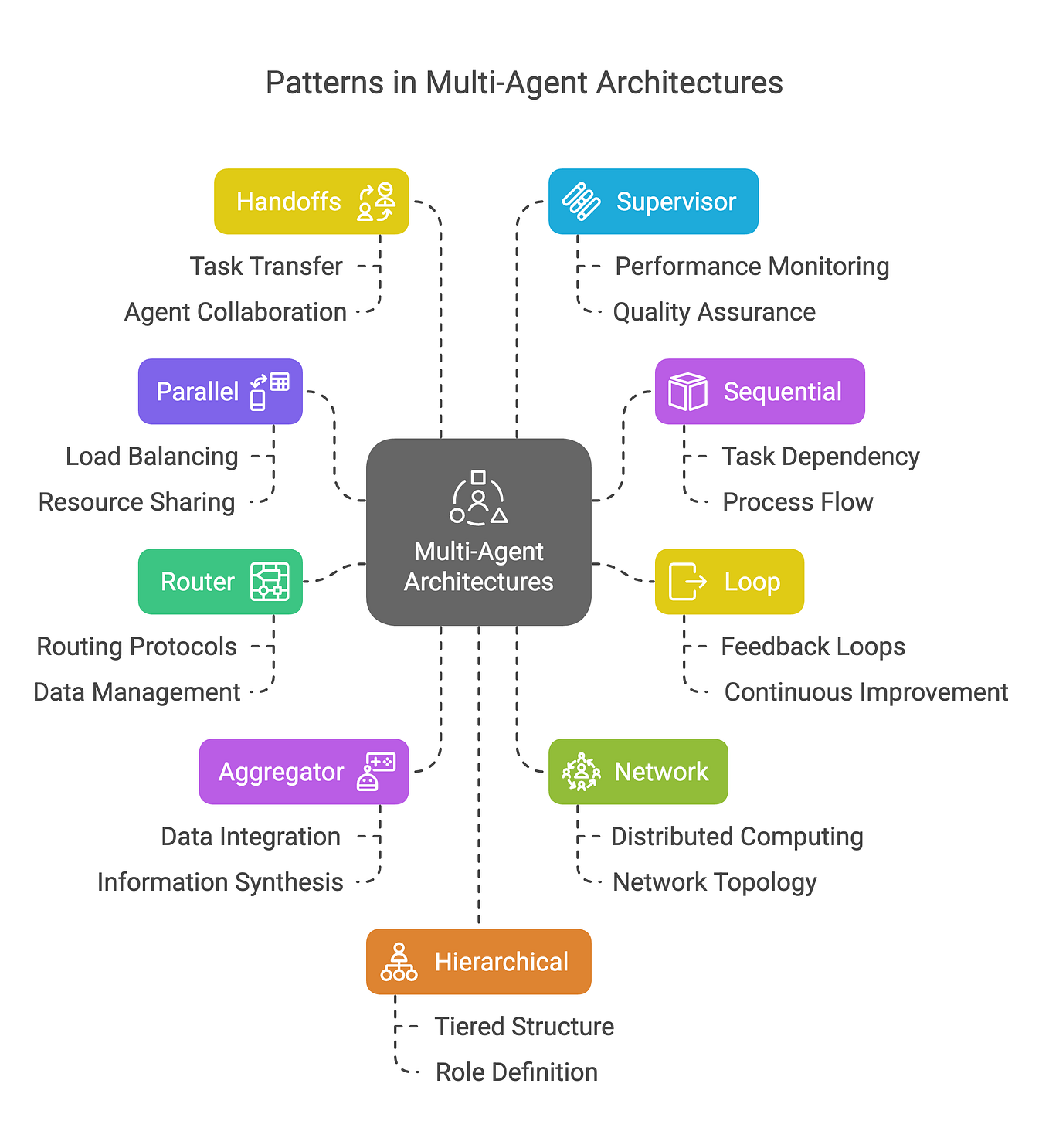
B. Sequential (Pipeline) Pattern
In this pattern, agents are chained together in a fixed, linear sequence. The output of one agent becomes the direct input for the next.
- How it works: Think of an assembly line. An initial request goes to Agent 1 (e.g., a "drafting agent"). Its output is passed to Agent 2 (e.g., a "reviewing agent"), whose output is then passed to Agent 3 (e.g., a "formatting agent").
- Analogy: A CI/CD pipeline in software development, where code flows through build, test, and deploy stages sequentially.
- When to use: Ideal for multi-stage processing tasks where each step builds directly on the last, and there's no need for dynamic routing or decision-making about the workflow itself.
C. Collaborative (Group Chat / Debate) Pattern
This pattern involves multiple agents interacting in a shared context to collaboratively solve a problem, refine an idea, or reach a consensus. This directly addresses the "debate" part of our learning outcome.
- How it works: Agents act like participants in a chat room. A "moderator" or "chat manager" might guide the conversation.
- Brainstorming: Multiple agents with different perspectives (e.g., creative, technical, financial) can generate and build upon ideas.
- Debate: One agent can propose a solution (the "proponent"), while another acts as a critic (the "opponent"), finding flaws and suggesting improvements. This is also called a "critique loop" or "maker-checker" pattern. This cycle repeats until the output meets a quality standard.
- Analogy: A code review process where a developer (maker) submits code and a reviewer (checker) provides feedback for revisions. Or, a parliamentary debate where different sides argue a point to reach a more robust conclusion.
- When to use: For tasks that benefit from iterative refinement, quality assurance, or exploring a problem from multiple angles to find the best solution.
The video below briefly mentions the debate method.
Master ALL 20 Agentic AI Design Patterns [Complete Course]
This excerpt from a broader video on agentic patterns gives a quick mention of the debate method as a reasoning technique.
Watch the short clip from 47:46 to 48:25 to hear how the 'debate method' with proponent and opponent agents is framed.
D. Parallel (Concurrent) Pattern
Here, multiple agents work on the same input simultaneously and independently. Their individual results are then collected and aggregated to form a final output.
- How it works: An orchestrator fans out the initial request to several specialist agents at once. For example, when analyzing a company, one agent might analyze financial statements, another technical stock charts, and a third public sentiment from news. An aggregator then combines these diverse analyses into a single, comprehensive report.
- Analogy: A panel of expert judges in a competition, where each judge scores a performance independently, and the final score is an aggregation of their individual scores.
- When to use: When a task can be broken into independent sub-problems that can be solved in parallel. It's great for reducing latency and gathering diverse perspectives on the same subject.
3. How Agents Communicate
Underpinning all these patterns is the mechanism for communication. As a software engineer, you can think of this as the API contract between microservices. The LangChain video you watched earlier introduces the two primary methods.
- Shared State (Blackboard): Agents interact indirectly through a shared, structured memory object. An agent reads the current state, performs its task, and writes its output back to the state. This is analogous to multiple processes communicating via a shared database or a file. In LangGraph, the
Stateobject serves this exact purpose. - Message Passing (Tool Calls): One agent explicitly calls another agent as if it were a function or tool. The calling agent passes specific parameters, and the called agent returns a response. This is a more direct form of communication, similar to an RPC or REST API call.
The choice of communication style is a key architectural decision that impacts how you structure your agent system's control flow and state management.
4. Choosing a Pattern
There is no single "best" pattern. The right choice depends entirely on your specific problem. The Azure article provides an excellent comparison table to help guide this decision.
Take a moment to review this table, as it's a perfect summary of the trade-offs involved.
AI Agent Orchestration Patterns - Azure Architecture Center
Let's return to the Azure Architecture Center guide. The final table succinctly compares the patterns we've discussed.
Carefully study the table in the 'Choosing a pattern' section. Pay attention to the 'Best for' and 'Watch out for' columns for each pattern. This is a valuable reference for system design.

Conclusion
In this lesson, we established the conceptual foundation for building multi-agent systems. You now understand why distributing capabilities across multiple specialized agents is often superior to creating a single monolithic agent.
Key Takeaways:
- Motivation for Multi-Agent Systems: They offer modularity, specialization, and scalability, overcoming the limitations of single agents in handling complex tasks and large numbers of tools.
- Hierarchical Pattern: A manager agent delegates tasks to worker agents, providing centralized control.
- Sequential Pattern: Agents operate in a fixed pipeline, suitable for linear, multi-stage processes.
- Collaborative/Debate Pattern: Agents interact to iteratively refine work, build consensus, or brainstorm, which is excellent for tasks requiring high quality or creativity.
- Parallel Pattern: Agents work simultaneously on the same problem from different angles, reducing latency and providing diverse insights.
- Communication: Agents coordinate through either a shared state (blackboard) or direct message passing (tool calls).
We've covered the "what" and the "why." In our next lesson, we will put this knowledge into practice. We'll start building our first multi-agent system by implementing a two-agent system with distinct roles to collaborate on a task, taking our first practical step into the world of advanced agent architectures.