Recommended resources
The freely available resources this lesson will direct you to.
- Master the Perfect ChatGPT Prompt Formula (in just 8 minutes)!www.youtube.com
- The Ultimate 20+ ChatGPT Prompts For Sales (In Under 3 Minutes!)www.youtube.com
- What is Prompt Engineering? Tips & Best Practices | Salesforcewww.salesforce.com
- The Ultimate Guide to Prompt Builder | Spring '24 - Salesforce Adminsadmin.salesforce.com
Hello, and welcome to the first lesson in Reliable Prompting for Sales Work. This module begins with a practical skill: giving an AI tool a clear enough brief to produce useful sales work without filling gaps with guesses. Later lessons will cover how to improve a weak response, check an output, and handle sensitive information.
Today you’ll build a prompt with five parts: task, business context, source material, output format, and constraints. We’ll use a fictional sales opportunity so you can concentrate on the prompt itself rather than on a particular AI tool or CRM.
A prompt is a brief, not just a question
Suppose you ask an AI tool, “Summarize this deal.” It knows the action you want, but not which deal, what evidence to use, or what kind of summary would help you make a decision. A sales prompt works better when it resembles the brief you would give a colleague: explain the job, supply the relevant facts, and define what a useful answer looks like.
The image below offers a general starting point. Notice that its example supplies context and a task, then adds instructions. For sales work, we will make two things more explicit: the source material the AI may rely on and the shape of the finished output.
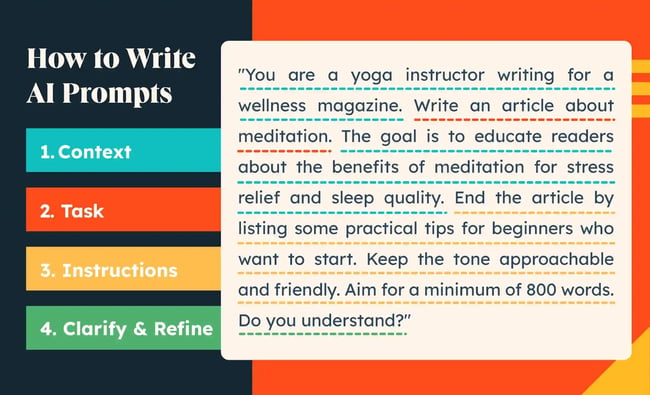
Jeff Su’s short explanation is useful for deciding what to write first. Watch the task, context, and format portions; you can skip the other elements for now.
Master the Perfect ChatGPT Prompt Formula (in just 8 minutes)!
In “Master the Perfect ChatGPT Prompt Formula (in just 8 minutes)!” Jeff Su introduces prompt components and shows why a clear task comes before optional refinements.
Watch the overview for the distinction between essential and optional elements. Continue with the task and the context; notice how an action verb and a defined audience narrow the request. Then skip to the format to see how specifying the final shape makes an answer easier to use.
In sales, context must be particular to your offering and audience. This brief comparison from lemlist illustrates why “What problems do buyers have?” is less useful than a request that identifies the target buyer and what you sell. Treat either result as a starting point, not as verified knowledge about an individual prospect.
The Ultimate 20+ ChatGPT Prompts For Sales (In Under 3 Minutes!)
In “The Ultimate 20+ ChatGPT Prompts For Sales (In Under 3 Minutes!),” lemlist applies prompt context to sales tasks.
Watch sales context for the seller, target audience, and offering. Then watch the comparison between a broad request and one tailored to a target segment. Focus on what the more detailed prompt specifies, not on whether its generated claims would be true of a real prospect.
The five parts of a usable sales prompt
Before working through an example, read Salesforce’s guidance on clear tasks, relevant context, constraints, and separating instructions from reference material.
What is Prompt Engineering? Tips & Best Practices | Salesforce
Salesforce’s guide explains how prompt wording and structure affect the usefulness of a business response. Read these two short passages to give the five-part framework a foundation.
Under “Prompt Engineering Best Practices,” read the best practices, from the opening sentence about defining a task through the closing sentence about iteration. Then find “Structural Elements in Prompting” and read the structure guidance, from the sentence about separating instructions and content through the sentence about structured outputs. Pay particular attention to delimiters and explicit formatting.
The five parts answer different questions. Keeping them separate helps you spot what a prompt is missing.
| Part | Question it answers | Sales example |
|---|---|---|
| Task | What should the AI do? | “Draft an internal deal update.” |
| Business context | What does it need to know about your work and the audience? | “We provide market-research consulting; the reader is a sales manager.” |
| Source material | Which supplied information describes this particular situation? | “Use the meeting notes below for claims about the prospect.” |
| Output format | What should the deliverable look like? | “Use four headings and no more than 140 words.” |
| Constraints | What boundaries must the answer respect? | “Do not invent a budget or present a proposed action as an agreement.” |
Task is an action with a purpose. “Help with my pipeline” leaves both unclear. “Summarize this opportunity for my sales manager before our weekly review” names the action and its use.
Business context explains relatively stable facts: what your team offers, who will read the result, and why they need it. It is not a substitute for evidence about a specific buyer. An AI tool should not be expected to know your current product scope or a prospect’s latest priorities unless you provide that information.
Source material is the record for this request: perhaps call notes, an approved service description, or a document you are allowed to share. Label it so the AI can distinguish notes from instructions. If no prospect evidence is available, say so; do not ask the model to turn general industry knowledge into claims about that prospect.
Output format makes the result usable at the point of work. An internal manager might need a short status brief; a spreadsheet workflow might need defined columns. Length, headings, and required fields are more informative than “make it professional.”
Constraints define what the answer must not assume or do. In sales, especially useful constraints distinguish confirmed facts from suggestions: an unconfirmed budget is unknown, not zero; a recommended next step is proposed, not agreed. A prompt can reduce unsupported claims, but it cannot guarantee accuracy. You still need to review what comes back.
Build a prompt from a fictional opportunity
Imagine you work for Northstar Research, a fictional firm that provides market-sizing research and buyer interviews. Your sales manager needs a quick update on a conversation with Harborline Components, a fictional prospect. The following are the only opportunity notes available:
An operations lead said Harborline is exploring expansion into two regional markets. The team is concerned that its demand forecasts use outdated reports. The VP of Sales is expected to review options next week. The operations lead requested a short outline of our method and indicative scope. Budget, decision authority, and procurement timing were not confirmed. Pricing was not discussed.
A vague prompt—“Write an update on Harborline”—invites the AI to choose its own emphasis and perhaps make a confident-sounding inference. Instead, assemble the five parts. Here is a complete prompt you could paste into an AI tool using fictional or otherwise approved information:
Task:
Draft an internal deal update to help my sales manager decide on the next contact with this prospect.

Business context:
Northstar Research provides market-sizing research and buyer interviews. This is an early-stage consulting opportunity. The reader is my sales manager, not the prospect.

Source material:
Use the notes between the markers for all prospect-specific claims.

BEGIN NOTES
An operations lead said Harborline Components is exploring expansion into two regional markets. The team is concerned that its demand forecasts use outdated reports. The VP of Sales is expected to review options next week. The operations lead requested a short outline of our method and indicative scope. Budget, decision authority, and procurement timing were not confirmed. Pricing was not discussed.
END NOTES

Output format:
Use these headings in order: Deal signal; Confirmed facts; Open questions; Proposed next step. Under Confirmed facts, use no more than three bullets. Under Open questions, use no more than two bullets. Keep the entire update under 140 words.

Constraints:
Base prospect-specific statements only on the notes. You may use the business context to describe our offering, but do not treat it as evidence of what the prospect has agreed to buy. Do not invent a budget, price, decision maker, commitment, or date. Label a suggested action as a proposal, not an agreed plan. Use concise, neutral language. If a necessary detail is missing, say it was not confirmed.
Notice the division of labour within the prompt. The business context permits the AI to describe Northstar’s services. The notes establish what Harborline actually said or requested. The format produces a brief your manager can scan. The constraints protect the distinction between evidence and recommendation.
For example, “The VP of Sales is expected to review options next week” is supported by the notes. “The VP of Sales approved our proposal” is not. Likewise, the prompt can request a proposed next step involving the requested outline, but the resulting brief must not imply that Harborline accepted a scope or price.
The markers around the notes matter because they tell the model where reference material begins and ends. Simple labels such as BEGIN NOTES and END NOTES are sufficient; elaborate prompt syntax is not required.
Make the first draft fit the decision
When constructing a prompt for another sales task, work through these five questions before you send it:
- What decision or action will the response support? State the task with a verb such as summarize, draft, or compare.
- Who is the output for, and what offering or workflow must they understand? Supply only the business context relevant to that task.
- What supplied material supports the answer? Identify and separate it from your instructions. If you lack the necessary notes, obtain them rather than asking for a prospect-specific account of events.
- What would a usable deliverable look like? Specify headings, fields, length, or another practical format.
- Where could a plausible answer become misleading? Add constraints for unsupported facts, missing information, commitments, and tone.
A useful final check is to read the prompt as though you were handing it to a new teammate. Could they tell what to produce, which facts they may use, and what they must leave uncertain? If so, you have given the AI a workable brief. Use only information your organisation permits you to submit to the chosen tool; a later lesson will address anonymising sensitive material in detail.
Conclusion
A strong sales prompt does more than request polished writing. It names the task, supplies relevant business context and source material, defines the output format, and sets constraints on what may be claimed. In the fictional deal update, those parts make the difference between a generic story about a prospect and a short brief grounded in the available notes.
Next, you’ll learn to improve a weak AI response by identifying one prompt defect at a time and revising the instruction that caused it.