Recommended resources
The freely available resources this lesson will direct you to.
- Google's 9 Hour AI Prompt Engineering Course In 20 Minuteswww.youtube.com
- The Ultimate 20+ ChatGPT Prompts For Sales (In Under 3 Minutes!)www.youtube.com
- Prompt design strategies | Gemini API | Google AI for Developersai.google.dev
- Best practices for prompt engineering with the OpenAI APIhelp.openai.com
Hello again. Last lesson, you built a sales prompt with five parts: task, business context, source material, output format, and constraints. Even a well-structured prompt can produce a disappointing first response. The useful question is not simply “How do I get a better answer?” but “What, specifically, did the prompt leave the AI free to get wrong?”
In this lesson, you’ll diagnose a weak response, revise one prompt defect at a time, and compare the new response with the old one. That approach helps you improve repeatable sales work without adding a long list of instructions that may not address the problem.
Treat the first response as evidence
A weak response is information about how the AI interpreted your brief. It may have answered a different task, written for the wrong audience, filled an evidence gap with a plausible claim, or produced a format that is awkward to use. Those are different problems, so they call for different repairs.
This image captures the broad rhythm of the work. The important step is review output: identify what failed before deciding how to refine the prompt.
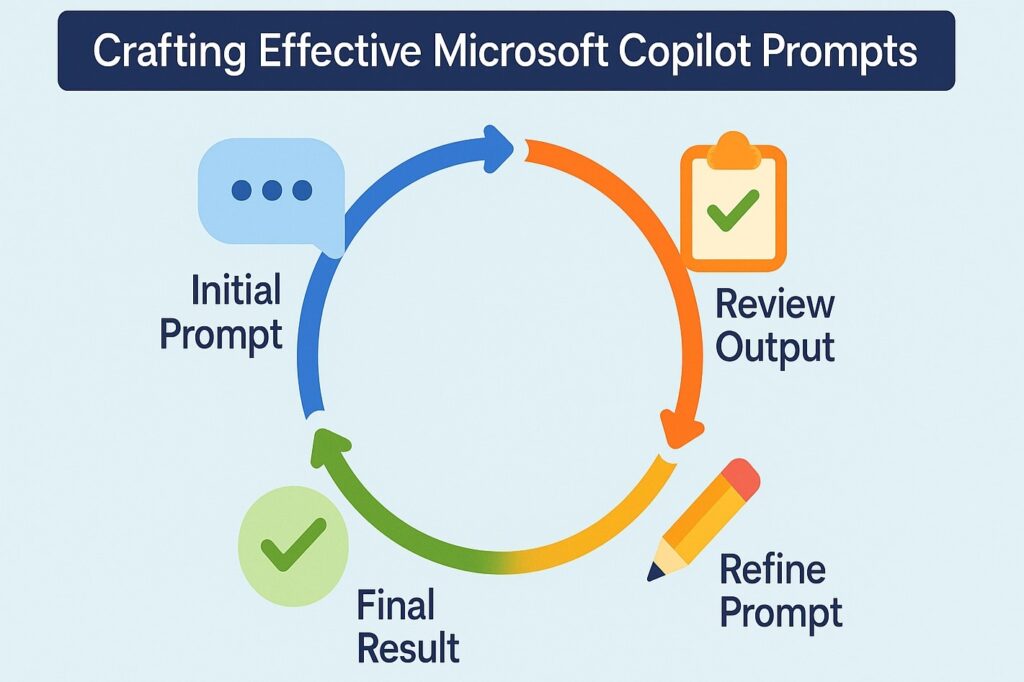
Tina Huang’s recap introduces evaluation and iteration, then describes several ways to refine instructions. Watch these two short portions for the overall method; we’ll apply it to a sales update rather than the video’s gift and marketing examples.
Google's 9 Hour AI Prompt Engineering Course In 20 Minutes
Watch “Google's 9 Hour AI Prompt Engineering Course In 20 Minutes!” by Tina Huang for a compact explanation of why prompting includes evaluation and iteration, not just writing the initial request.
Watch the framework for the roles of task, context, references, evaluation, and iteration. Then watch refinement methods for ways to restructure or narrow an instruction. Focus on choosing a method in response to a particular failure, rather than applying every method at once.
A practical diagnosis begins by naming an observable mismatch. “The answer is bad” gives you little to work with. “It says the prospect approved a project, but the notes only say they requested an outline” identifies a claim you can trace to the prompt.
| What you observe in the response | First place to inspect in the prompt |
|---|---|
| It performs the wrong job | Task: Did you specify the action and its purpose? |
| It sounds generic or addresses the wrong reader | Business context: Did you identify your offering and audience? |
| It states unsupported prospect facts | Source material or constraints: Did you supply the evidence and set a boundary on claims? |
| It contains useful information but is hard to use | Output format: Did you specify the fields, length, or structure you need? |
| It makes a suggestion sound like an agreement | Constraints: Did you distinguish proposed actions from confirmed commitments? |
These are candidate diagnoses, not guarantees. If the relevant instruction is already present and unambiguous, the problem may be that the model did not follow it. You still need to review the next response rather than assuming a revised prompt has solved the issue.
Make the smallest revision that addresses the defect
OpenAI’s guidance pairs less effective prompts with more specific alternatives. Read the examples on specifying the desired result and replacing imprecise wording with an observable requirement.
Best practices for prompt engineering with the OpenAI API
Read OpenAI’s “Best practices for prompt engineering with the OpenAI API” to see how a vague instruction can be made testable without changing the underlying task.
In “Rules of Thumb and Examples,” read rule 3, “Be specific, descriptive and as detailed as possible,” and rule 4, “Articulate the desired output format through examples.” Begin at specificity and format, and continue through rule 4’s improved entity-extraction example so you can compare the two output layouts. Then, in rule 6, “Reduce ‘fluffy’ and imprecise descriptions,” read the short comparison. Notice how the revision defines something you could check in the response.
“Be more specific” is useful only when you can say about what. If an update is too long, “keep it concise” may not help; “use no more than 120 words” defines the missing boundary. If it invents a buying commitment, a word limit does nothing. The revision must address the diagnosed defect.
Google’s prompt-design guide also treats iteration as a process of trying a change and observing its effect. Its examples include rephrasing an instruction and expressing a task differently when the first wording does not produce the intended kind of answer.
Prompt design strategies | Gemini API | Google AI for Developers
Read the “Prompt iteration strategies” portion of Google AI for Developers’ “Prompt design strategies” for alternatives to repeatedly asking the model to “try again.”
In “Prompt iteration strategies,” start at the iteration guidance. Stop before “Fallback responses.” Pay particular attention to the book-category example: the answer is substantively correct, but its form misses the request, so the instruction is revised to make the expected response clearer. You do not need the model-parameter material above this section.
For ordinary sales tasks, start with the simplest repair: clarify the missing instruction, supply permitted source material, or specify the output more precisely. Changing several things at once may improve the answer, but it makes it difficult to know which change helped. That matters when you want to reuse a prompt across many deal updates.
Diagnose and revise a sales update
Return to the fictional Northstar Research opportunity from the previous lesson. The available notes say that Harborline Components is exploring two regional markets, is concerned about outdated demand forecasts, and requested a short outline of Northstar’s method and indicative scope. Its VP of Sales is expected to review options next week. Budget, decision authority, procurement timing, and pricing were not confirmed.
Suppose you submit this abbreviated prompt:
Task:
Write a brief internal update for my sales manager about Harborline Components.

Business context:
Northstar Research provides market-sizing research and buyer interviews.

Source material:
An operations lead said Harborline is exploring two regional markets.
The team is concerned that its demand forecasts use outdated reports.
The VP of Sales is expected to review options next week.
The operations lead requested a short outline of our method and
indicative scope. Budget, decision authority, and procurement timing
were not confirmed. Pricing was not discussed.

Output format:
Use two headings: Deal signal and Next step. Keep it under 100 words.

Constraints:
Use a neutral tone.
This prompt contains all five parts, but its constraint on prospect-specific claims is weak. Imagine the AI returns this response:
Deal signal: Harborline has approved Northstar’s market-sizing work and will move to contracting next week.
Next step: Send the requested method and scope outline.
The response has a clear format and an appropriately neutral tone. The defect to address first is narrower: it turns a request and an expected review into an approval and a contracting plan. The notes do not establish either claim.
Keep the task, context, notes, and format unchanged. Add one evidence-boundary instruction to the Constraints section:
For prospect-specific claims, use only the source notes. Treat a request
for an outline as a request, not an approval. If approval or contracting
plans are not stated in the notes, do not claim they are confirmed.
That is one prompt-level repair: it makes the rule for interpreting prospect evidence explicit. It does not try to solve every possible weakness at once. A better response might now say:
Deal signal: Harborline is exploring two regional markets and requested an outline of Northstar’s method and indicative scope. Approval is not confirmed.
Next step: Reach out soon to see how we can help.
The unsupported approval is gone. However, the next step is still vague. Do not lose sight of the improvement: the first revision addressed the first diagnosed problem. Now identify the remaining problem before editing again.
The current output format says only to include a “Next step” heading. It does not say what makes that section useful to a sales manager. Keep the evidence constraint in place and revise just the Next step format instruction:
Under Next step, give one concrete proposed action tied to a request
in the notes. Do not present the action as already agreed.
A more useful next-step line would be:
Next step: Propose sending the requested method and indicative-scope outline; ask the operations lead whether it would be useful before next week’s VP review.
This is an action Northstar could take, not a claim that Harborline agreed to receive a proposal by a certain date. The two revisions addressed different defects: first an unsupported claim, then an underspecified next step.
The sample responses above illustrate possible outcomes, not guaranteed results from a particular AI tool. A prompt makes your intent clearer; it does not remove the need to inspect what the tool actually writes.
Compare responses without losing the cause
When you revise a prompt, save the original response and the revised one. Compare them against the failure you named before making the change. In the Harborline example, the first question is: Did the approval and contracting claims disappear? Only after checking that should you move on to the usefulness of the next step.
If possible, keep the same fictional case, source notes, and tool while testing a revision. AI responses can vary between runs, so a single better answer is encouraging rather than proof that the wording will always work. If a defect recurs, you may need to express the rule more directly or place the relevant source and instruction closer together. Keep the purpose of each edit clear.
There is also a limit to what revision can fix. If you ask for a prospect-specific outreach email but have supplied no verified information about that prospect, “make it more personalised” is not a sound repair. Obtain information you are permitted to use, or ask for a clearly labelled generic draft. A prompt cannot turn missing evidence into a confirmed fact.
For now, use fictional or organisation-approved information when trying these techniques. A later lesson will address how to anonymise sensitive client and prospect details before using a public AI tool.
Conclusion
Improving a weak AI response is a diagnostic process. Name the observable failure, locate the prompt part most likely responsible, make one targeted revision, and inspect what changed. The Harborline update showed why removing an unsupported buying claim and making a next step useful require separate edits.
In the next lesson, you’ll take a broader view of the finished sales output: evaluating it against a defined checklist for accuracy, relevance, specificity, and tone.