Recommended resources
The freely available resources this lesson will direct you to.
- How Principal & Interest Actually Work in Loan Paymentswww.youtube.com
- 🔴 HIPOTECAS✅. SISTEMA DE AMORTIZACIÓN FRANCÉS. 😱 MI RETO: LO ENTENDERAS EN 2 MINUTOS :) 😉www.youtube.com
- Sistema de amortización francés: qué es y cómo funcionawww.bancsabadell.com
- Comparing Loan Amortization Calculations Between Excel ...medium.com
Hello! Welcome back.
In our last lesson, we mastered the Cash-on-Cash (CoC) return, a metric focused entirely on the cash flow generated by your invested capital. We concluded by noting that CoC ignores a powerful, "silent" form of return: the wealth you build simply by paying your mortgage.
Today, we dive into that very concept. We will explore equity buildup, which is the increase in your ownership stake in the property that comes from paying down your loan's principal balance. While it doesn't put cash in your pocket month-to-month, it's a fundamental component of your total investment return.
By the end of this lesson, you will be able to dissect a mortgage payment into its interest and principal components and calculate the total equity you build over a given period.
1. Understanding Loan Amortization: The French System
When you take out a mortgage in Spain, you'll almost certainly encounter the French amortization system. This is the standard method for structuring loan repayments. Its defining characteristic is a constant monthly payment (for fixed-rate loans), but the composition of that payment changes dramatically over time.
Each payment you make is split into two parts:
- Interest (
Intereses): The cost of borrowing the money for that period. - Principal (
CapitalorAmortización): The portion that reduces your outstanding loan balance.
Equity buildup is the direct result of paying down the principal. Every euro of principal you pay off reduces your debt and increases your equity (your ownership stake) by the same amount.
The core principle of the French system is that in the early years of the loan, most of your payment goes toward interest. As time goes on, the interest portion shrinks, and the principal portion grows.
Sistema de amortización francés: qué es y cómo funciona
To understand the mechanics of this system, let's turn to this excellent explanation from Banc Sabadell, a major Spanish bank.
Please read the first two sections, 'Qué es el sistema de amortización francés' and 'Cómo funciona el sistema de amortización francés'. Focus on the core idea: even with a constant monthly payment, the split between interest and capital repayment shifts over the life of the loan.
To get a quick visual intuition for this concept, the following short video uses a pyramid analogy that you might find helpful.
🔴 HIPOTECAS✅. SISTEMA DE AMORTIZACIÓN FRANCÉS. 😱 MI RETO: LO ENTENDERAS EN 2 MINUTOS :) 😉
This video from 'THE GOSSIP BANKER' offers a simple and effective visual for the French system.
Watch the first 1 minute and 57 seconds. The speaker's analogy of two inverted pyramids for capital and interest is a great way to visualize how the proportions change over the loan term.
2. Deconstructing a Mortgage Payment
So, how is this split calculated? The logic is sequential and builds on itself month after month.
-
Calculate Interest for the Period: The interest owed for any given month is calculated on the remaining loan balance from the previous month.
-
Calculate Principal for the Period: Since your total monthly payment is fixed, the principal portion is simply what's left over after the interest is paid.
-
Update the Loan Balance: The new outstanding balance is the old balance minus the principal you just paid.
This new, lower balance is then used to calculate the interest for the next month, and the cycle repeats. Because the balance is slightly lower, the next interest payment will be slightly lower, meaning the principal payment will be slightly higher.
Let's look at the amortization schedule below. Observe the columns for Intereses and Amortización de Capital. Notice how in the first month (Mes 1), the interest is €250 while the principal is only €145.41. Now look further down the table. By month 120, the principal portion has grown to €195.96, significantly more than at the start. This accelerating principal paydown is the engine of equity buildup.

Practical Example Walkthrough
Let's use the example from the Banc Sabadell article to see this in action.
- Loan Amount: €250,000
- Interest Rate: 3.25% per year (which is approximately 0.27083% per month)
- Term: 25 years (300 months)
- Monthly Payment: €1,218.20 (The article says €1,128.20, but that corresponds to a different rate. Let's use the correct payment for this rate to be precise). Let's use the article's figures for consistency: Payment of €1,128.20.
Month 1:
- Interest: €250,000 * (3.25% / 12) = €677.08
- Principal: €1,128.20 - €677.08 = €451.12 (Note: the article has a typo here, showing €541.21. Our calculation is correct based on the inputs.)
- New Balance: €250,000 - €451.12 = €249,548.88
Month 2:
- Interest: €249,548.88 * (3.25% / 12) = €675.86
- Principal: €1,128.20 - €675.86 = €452.34
- New Balance: €249,548.88 - €452.34 = €249,096.54
As you can see, from the first month to the second, the interest payment dropped by over a euro, and that exact amount shifted over to the principal payment. Over 30 years, this small monthly shift compounds significantly.
The equity buildup for a given period is the sum of all principal payments made during that period. For the first two months, the equity buildup would be €451.12 + €452.34 = €903.46.
Test your understanding!
You secure a mortgage with the following terms:
- Loan Amount: €150,000
- Annual Interest Rate: 4%
- Term: 20 years
- Your calculated fixed monthly payment is €908.99.
Calculate the interest and principal components for the very first monthly payment. How much equity have you built after this single payment?
Show answer
-
Calculate the monthly interest rate:
- Monthly Rate = 4% / 12 = 0.3333...% or 0.04 / 12
-
Calculate the interest for the first month:
- Interest = Initial Loan Balance × Monthly Rate
- Interest = €150,000 × (0.04 / 12) = €500.00
-
Calculate the principal for the first month:
- Principal = Monthly Payment - Interest
- Principal = €908.99 - €500.00 = €408.99
After the first payment, you have built €408.99 in equity through principal paydown. Your new loan balance is €149,591.01.
3. Modeling Equity Buildup in Python
Manually calculating this for every month is tedious and error-prone. This is a perfect task to automate with code. As a software engineer, you'll appreciate how easily we can model this using the numpy_financial library.
Specifically, we will use two key functions:
npf.ipmt(): Calculates the interest portion of a payment for a given period.npf.ppmt(): Calculates the principal portion of a payment for a given period.
This approach is far more direct than manually iterating the balance calculation.
Comparing Loan Amortization Calculations Between Excel and Python
The following article compares Excel and Python for amortization calculations and provides an excellent Python class structure for this task. We will borrow its core logic.
Skim through the Python code block under the heading 'Python Code for Amortization Schedule'. Notice the use of npf.ipmt and npf.ppmt to calculate interest and principal. Then, read the short FAQ 'What are IPMT and PPMT functions used for?' to solidify your understanding of these powerful functions.
Let's write a Python script to calculate the total equity buildup in the first year of a loan.
# You may need to install these libraries if you haven't already:
# pip install numpy-financial pandas

import numpy_financial as npf
import pandas as pd

def calculate_yearly_equity_buildup(loan_amount: float, annual_rate: float, term_years: int, year: int) -> float:
    """
    Calculates the total principal paid down (equity buildup) in a specific year of a loan.

    Args:
        loan_amount (float): The initial loan principal.
        annual_rate (float): The annual interest rate (e.g., 0.03 for 3%).
        term_years (int): The total loan term in years.
        year (int): The specific year for which to calculate buildup (e.g., 1 for the first year).

    Returns:
        float: The total equity built up during that year.
    """
    monthly_rate = annual_rate / 12
    total_months = term_years * 12

    # Define the range of months for the specified year
    start_month = (year - 1) * 12 + 1
    end_month = year * 12

    # Calculate principal payment for each month in the specified year
    # Note: `per` is 1-based, so we use range(start_month, end_month + 1)
    # The loan_amount is negative as it's an outflow from the lender's perspective.
    principal_payments = [npf.ppmt(monthly_rate, per, total_months, -loan_amount) for per in range(start_month, end_month + 1)]

    return sum(principal_payments)

# --- Example Calculation ---
# Let's use our consistent example
loan_amount = 200000  # €200,000
annual_rate = 0.03    # 3%
term_years = 30       # 30 years

# Calculate equity buildup for the first three years
equity_year_1 = calculate_yearly_equity_buildup(loan_amount, annual_rate, term_years, year=1)
equity_year_5 = calculate_yearly_equity_buildup(loan_amount, annual_rate, term_years, year=5)
equity_year_20 = calculate_yearly_equity_buildup(loan_amount, annual_rate, term_years, year=20)


print("--- Equity Buildup Analysis ---")
print(f"Loan Amount: €{loan_amount:,.2f}, Rate: {annual_rate:.2%}, Term: {term_years} years")
print("-----------------------------------")
print(f"Equity Buildup in Year 1:  €{equity_year_1:,.2f}")
print(f"Equity Buildup in Year 5:  €{equity_year_5:,.2f}")
print(f"Equity Buildup in Year 20: €{equity_year_20:,.2f}")
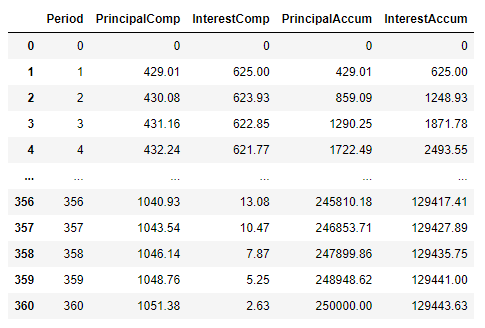
Running this code will clearly demonstrate the acceleration of principal paydown. The equity you build in Year 20 will be substantially higher than in Year 1, even though your monthly payment remains the same. The output of such a script can be used to generate a full amortization table, like the one shown in this DataFrame.
Conclusion
You have now demystified the process of equity buildup. It is no longer an abstract concept but a calculable figure that represents a core part of your return on investment. While it isn't cash flow, it represents a "forced savings" mechanism that steadily increases your net worth over time.
Key Takeaways:
- Equity Buildup is the increase in your ownership stake in a property, achieved by paying down the principal of your mortgage.
- The French Amortization System, standard in Spain, features constant payments but a changing split: interest payments decrease while principal payments increase over time.
- Principal paydown, and thus equity buildup, accelerates throughout the loan term.
- We can precisely calculate the principal portion of any payment using formulas or, more efficiently, with Python libraries like
numpy_financial.
Preview of the Next Lesson:
So far, we've looked at Cash-on-Cash return (driven by leverage) and equity buildup (a result of paying off leverage) as separate concepts. In the next lesson, "Analyze the impact of different down payment amounts and interest rates on cash flow and returns," we will bring these ideas together. We'll perform sensitivity analysis to see how changing our financing assumptions—like putting more or less money down—creates trade-offs between immediate cash flow (CoC return) and long-term equity buildup.