Recommended resources
The freely available resources this lesson will direct you to.
Hello! Last time, you identified a thought that appeared just before you avoided or delayed a challenging activity. You did not have to decide whether it was true. Now you can ask a different question: How well does the available evidence support what the thought predicts?
This lesson focuses on examining evidence for and against one prediction. The aim is neither to talk yourself out of a genuine concern nor to assume that a feared outcome is certain. You will practise reaching an honest conclusion even when some facts are missing. Allow about 35–40 minutes to read, watch, and revisit the record you made last time.
A prediction is a claim to examine, not a fact to obey
Suppose you are invited to introduce yourself in French without notes. The thought you catch is: “I’ll freeze and won’t get through a single sentence.” You might feel anxious immediately, but the strength of that feeling does not establish what will happen. Equally, telling yourself “I’ll do brilliantly” would not establish the opposite.
The useful move is to treat the thought as a prediction about an observable event. Did you get through a sentence, perhaps with a pause? Did you stop entirely? This is easier to evaluate than “I’ll be terrible,” which could mean anything from mispronouncing a word to being unable to speak.
Watch how Change Your Anxious Thinking: CBT for Anxiety & Cognitive Restructuring, from Self-Help Toons, moves from a specific public-speaking fear to questions about its supporting and contrary evidence.
Change Your Anxious Thinking: CBT for Anxiety & Cognitive Restructuring
Watch the public-speaking example for a demonstration of checking a prediction against experience, rather than trying to replace it with forced optimism.
Start with the prediction: notice how the speaker specifies the feared outcome and asks what evidence actually bears on it. Then watch past experiences for the distinction between feeling unprepared and what happened during previous talks. You can stop there; this lesson is about evaluating the evidence, not yet composing a replacement thought.
In the example, feeling uneasy before a talk matters—it is a real experience—but it is not, by itself, proof that the talk will fail. Previous talks that included mistakes and still reached completion are also relevant. Both observations belong in the evaluation.
Give both sides a fair hearing
The NHS Thought record CBT exercise provides a place to record the situation, feeling, and thought, followed by separate spaces for evidence that supports and evidence that goes against the thought. Read its example through step 5. We will leave its later step about writing an alternative thought for the next lesson.
Thought record CBT exercise - Every Mind Matters - NHS
Read the NHS Every Mind Matters thought-record example to see what belongs in each evidence column. Pay particular attention to how it acknowledges a real mistake without treating that mistake as proof of a sweeping conclusion.
In “My thought record,” read steps 1–5, from the instructions beginning the five steps. Steps 1–3 establish the situation, feeling, and thought; steps 4–5 supply evidence on both sides. Stop after step 5 for now.
The form is shown below. Its two evidence rows sit between the original thought and the later, more realistic thought—a useful reminder not to rush from distress straight to reassurance.
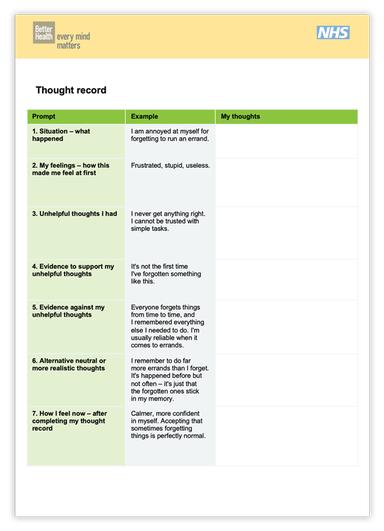
Notice the scope of the NHS example. Forgetting an errand is evidence that the person sometimes forgets things. It is not sufficient evidence for “I never get anything right.” Remembering other errands is relevant contrary evidence. The two columns do not cancel the forgotten errand; they help determine whether the original conclusion goes further than the facts warrant.
The same principle applies to predictions. Put observations in the columns, not arguments designed to win:
- Evidence for might include a closely comparable attempt that went badly, missing preparation, or direct feedback relevant to the feared result.
- Evidence against might include comparable attempts that went better, demonstrated preparation, or occasions when you managed a difficulty the prediction says you could not manage.
- Unknowns belong in neither column. If you have not attempted this particular activity, you do not yet know exactly how it will go.
“I'm anxious” is evidence of anxiety. “I paused for ten seconds during a similar introduction last week” is evidence about speaking performance. Neither should be quietly converted into “Everyone will judge me”: that is a claim about other people’s reactions and needs evidence of its own.
Evaluate the claim as it was actually stated
Return to the French introduction: “If I speak without notes, I’ll freeze and won’t get through a single sentence.” Imagine these are the facts you have:
| Evidence that supports the prediction | Evidence that goes against it |
|---|---|
| During one unexpected French question, you lost your place and stopped speaking. | You completed three introductions aloud without notes while practising alone. |
| You have not yet given a full introduction without notes to another person. This leaves an important gap; it is not proof of failure. | On another occasion, you paused when asked a short question, then answered it. |
The stopped response is relevant evidence for a risk of freezing. It deserves attention. But the prediction says you won’t get through a single sentence. The completed practice introductions and the answer after a pause count against that absolute claim. They do not prove that speaking to another person will feel the same as practising alone. That difference in setting limits how strongly the practice evidence applies.
A careful evaluation might therefore be:
“I have frozen once when put on the spot, so a pause or difficulty is plausible. I have also spoken without notes in practice and recovered from a pause before. I cannot conclude that I will be unable to finish even one sentence; I have not tested this exact situation.”
That is an assessment of the prediction, not yet an instruction to act or a promise that everything will go smoothly. It preserves the meaningful concern and rejects more certainty than the evidence allows.
Several questions help you weigh the columns rather than simply count entries. How similar were the past situations to this one? Does an observation support the whole prediction, or only part of it? Were there unusual conditions—such as no preparation—that make one attempt a poor guide to this attempt? And what outcome did you actually observe, as distinct from what you feared someone thought?
A single vivid failure can loom larger in memory than several ordinary completions. But the reverse error is possible too: numerous easy practice runs may say little about a demanding live situation. Relevance and quality matter more than the number of lines in either column.
When the evidence supports a real concern
Evaluating a prediction fairly does not require finding a reassuring answer. Imagine a different thought before explaining a startup idea: “This particular customer group may not care enough about this problem to use a solution.” If several people in that group have independently said the problem rarely occurs and described no current workaround, that is meaningful supporting evidence. An enthusiastic response from someone outside the group does not erase it.
Here, the conclusion could be: “There is a substantive reason to doubt demand in this group, though I do not yet know whether the same is true of every potential customer.” The evidence may point toward a need to learn more or change an assumption. The purpose of the thought record is better judgment, not automatic optimism.
This distinction is especially important where consequences are real. In a trading decision, a prior price rise is not evidence that a loss is impossible. Evidence-based thinking means taking the possible loss seriously and separating what is known from what remains uncertain; it does not mean using a thought record to dismiss financial risk.
If evidence on either side is thin, “I don’t know yet” is a valid result. Avoidance can leave a prediction untested. Do not treat “it hasn’t happened” as proof that it will not happen, or “I can imagine it happening” as proof that it will. For an interpersonal prediction such as “They’ll think I’m incompetent,” also distinguish what you observed—a question, a comment, or a facial expression—from your interpretation of what it meant.
Conclusion
To evaluate an unhelpful prediction, state the feared outcome precisely, record relevant evidence for and against it, and weigh how directly each observation bears on the claim. A feeling is real but is not automatically evidence of the event you fear. A past difficulty can indicate a genuine risk without proving that an absolute prediction will come true.
Your conclusion may be that the prediction is overstated, partly supported, well supported, or still uncertain. In the next lesson, you will use that conclusion to write a balanced, action-focused statement—one that takes the evidence seriously without letting an untested prediction make the decision for you.