Recommended resources
The freely available resources this lesson will direct you to.
Hello! In the previous lesson, you weighed evidence for and against an unhelpful prediction. You might have found that it was overstated, partly supported, or simply untested. The next step is to put that conclusion into words you can use when the situation comes up.
In this lesson, you will turn a prediction into a balanced, action-focused statement: one that acknowledges a genuine difficulty, leaves room for uncertainty, and identifies something useful you can do. Allow about 35–40 minutes for the lesson and the short resources.
Balance is not the same as reassurance
Imagine you are about to introduce yourself in French without notes. The prediction from last lesson was: “I’ll freeze and won’t get through a single sentence.” Your evidence gave a more complicated picture: you once stopped when surprised by a question, but you have completed introductions in practice and recovered from a pause before.
Replacing the prediction with “I’ll speak perfectly” would ignore the first observation. Keeping “I’ll definitely freeze” would ignore the others. A balanced statement needs to hold both:
“I might pause, especially if I’m put on the spot. I’ve also completed introductions in practice and recovered from a pause before, so stopping completely is not a certainty.”
That is a more defensible expectation. It is not yet fully action-focused; we will add what you can do in a moment.
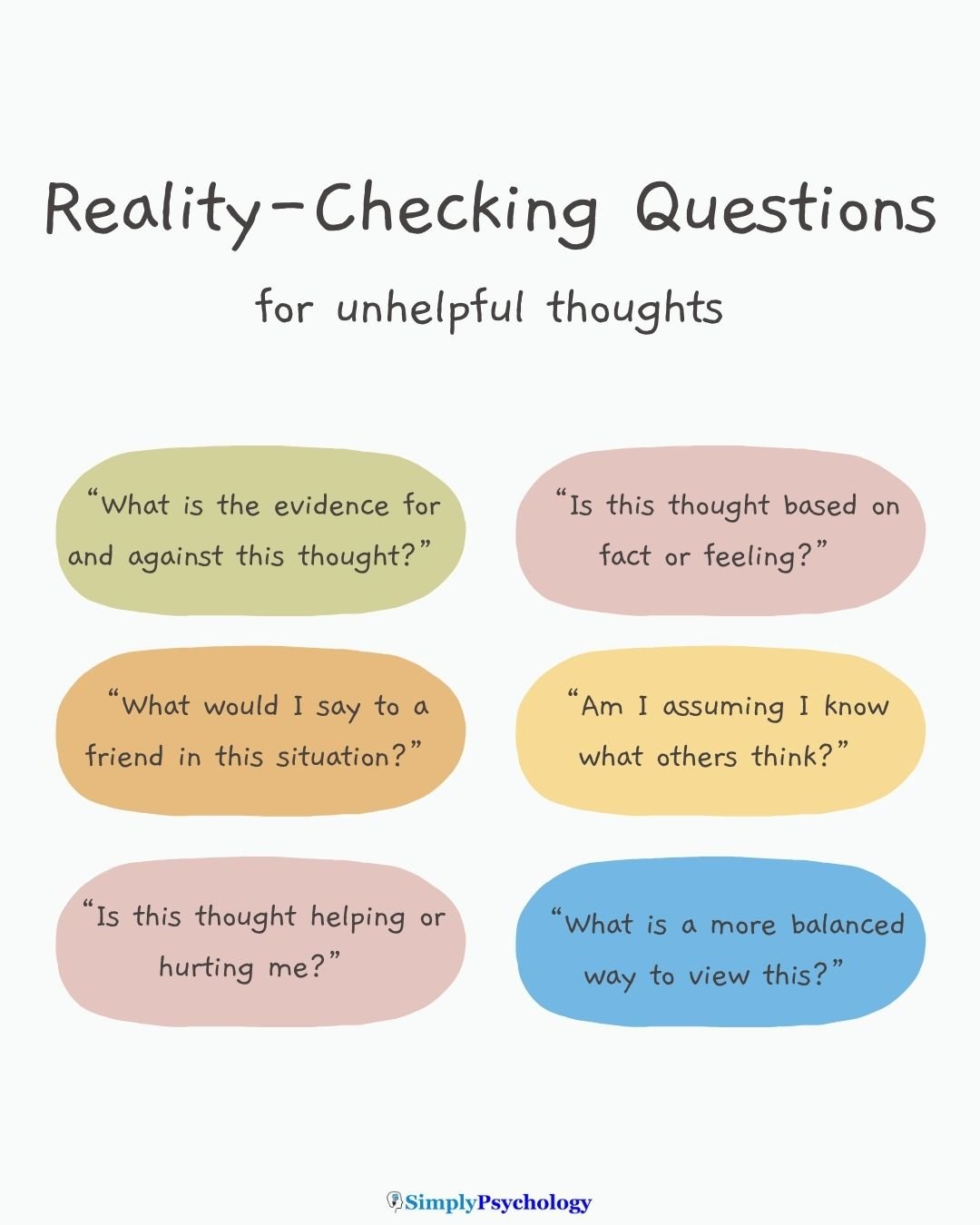
The Reality-Checking Questions image offers several routes to a balanced view. “What is the evidence for and against this thought?” draws on last lesson’s work. “What is a more balanced way to view this?” asks you to express its conclusion. The question “Is this thought helping or hurting me?” is useful too, but it should not replace checking accuracy: an unpleasant prediction may contain a real warning.
Watch this short portion of Reframe Negative Thoughts with Cognitive Restructuring (CBT) from Self-Help Toons. Notice the shift from finding another interpretation to asking how you could handle a difficult outcome.
Reframe Negative Thoughts with Cognitive Restructuring (CBT)
Self-Help Toons’ video connects a more balanced perspective with a practical question: what could you do if the feared difficulty occurred?
Watch other perspectives for questions that loosen an assumed interpretation, then ways to cope for the move toward action. Focus on the latter move; you do not need to answer every question in the video.
Turn the evidence into a usable sentence
A workable rewrite has three parts, though it need not sound like a formula:
- Name the credible difficulty without treating it as inevitable.
- Include the counterevidence or uncertainty that limits the original prediction.
- Choose a controllable response, including what you could do if the difficulty appears.
For the French introduction, the full statement might be:
“I might pause because I have stopped when surprised before. But I’ve completed introductions in practice and recovered from a pause, so I don’t know that I’ll stop entirely. I can begin with a sentence I’ve practised; if I lose my place, I can take a moment and try that sentence again.”
The action is beginning and responding to a pause, not guaranteeing a fluent performance. You can carry it out while anxious. It also leaves open the possibility that the attempt will be difficult.
The Centre for Clinical Interventions’ Improving Self-Esteem: Biased Expectations shows a similar change in its quiz-team example. Read the completed diary to see how a prediction of complete failure becomes a more realistic expectation. Its final expectation is balanced, but does not specify a next action; we will supply that separately.
Improving Self-Esteem - 04 - Biased Expectations
Read the Centre for Clinical Interventions’ completed thought diary to see how evidence and a likely outcome shape a rewritten prediction.
On p. 6, find “Thought Diary for Biased Expectations (example).” Read the completed example, beginning with the invitation and ending with “What’s a more realistic expectation?” Notice that the person allows for not knowing some answers without concluding that they will contribute nothing or be judged as a person.
The diary separates not knowing every answer from making the team lose and looking foolish. You could make its final expectation more action-focused by adding: “I can go, offer answers where I have an idea, and let a question pass when I don’t.” That step is within the person’s control; winning the quiz is not.
Let the action fit the concern
An action-focused statement is not an order to ignore risk. If the evidence strongly supports a concern, the useful action may be preparation, adjustment, or gathering information, rather than pressing ahead unchanged.
Suppose you predict, “I won’t be able to answer questions about the costs in my short business presentation.” You have not worked out the costs yet. “I’ll answer everything confidently” would be poorly grounded. A better statement is:
“I haven’t worked out the costs, so I may not be able to answer those questions yet. I can prepare a simple estimate before presenting. If I’m asked something I still don’t know, I can say what I need to check and follow up.”
Here the rewrite preserves the warning and makes it useful. The same principle matters in higher-stakes decisions: a balanced thought about a possible trading loss is not a reason to take an unplanned financial risk. The action may instead be to check whether the decision meets your rules or to refrain from it.
The Centre for Clinical Interventions’ Back from the Bluez makes the connection between a balanced thought and behavior explicit. Its example is interpersonal rather than performance-related, but the principle transfers: choose conduct consistent with your better-supported interpretation instead of automatically following the original thought.
Read the Centre for Clinical Interventions’ explanation of why acting on a balanced thought matters, with particular attention to its examples of what someone could do next.
In Module 7, find “Turning Your Thoughts into Actions,” immediately after “Thought Cards.” Read the opening discussion, from the suggestion to act on balanced thoughts through the examples of asking how someone feels or offering help. Notice that these actions do not require certainty about what the other person thinks.
An action can help you learn, but it does not have to prove your new statement right. If you try the French introduction and do pause, the balanced statement has not failed—it allowed for a pause. What matters next is what actually happened and whether you used the response you had chosen. If you stop entirely, that is new evidence to consider, not a verdict on your ability.
A quick check before you use your rewrite
When you return to the prediction you evaluated last lesson, keep the rewrite short enough to recall in the moment. Check that it:
- Retains any genuine risk: “I might pause,” not “There’s no chance I’ll pause.”
- Limits what the evidence cannot establish: “I don’t know how this attempt will go,” not “I know everyone will judge me.”
- Names an observable action: “I can begin with my practised sentence,” not “I must feel confident.”
- Allows a response to difficulty: “If I lose my place, I can pause and restart,” not “Any pause means failure.”
You do not need to feel immediately convinced or calm for the statement to be useful. Its job is to give you a fairer account of the situation and a workable next move.
Conclusion
A balanced, action-focused statement is neither forced optimism nor resignation. It takes the evidence for a concern seriously, includes what limits that concern, and identifies an action you can control—even if the outcome remains uncertain. The strongest rewrites also say how you could respond if the feared difficulty occurs.
Next lesson, you will build a graded exposure ladder: a way to approach an avoided activity in manageable steps. The statement you have written here can help you take one of those steps without demanding certainty first.