Recommended resources
The freely available resources this lesson will direct you to.
Introduction
Hello again! In our last lesson, we explored the counterintuitive but powerful idea of 'desirable difficulties'. You learned that making learning more effortful—through strategies like spacing, testing, and interleaving—leads to much stronger and more flexible long-term memory compared to passive, easy review.
Today, we're going to look under the hood to see why this works. This lesson addresses the learning outcome: Describe the roles of encoding, consolidation, and retrieval in memory formation. We will break down the entire journey of a memory, from the moment you first encounter a piece of information to the moment you recall it weeks later.
Understanding these three stages is fundamental to your goal of "debugging your learning." When you fail to remember something, it's rarely just a vague failure of "memory." By the end of this lesson, you'll be able to ask more precise diagnostic questions: Was it an encoding problem, a consolidation failure, or a retrieval issue? This framework is the first step to applying targeted solutions.
The Three Stages of Memory
At its core, the process of forming a lasting memory can be broken down into three essential stages. These stages are not perfectly separate events; they are deeply interconnected and influence one another.

To get a formal introduction to these concepts and how they relate to each other, please read the first few paragraphs of the following text.
Memory (Encoding, Storage, Retrieval)
The article 'Memory (Encoding, Storage, Retrieval)' from the Noba Project offers a clear, academic overview of this model. It establishes the definitions we will use throughout the course.
Please read the introductory section titled 'Three Stages of the Learning/Memory Process.' As you review the learning stages, focus on the definition of each stage and the key idea that they are 'inextricably bound together.'
As the text highlights, any successful act of remembering requires all three stages to be intact. A failure at any point in the chain leads to forgetting or misremembering. Let's examine each link in this chain more closely.
Stage 1: Encoding - Creating the Initial Memory Trace
Encoding is the process of converting sensory input into a form that the brain can process and store. It's the "input" stage of memory. However, your brain doesn't just passively record everything like a camera.
An essential principle of encoding is that it is selective and requires attention. Think about designing a user interface; you use visual hierarchy, colour, and contrast to guide the user's attention to what's most important. In the same way, your learning process depends on directing your attention to the right information.
What you do with that information once you're paying attention is what truly matters for retention. This is where the concept of "deep processing" comes in.
Encoding Strategies for Long-Term Learning
This article, 'Encoding Strategies for Long-Term Learning,' provides an excellent explanation of why not all encoding is created equal. It introduces the hugely influential 'Levels of Processing' theory.
Please read the sections 'What Is Encoding?' (focusing on the encoding process) and 'What Is the Levels of Processing Theory in Education?' (covering the processing theory). Focus on the distinction between shallow and deep processing.
To bring this to your world:
- Shallow Processing: Highlighting key terms in an article about a new UX methodology or simply re-reading your notes on it. You are only engaging with the surface features of the information.
- Deep Processing: After reading the same article, you try to explain the methodology in your own words to a colleague, or you think about how it compares to a method you already use. You are engaging with the meaning of the information.
The "desirable difficulties" we discussed last time, like generation and elaboration, are essentially methods to force deeper processing during the encoding stage.
Stage 2: Consolidation - Stabilizing the Memory
Once a memory is encoded, it is still fragile. Consolidation is the neurobiological process that reorganizes and stabilizes this memory trace for long-term storage. Think of it as the brain's "file saving" process, where it moves information from a temporary holding area to more permanent storage.
To understand the critical importance of consolidation, there is no better story than that of patient H.M., a man who lost the ability to form new long-term memories after a brain surgery.
What happens when you remove the hippocampus? - Sam Kean
This animated TED-Ed video, 'What happens when you remove the hippocampus?', tells the famous story of patient H.M. It's a fascinating and poignant illustration of what happens when consolidation fails.
Just past the two-minute mark, please watch Milner's memory findings. This segment explains how H.M. could hold information in his mind for a few moments (working memory) but couldn't consolidate it into long-term memory. It also reveals a fascinating twist about different types of memory.
H.M.'s case showed that the hippocampus is crucial for consolidating declarative memories—memories of facts and events ("knowing that"). Without a functioning hippocampus, his new experiences were like messages written in sand, washing away moments after they were formed. The process of consolidation effectively transfers these memories from being dependent on the hippocampus to being stored in a distributed network across the cortex.
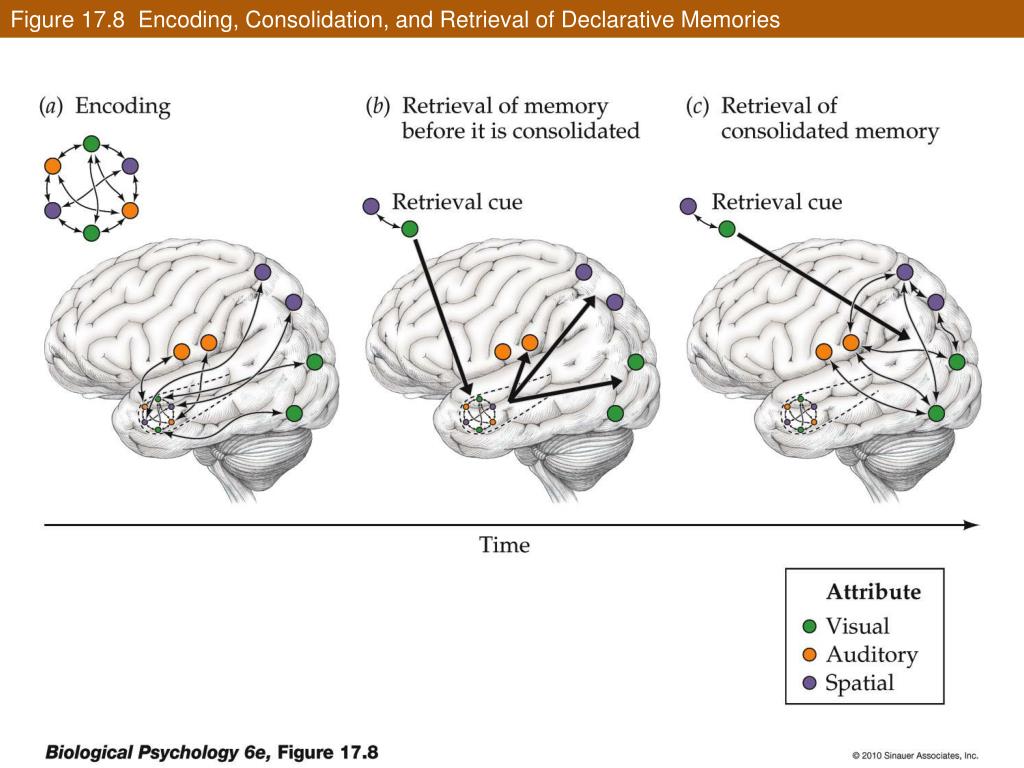
Consolidation doesn't happen instantly. It's a process that unfolds over hours, days, and even weeks. It is powerfully enhanced by sleep and by spaced practice—revisiting information at increasing intervals gives the consolidation process time to work.
Stage 3: Retrieval - Accessing the Memory
Encoding and consolidating a memory are useless if you can't access it when you need it. Retrieval is the process of finding and bringing a stored memory back into conscious awareness. This is where we often notice our memory "failing."
However, a retrieval failure doesn't necessarily mean the memory is gone. A key distinction here is between information that is available (stored somewhere in your brain) and information that is accessible (you can actually find it right now).
What makes a memory accessible? The answer lies in retrieval cues.
Memory (Encoding, Storage, Retrieval)
Let's return to the 'Memory' article from the Noba Project to understand the dynamics of retrieval.
Please read the 'Retrieval' section. Focus on the concepts of 'available vs. accessible' information, retrieval cues, and the 'encoding specificity principle'.
The Encoding Specificity Principle is a crucial takeaway: retrieval is most successful when the conditions at retrieval match the conditions at encoding. This is why smelling a certain food might suddenly bring back a vivid childhood memory, or why going back to your old primary school might trigger memories you haven't thought of in years. The context provides powerful retrieval cues.
Finally, retrieval is not a passive act of "playing back" a memory. Every time you successfully retrieve a memory, you change it. This is the mechanism behind one of our most powerful desirable difficulties:
- The Testing Effect: Actively retrieving information (i.e., testing yourself) makes the memory trace stronger and more easily accessible in the future. The very act of retrieval is a powerful form of practice.
Test your understanding!
You're learning a new piece of coding syntax for data analysis. A week later, you try to use it but can't remember how it works. Using the three-stage model, describe three distinct possible reasons for this failure, one for each stage.
Show answer
Here are some possible answers:
-
Encoding Failure: When you first learned the syntax, you were distracted by notifications. You just copied and pasted the code without thinking about what each part did. You engaged in shallow processing, so a robust memory trace was never created in the first place.
-
Consolidation Failure: You learned it in a late-night cramming session and didn't get enough sleep afterwards. The memory was encoded but remained fragile and was not successfully transferred to long-term storage.
-
Retrieval Failure: You learned the syntax while working on a specific tutorial project (e.g., analyzing sales data). Now you're trying to apply it to a totally different context (e.g., analyzing user survey results), and the lack of familiar cues makes it inaccessible. The memory is available, but you can't find the right "mental path" to it.
Conclusion
You now have a foundational model for how memory works. Information is first encoded, then consolidated for long-term storage, and finally retrieved for use.
Key Takeaways:
- Encoding is the gateway to memory. Its effectiveness depends on attention and the depth of processing. Deep processing (focusing on meaning) creates stronger memories.
- Consolidation is the process that stabilizes memories for the long term. It happens over time and is heavily dependent on sleep and spacing.
- Retrieval is the act of accessing stored information. It depends on having effective cues and is a reconstructive process. Importantly, the act of retrieval itself strengthens the memory.
By understanding these three stages, you can start to diagnose your own learning challenges more effectively and choose the right strategies to improve.
In our next lesson, we will begin Module 2 by focusing on a direct consequence of this model: the forgetting curve. We will explore how quickly we forget information if we don't actively try to retrieve it, and how this knowledge allows us to plan review sessions for maximum efficiency.