Recommended resources
The freely available resources this lesson will direct you to.
- How to study to maximize performance | Elizabeth Bjork & Robert Bjork | TEDxManhattanBeachwww.youtube.com
- Desirable Difficulties - How Learning Workswww.youtube.com
- Creating Desirable Difficulties to Enhance Learningbjorklab.psych.ucla.edu
- Mastering the Mental Model of Desirable Difficultywww.funblocks.net
Introduction
Hello! In our last lesson, we drew a crucial distinction between short-term performance and long-term learning. You learned that easy, fluent performance often creates an illusion of competence because it relies on high retrieval strength without necessarily building deep storage strength. The key takeaway was that true, durable learning often happens when retrieval is effortful and feels difficult.
This lesson directly builds on that idea. Now that you know why struggle can be beneficial, we'll explore how to introduce it into your learning process strategically. We will address the learning outcome: Explain why 'desirable difficulties' enhance long-term retention and knowledge transfer.
You'll learn to identify specific, evidence-based techniques that make learning more challenging in the short term but result in knowledge that is more durable, flexible, and applicable to new situations—exactly what you need when translating theory into practice in your design work.
The Learning Paradox: Why Harder Can Be Smarter
As a designer, you know that user perceptions can sometimes be at odds with reality. The same is true in learning. We instinctively believe that smooth, rapid, and error-free learning is the most effective. However, research in cognitive science reveals the opposite is often true.
Take a look at the following image. It powerfully illustrates the gap between what learners think is working and what actually leads to successful, long-term learning.
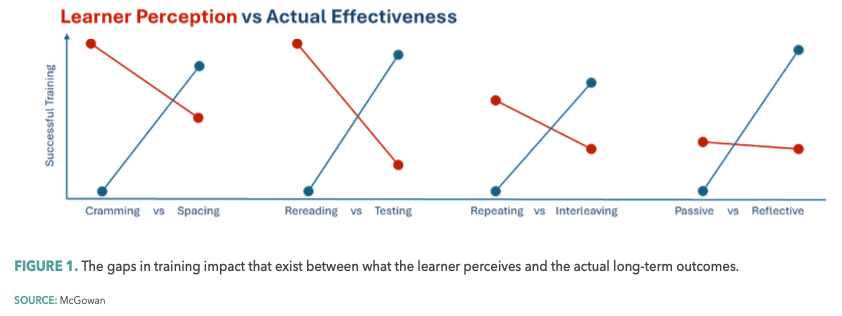
This paradox is the essence of desirable difficulties. They are the strategies represented by the blue line—methods that may feel less productive in the moment but yield far greater returns in retention and real-world application.
What Is a 'Desirable Difficulty'?
The concept might sound like a contradiction, but it's a precise principle from cognitive psychology. To get a clear definition, let's start with a short reading.
Mastering the Mental Model of Desirable Difficulty
This article, 'Mastering the Mental Model of Desirable Difficulty,' provides an excellent introduction to the topic. It neatly defines the term and uses a fitting analogy.
Please read the 'Introduction' section. Focus on the formal definition and the analogy of 'strength training for your brain.'
As the article explains, a desirable difficulty is a strategic obstacle that makes learning more effortful, which in turn triggers deeper cognitive processing. It's not about making learning impossible; it's about making it productively difficult.
Here’s how it connects to our previous lesson:
- Easy learning conditions (like re-reading notes) keep retrieval strength high. Your brain doesn't have to work hard.
- Desirable difficulties intentionally lower your immediate retrieval strength. This forces your brain to engage in effortful retrieval, which is the primary mechanism for building long-term storage strength.
This effort also enhances knowledge transfer—your ability to apply what you've learned to new contexts. When you struggle with a concept and overcome that struggle, you develop a more flexible and abstract understanding that isn't tied to a single example or context. This is vital for a problem-solving field like UX design, where you constantly apply principles to novel situations.
Four Key Types of Desirable Difficulty
So, what do these strategic obstacles look like in practice? The researchers who coined the term, Robert and Elizabeth Bjork, have identified several core types. The best way to learn them is to hear from the experts themselves.
How to study to maximize performance | Elizabeth Bjork & Robert Bjork | TEDxManhattanBeach
In this classic TEDx talk, the Bjorks provide a clear, example-driven overview of four key desirable difficulties. Their explanations are foundational to understanding how to learn effectively.
Please watch from 01:30 to 13:20. This segment introduces the core concept and then details four specific strategies. Pay close attention to the real-world examples they use for each one, like practicing beanbag throws or learning to bat.
To summarize and anchor what you just watched, here are the four desirable difficulties the Bjorks discussed, with examples tailored to your interests:
-
Varying the Conditions of Practice: Instead of always practicing a skill in the same way or place, mix it up.
- Example: Instead of only practicing wireframing on your quiet home office computer, try sketching out a user flow on a tablet in a bustling café. This forces you to adapt and strengthens the core skill independent of the environment.
-
Spacing Out Practice: Distribute your learning sessions over time rather than cramming them all at once.
- Example: If you're learning about A/B testing, studying for 30 minutes on Monday, Wednesday, and Friday is far more effective for long-term memory than a single 90-minute session on Monday.
-
Retrieval Practice (Testing): Actively recalling information from memory instead of passively reviewing it.
- Example: After reading an article about Gestalt principles, close the tab and try to write down all the principles you can remember and explain them in your own words. This is much more powerful than simply re-reading the article.
-
Interleaving: Mixing the practice of different but related topics or skills in a single study session.
- Example: Instead of a "blocked" session where you only practice creating components in Figma for an hour, an interleaved session might involve 15 minutes on components, then 15 minutes on writing user interview questions, then 15 minutes back on components. This feels harder because you have to constantly switch gears, but it dramatically improves your ability to distinguish between concepts and choose the right "tool" for the job.
"Desirable" vs. Just Plain "Difficult"
This is a crucial point. The goal isn't to make learning painful or frustrating for no reason. A difficulty is only "desirable" if the effort it requires is directly related to the learning goal itself. Introducing arbitrary obstacles is counterproductive.
In our second lesson, we talked about cognitive load.
- An undesirable difficulty adds extraneous load (like trying to read an article with a tiny, low-contrast font). It makes you work harder on the wrong things.
- A desirable difficulty adds germane load (like trying to recall a concept from memory). It makes you work harder on the things that build memory.
This short video explains this distinction perfectly.
Desirable Difficulties - How Learning Works
Dr. Benjamin Keep provides a very clear framework for telling the difference between a 'good' difficulty and a 'bad' one. This is key to debugging your own learning process.
Please watch the segment from 06:57 to 10:40. The core idea is in the question: 'Does the difficulty relate to what the learner is learning, or is it just there as a distraction?'
The takeaway is simple but profound: the struggle must be part of the skill you are trying to build.
Test your understanding!
Imagine you are trying to get better at giving and receiving design critiques. Your goal is to learn a framework like the "I Like, I Wish, I Wonder" method.
Propose one desirable difficulty and one undesirable difficulty you could introduce into your practice. Explain your reasoning for each.
Show answer
Here's one possible answer:
-
Desirable Difficulty: After learning the framework, you could do a practice critique session with a colleague where you are not allowed to have the "I Like, I Wish, I Wonder" prompts written down in front of you. You have to recall and apply the structure from memory. This is desirable because the difficulty (recalling the framework) is directly related to the goal of internalizing and using it fluently.
-
Undesirable Difficulty: You could conduct the practice critique session over a video call with a very poor internet connection that keeps cutting out. This is undesirable because the difficulty (straining to hear, repeating yourself) adds extraneous cognitive load that has nothing to do with learning the critique framework. It's just a distraction that hinders learning.
Conclusion
Today, we've unlocked one of the most powerful principles for effective learning. By understanding and embracing desirable difficulties, you can move beyond the trap of easy performance and start building robust, flexible knowledge that lasts.
Key Takeaways:
- Desirable difficulties are strategic obstacles that make learning more effortful, leading to better long-term retention and knowledge transfer.
- They work by forcing effortful retrieval, which is the key to building strong, durable memories (high storage strength).
- Key types include varying practice conditions, spacing, retrieval practice, and interleaving.
- A difficulty is only "desirable" if the effort is germane to the learning goal, not just a random distraction.
You now have the "what" and the "why." In our next lesson, we will go one level deeper. We will explore the three fundamental stages of memory—encoding, consolidation, and retrieval—to see the precise biological and cognitive processes that these desirable difficulties act upon. This will complete our foundational understanding of how memory works.