Recommended resources
The freely available resources this lesson will direct you to.
Introduction
Welcome back! In our last lesson, we explored the long-run dynamics of perfectly competitive markets. We saw how the complete freedom of entry and exit forces all firms to a point of zero economic profit, where they produce at their most efficient scale. This outcome is driven by the relentless pressure of competition.
Today, we journey to the other extreme of the market structure spectrum: monopoly. What happens when competition is absent? How does a firm behave when it is the sole provider of a good or service, and new rivals are kept at bay?
This lesson will address exactly that. Our goal is to identify the key characteristics of a monopoly and explain the sources of its market power. Understanding where this power comes from is the first step to analyzing a monopolist's decisions about price and quantity, which we will cover in the next lesson. We will see that the defining feature of a monopoly—the very thing that makes it different from a competitive firm—is the presence of barriers to entry.
1. What is a Monopoly?
The word "monopoly" might bring to mind classic board games or historical giants like Standard Oil. In economics, it has a precise definition. Let's start with a short video that outlines the core concepts.
What is a Monopoly? | Economics Explained
This video from the Federal Reserve Bank of St. Louis provides a concise and clear definition of monopoly and its fundamental characteristics.
Watch the first minute (0:00-1:07) to get a clear definition and then the conclusion (6:28-7:15) for a summary. Focus on the three key traits mentioned: a single supplier, no competition, and no close substitutes.
As the video explains, a monopoly is a market structure characterized by a single seller of a unique product with no close substitutes. This uniqueness gives the firm significant control over the price it charges. Unlike the perfectly competitive firms we've studied, which are price takers, a monopolist is a price maker.
We can summarize the defining characteristics of a monopoly as follows:
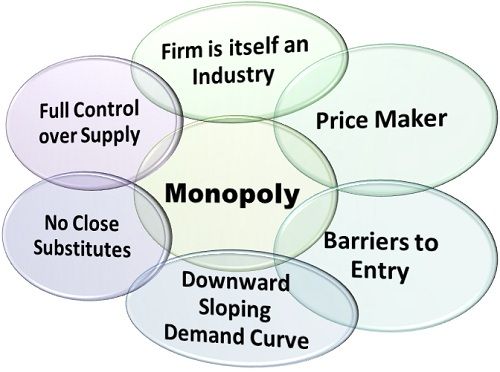
The most critical of these characteristics—and the one that makes all the others possible—is the existence of barriers to entry. These are the obstacles that prevent other firms from entering the market to compete with the monopolist.
2. Sources of Monopoly Power: Barriers to Entry
In the last lesson, you saw how economic profits act as a signal, attracting new firms into a perfectly competitive market and eroding those profits. In a monopoly, high barriers to entry block this from happening, allowing a monopolist to potentially earn economic profits indefinitely. These barriers are the ultimate source of a firm's market power.
We can group these barriers into three main categories:
- Natural Barriers (market-based or technical)
- Government-Created Barriers (legal)
- Strategic Barriers (actions by the firm)
Let's explore these in detail.
Monopoly – Introduction to Microeconomics
The following text from an open-source microeconomics course provides a comprehensive overview of the different types of barriers to entry. It gives clear explanations and relevant examples for each.
Please read through the sections on barriers to entry. I'll guide you through each type below. Start by reading the introduction to barriers to entry in Section 8.2, then proceed through the specific types: Natural Monopoly/Economies of Scale Control of a Physical Resource Legal Monopoly (Franchising, Licensing, and Intellectual Property) Intimidating Potential Competition (Strategic Barriers)
Let's unpack the key ideas from that reading.
A. Natural Barriers
These barriers arise from the natural structure of the industry itself.
- Economies of Scale (Natural Monopoly): This is one of the most important barriers. A natural monopoly exists when economies of scale are so large that one firm can supply the entire market at a lower average cost than two or more firms could.
- Think of public utilities like water or electricity distribution. The cost of setting up a network of pipes or cables is enormous (a high fixed cost). Once it's built, the marginal cost of adding one more customer is very low. It would be incredibly inefficient for a second company to build a duplicate network. The incumbent firm's cost advantage is a powerful deterrent to entry.

-
Control of a Key Resource: If a single firm has exclusive control over an input that is essential for production, it can prevent any other firm from competing. The classic example is De Beers' historical control over a vast majority of the world's diamond mines.
-
Network Externalities: This barrier is especially relevant in the tech industry. A product exhibits network externalities if its value to a user increases as more users join. For example, a social media platform like Facebook or a professional network like LinkedIn becomes more useful as your friends and colleagues join. This creates a powerful advantage for the largest network, making it difficult for new platforms to attract users and compete. Microsoft's Windows operating system is another classic example; its dominance created a strong incentive for developers to write software for Windows, which in turn reinforced its market position.
B. Government-Created (Legal) Barriers
Governments can create monopolies by legally restricting entry.
- Intellectual Property (Patents, Copyrights, Trademarks): These laws grant inventors and creators exclusive rights to their creations for a limited period.
- A patent on a new drug gives a pharmaceutical company a temporary monopoly, allowing it to charge a high price to recoup its massive research and development (R&D) costs. This is a policy trade-off: we accept temporary monopoly prices as a way to incentivize innovation.
- Copyrights protect creative works like books, music, and software.
- Licenses and Franchises: The government can limit the number of firms in an industry by requiring licenses or granting exclusive franchises. For example, some cities limit the number of taxi medallions, or a government might grant a single firm the exclusive right to provide garbage collection services in a region.
C. Strategic Barriers
Incumbent firms can take deliberate actions to deter potential competitors.
- Predatory Pricing: An established firm might slash its prices, even selling at a loss, to drive a new entrant out of business. Once the competitor is gone, the monopolist raises prices again. The threat of such behavior can be enough to deter entry.
- Excessive Advertising and Brand Loyalty: A firm with a powerful brand name and a large advertising budget, like Coca-Cola or Pepsi, creates a significant hurdle for new entrants. A new company would need to spend an enormous amount to build a comparable level of consumer awareness and loyalty.
3. Market Power Explained
So, what do all these barriers to entry give a monopolist? They grant the firm market power.
Monopoly – Introduction to Microeconomics
Let's return to the same reading to get a precise definition of market power.
Please read the short section titled 'The Power of a Monopoly'. Focus on how it contrasts a 'price maker' with the 'price taker' model of perfect competition.
As the text highlights, market power is the ability to raise the price of a product above marginal cost without losing all of its customers.
Let's connect this back to what we've learned:
- A perfectly competitive firm has zero market power. It faces a perfectly horizontal demand curve at the market price. If it tries to charge even slightly more, its customers will all go to its competitors. It is a price taker and, in equilibrium, P = MC.
- A monopolist is the market. It faces the entire downward-sloping market demand curve. This means it can choose its price. If it raises the price, it will sell less, but it won't lose all its customers because there are no close substitutes or competitors to switch to. It is a price maker, and it will choose a price that is greater than its marginal cost (P > MC) to maximize its profit.
This ability to set price above marginal cost is the essence of monopoly power, and it's a direct result of the barriers to entry that shield the firm from competition.
Conclusion
In this lesson, we have defined the market structure of monopoly and dissected the sources of its power. We moved from the world of perfect competition, characterized by free entry, to its opposite, where entry is blocked.
Here are the key takeaways:
- A monopoly is a single seller of a unique product with no close substitutes. It is a price maker, not a price taker.
- The source of a monopoly's power lies in barriers to entry, which prevent other firms from competing away its profits.
- These barriers can be natural (economies of scale, control of resources, network externalities), government-created (patents, licenses), or strategic (predatory pricing, brand loyalty).
- Market power is the ability to set price above marginal cost (P > MC), a privilege that perfectly competitive firms do not have.
Now that we understand why a monopolist has market power, our next step is to analyze how it uses this power. In the next lesson, we will build a model to determine a monopolist's profit-maximizing price and output, and we will begin to explore the consequences of this behavior for the market and for society.