Recommended resources
The freely available resources this lesson will direct you to.
Introduction
Hello and welcome to a new module! In the previous module, we focused entirely on the cost side of a business, exploring how costs behave in both the short run and the long run. We ended by examining how a firm's average costs can decrease (economies of scale) or increase (diseconomies of scale) as it changes its entire scale of operation.
Now, it's time to bring revenue into the picture to understand a firm's ultimate goal: maximizing profit. This lesson begins that journey by addressing a fundamental concept that lies at the heart of economic decision-making. Our learning outcome is to distinguish between accounting profit and economic profit.
You've probably heard the term "profit" used in business news or financial reports. However, an economist's definition of profit is different from an accountant's. This distinction is not just semantic; it has profound implications for how we evaluate whether a business is truly successful and whether its resources are being put to their best possible use.
1. The Two Types of Costs: Explicit vs. Implicit
The key to understanding the two types of profit lies in understanding the two types of costs that economists consider.
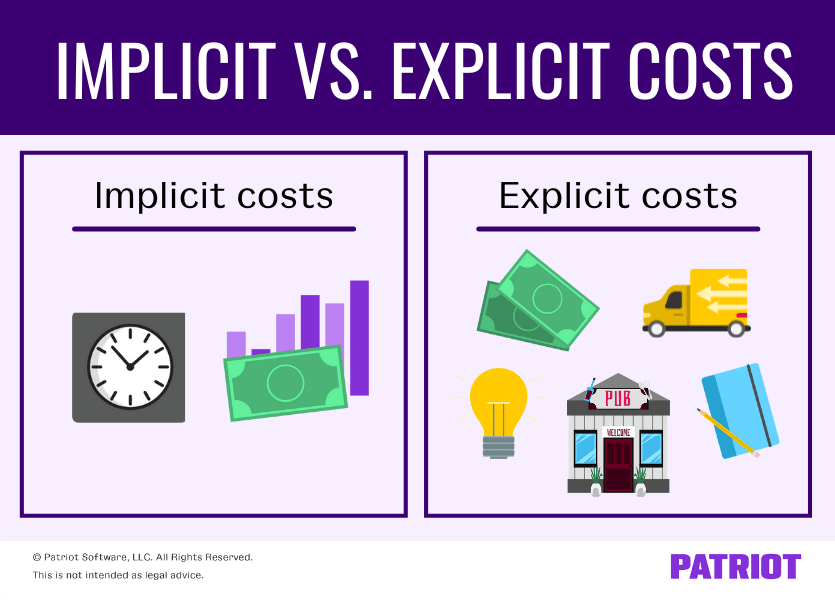
Explicit Costs are the straightforward, out-of-pocket payments a firm makes to others. These are the costs that an accountant would record on a balance sheet. They involve a direct monetary transaction.
- Examples: Wages paid to employees, rent for office space, cost of raw materials, utility bills.
Implicit Costs, on the other hand, represent the opportunity cost of using resources that the firm already owns or that are contributed by its owner. No money changes hands, but there is still a cost in the form of a sacrificed opportunity.
- Key Example: An entrepreneur who starts a new business gives up the salary they could have earned at another job. This foregone salary is an implicit cost.
- Another Example: Using personal savings to fund a business. The implicit cost is the interest or investment return that money could have earned if it were left in a savings account or invested in the stock market.
The image below provides a helpful visual breakdown of these two cost categories.
To get a formal definition and see how these costs fit into the profit calculation, please read the first part of this chapter from the Principles of Microeconomics textbook.
7.1 Explicit and Implicit Costs – Principles of Microeconomics
This reading provides clear definitions for explicit and implicit costs, which are the building blocks for understanding the two types of profit.
Please read from the beginning of the chapter down to the 'Definition: Accounting Profit and Economic Profit' section. Focus on the definitions of explicit and implicit costs and the examples provided.
2. The Accountant's View: Accounting Profit
Accountants are concerned with tracking the monetary flows in and out of a company. Therefore, they calculate profit by subtracting only the explicit, out-of-pocket costs from the total revenue.
The formula is simple:
This figure is crucial for tax purposes and for reporting financial health to investors and lenders. It tells you whether the business is bringing in more money than it is paying out.
Let's see this in action with a simple example.
Types of Profit- Micro Topic 3.4
This video by Jacob Clifford introduces the concepts of accounting and economic profit using an easy-to-follow example of an ice cream business.
Watch the segment from 0:21 to 1:15. Notice how the calculation includes only the explicit, out-of-pocket costs like the business license, the cart, and the ingredients.
As you saw, the ice cream business made an accounting profit of $150. From a purely financial reporting perspective, the business is profitable. But is it a good decision for Kevin, the owner? To answer that, we need the economist's perspective.
3. The Economist's View: Economic Profit
Economists are interested in the allocation of scarce resources. They want to know if running this business is the best possible use of the owner's resources (time, money, and effort). To determine this, they include all costs—both explicit and implicit.
The total cost from an economist's perspective is the economic cost:
This leads to the definition of economic profit:
or
Now, let's revisit the ice cream business and see how the calculation changes when we include the implicit cost of Kevin's time.
Types of Profit- Micro Topic 3.4
Continuing with the same video, let's see how including opportunity cost changes the picture.
Now watch from 1:15 to 3:29. Pay close attention to how the introduction of implicit costs (the opportunity cost of Kevin's time and money) leads to a negative economic profit.
The result is striking: while the business had a positive accounting profit, it has a negative economic profit. This means that Kevin would have been better off financially by pursuing his next best alternative (e.g., working at his other business).
4. Interpreting Economic Profit
The sign of the economic profit tells us a lot about the wisdom of a business decision:
- Positive Economic Profit: The business is generating more profit than the next best alternative. You are making the right choice!
- Negative Economic Profit: The business is generating less profit than the next best alternative. From a purely financial standpoint, you would be better off doing something else.
- Zero Economic Profit (Normal Profit): This is a crucial concept. It means the business is generating just enough revenue to cover all its explicit costs and its implicit costs. In other words, you are earning exactly as much as you would in your next best alternative. You are paying yourself for your time and covering the opportunity cost of your capital. This is considered a sustainable, acceptable outcome in economics, not a failure.
To see these ideas applied in another context, watch this detailed walkthrough from Khan Academy.
Economic profit vs accounting profit | Microeconomics | Khan Academy
This Khan Academy video provides another excellent example, this time involving a restaurant, to solidify the distinction between the two types of profit and their implications for decision-making.
Watch the entire video (up to 8:02). The instructor first calculates the accounting profit, then introduces the implicit cost of 'wages foregone' to calculate the economic profit. Focus on the conclusion he draws about whether it 'makes sense to run the business'.
5. Summary and Comparison
We've established that accountants and economists have different goals, leading to different calculations of profit. Accounting profit focuses on financial viability, while economic profit focuses on strategic optimality.
The reading below provides another clear, worked-out example (this time with a lawyer starting a practice) and formally lays out the profit formulas.
7.1 Explicit and Implicit Costs – Principles of Microeconomics
To reinforce the calculations and formal definitions, please read this section from the textbook, which includes another clear numerical example.
Read the sections 'Definition: Accounting Profit and Economic Profit' and 'Calculating Implicit and Explicit Costs'. Work through the example of Fred the lawyer.
Finally, the table below neatly summarizes the key distinctions between the two concepts.

Conclusion
In this lesson, we've unpacked the crucial difference between how an accountant and an economist view profit. This distinction will be fundamental to our analysis of firm behavior in the upcoming lessons.
Here are your key takeaways:
- Explicit costs are direct, out-of-pocket payments, while implicit costs are the opportunity costs of using one's own resources.
- Accounting Profit is calculated as
Total Revenue - Explicit Costs. It measures a firm's financial performance and is used for tax and reporting purposes. - Economic Profit is calculated as
Total Revenue - (Explicit Costs + Implicit Costs). It measures whether a firm is making the best use of its resources compared to the next best alternative. - A zero economic profit (or "normal profit") is not a bad outcome; it means you are fully covering all your costs, including the opportunity cost of your time and capital.
In our next lesson, we will build on this foundation. Now that we understand how to measure profit, we will learn the core rule that firms use to decide on the quantity of output that will maximize that profit: the MR = MC rule.