Recommended resources
The freely available resources this lesson will direct you to.
Hello! Welcome back to our module on "Understanding and Overcoming Procrastination."
In our last lesson, we focused on making tasks easier to start using the Two-Minute Rule. You learned to scale down daunting goals into tiny "gateway habits" to overcome initial inertia. This is a powerful way to reduce the friction of beginning a task.
But what if, in addition to making a task easier, we could also make it more attractive? This is our focus for today. We're moving from reducing the negative feelings associated with a task to increasing the positive ones.
The learning outcome for this lesson is to apply 'temptation bundling' to increase the immediate reward of your learning activities. This strategy is about systematically pairing something you need to do with something you want to do, making your learning habits instantly more enjoyable.
The Problem of Delayed Gratification
Many of the most important learning goals—like mastering data analysis or learning a new coding language—suffer from the same problem: the costs are immediate (effort, confusion, time), but the rewards are far in the future. Our brains often prefer the immediate gratification of scrolling through social media or watching a show over the long-term payoff of deep learning. This is a core driver of procrastination.
Temptation bundling is a strategy designed to solve this by bringing a dose of immediate gratification to your 'should' activities.
Let's look at a clever real-world example to see how it works.
Temptation Bundling: A Simple Way to Boost Your Willpower
This excerpt from James Clear's bestselling book, Atomic Habits, introduces temptation bundling with a memorable story about an engineering student who hacked his exercise bike. It's a perfect illustration of the core concept.
Read the first two paragraphs of the article, which tell the story of Ronan Byrne and his Netflix-powered bike.
As the story illustrates, the concept is simple yet powerful: link an action you want to do with an action you need to do.

The Psychology Behind the Bundle: Premack's Principle
This isn't just a clever trick; it's based on a well-established psychological concept called Premack's Principle. In simple terms, the principle states that more probable behaviors will reinforce less probable behaviors.
Think of it like this:
- Watching your favorite comedy special is a "high-probability" behavior. You're very likely to do it without any prompting.
- Working through a dry technical document on API integration is a "low-probability" behavior. It requires more willpower.
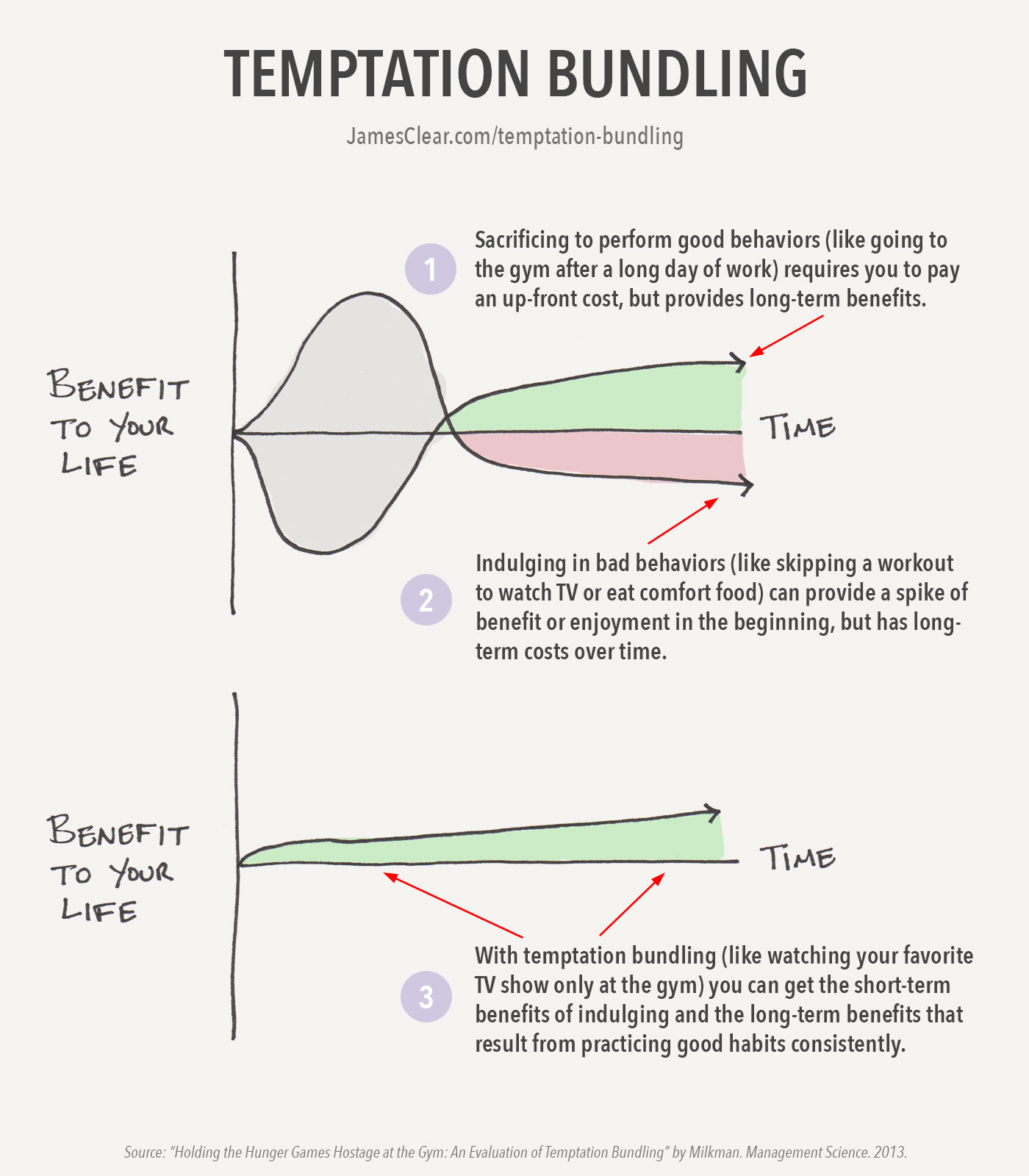
By making the high-probability behavior contingent on the low-probability one (e.g., "I can only watch the comedy special while I review the API documentation"), you use the appeal of the "want" to pull you through the "should."
This elegantly changes the emotional calculus of the task. As a designer, you appreciate how visuals can clarify complex data. The image below does just that for behavior.
The Science and Versatility of Temptation Bundling
The term "temptation bundling" was coined by Professor Katherine Milkman at the University of Pennsylvania. Her research provides a solid foundation for this strategy and demonstrates its effectiveness.
Temptation bundling: stop procrastinating by boosting your willpower
This article from Ness Labs dives into the original research behind temptation bundling and provides a wide range of examples, showing just how flexible this technique can be.
Please read the sections titled 'The science of temptation bundling' and 'The many faces of temptation bundling'. Pay attention to the results of the gym/audiobook study and the different ways the strategy can be applied.
As the article shows, the applications are broad. You can bundle:
- Household Chores: Listening to your favorite podcast only while cleaning the kitchen.
- Tedious Admin: Getting a pedicure only while clearing out your work email inbox.
- Difficult Social Tasks: Meeting a challenging colleague at your favorite coffee shop.
The key is that the "want" must be exclusively tied to the "should." If you listen to that podcast anytime you want, it loses its power as a motivator for cleaning.
How to Create Your Own Temptation Bundle
Now it's time to apply this to your own learning goals. Here is a straightforward, three-step process to design your own bundles.
Step 1: Create a Two-Column List
Take a moment to generate a list of your personal "wants" and "shoulds." Be specific!
-
Column 1: Your "Wants" (Pleasures & Rewards)
- What podcasts, music, or audiobooks do you love? (e.g., a specific comedy podcast, a new album)
- What simple treats do you enjoy? (e.g., a cup of high-quality tea, a specific Caribbean snack)
- What low-effort entertainment do you turn to? (e.g., watching YouTube clips about product design, browsing Dribbble)
-
Column 2: Your "Shoulds" (Learning Tasks You Avoid)
- What specific learning activities do you procrastinate on? (e.g., "reading the chapter on p-values in my stats book")
- What part of your skill development feels like a chore? (e.g., "practicing Python data manipulation with pandas")
- What tasks are important but not urgent? (e.g., "documenting a past UX project for my portfolio")
Step 2: Combine 'Wants' with 'Shoulds'
Look at your two lists and start pairing them up. The goal is to find a "want" that can be done simultaneously with a "should."
- Example 1: Listen to my favorite comedy podcast only while reviewing user feedback data from our last sprint.
- Example 2: Enjoy a cup of that special Blue Mountain coffee only while working through my morning SQL coding challenge.
- Example 3: Watch video essays about film cinematography only while doing my daily 30 minutes on the exercise bike.
Step 3: Check for Conflict
This is a crucial step that many people miss. The "want" should not undermine the "should."
For example, bundling "learning a complex new coding syntax" with "watching the latest episode of a dialogue-heavy drama" is a recipe for failure. The cognitive load from the TV show will interfere with the deep focus required for coding.
A better bundle would be "learning a new coding syntax" + "listening to my favorite instrumental electronic album." The music provides a pleasant background without competing for your attention.
Test your understanding!
You want to apply temptation bundling to learn more about advanced prototyping in Figma. Which of the following bundles is most likely to be effective, and why?
- Watch a new tutorial on Figma's interactive components (should) + Watch your favorite stand-up comedy special (want).
- Watch a new tutorial on Figma's interactive components (should) + Catch up on your favorite design news podcast (want).
- Watch a new tutorial on Figma's interactive components (should) + Treat yourself to your favorite snack (want).
Show answer
Bundle #3 is the most likely to be effective.
Here's why the others are problematic:
- Bundle #1: The comedy special requires your visual and auditory attention, which directly conflicts with watching and understanding a visual software tutorial. You'd end up doing both poorly.
- Bundle #2: The design podcast also requires auditory attention and cognitive processing. You would be trying to process two different streams of information at once, which is highly inefficient and distracting.
- Bundle #3: Enjoying a snack is a sensory reward that doesn't compete for the cognitive resources needed to watch and learn from the tutorial. It provides an immediate pleasure without interfering with the primary task.
Your Turn: Design Your Learning Bundle
Take one of your "should" learning tasks from the list you made and design a temptation bundle for it. Write it down in this format:
"I will only [WANT] while I [SHOULD]."
This simple commitment can dramatically change your motivation to engage with difficult but important learning tasks.
Conclusion
Today we've added a powerful strategy to your toolkit for fighting procrastination. While the Two-Minute Rule helps you get started, Temptation Bundling helps you want to get started. By linking an immediate reward to an effortful task, you change the entire emotional landscape of your learning routine.
Key Takeaways:
- Temptation Bundling pairs a "want" (an enjoyable activity) with a "should" (a necessary but less appealing task).
- It works by leveraging Premack's Principle, using a high-probability behavior to reinforce a low-probability one.
- The process involves listing your wants/shoulds, pairing them effectively, and checking for cognitive conflict.
- The goal is to make habits with long-term benefits more instantly gratifying.
What's Next?
So far, we've focused on adding things to make learning easier and more attractive. But what about removing the things that get in our way? In the next lesson, we will focus on proactive strategies to design your learning environment to minimize distractions and procrastination cues, making it easier to stay on track.