Recommended resources
The freely available resources this lesson will direct you to.
Hello! Welcome back to our course.
In our last two lessons, we delved into risk metrics from a lender's perspective, analyzing the Debt Service Coverage Ratio (DSCR) and the Break-Even Occupancy (BEO) rate. We saw how these metrics help determine a property's ability to cover its debt service payments.
Today, we'll complete our tour of key leverage risk metrics by focusing on our learning outcome: to calculate debt yield as a measure of leverage risk. Debt Yield is a straightforward yet powerful metric that lenders, particularly in commercial real estate, rely on for a quick, "back-of-the-envelope" assessment of risk. Unlike DSCR, it is not influenced by interest rates or amortization periods, providing a clear, unbiased look at the relationship between a property's income and the loan amount.
1. What is Debt Yield?
At its core, Debt Yield answers a simple question for the lender: "What is my cash return on the loan if I have to foreclose on this property and take it over on day one?"
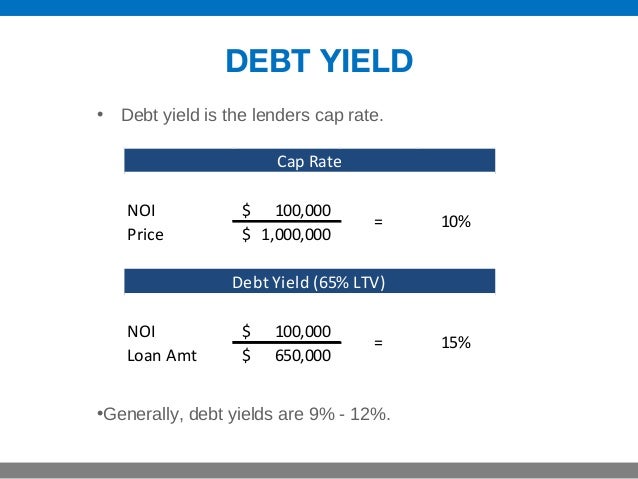
It's calculated as the property's Net Operating Income (NOI) divided by the total loan amount.

This metric gives the lender a snapshot of the return they would receive on their capital if they became the owner. Because it uses NOI, which is calculated before debt service, it provides a "capital structure neutral" view of the property's performance relative to the debt.
To get a formal definition and understand the lender's mindset, let's turn to our first resource.
Debt Yield | Formula + Calculator
This article from Wall Street Prep provides an excellent introduction to Debt Yield, explaining its definition, formula, and importance from a lender's viewpoint.
Please read the first two sections, 'What is Debt Yield?' and 'How to Calculate Debt Yield'. Focus on understanding that Debt Yield represents the lender's potential return in a foreclosure scenario and memorize the simple formula.
An intuitive way to think about Debt Yield is as the "lender's cap rate." As you know, the cap rate (NOI / Property Value) is your return if you paid all cash. The Debt Yield (NOI / Loan Amount) is the lender's return on their investment—the loan.
2. Why Debt Yield? The Limits of LTV and DSCR
You might wonder why lenders need another metric when they already have Loan-to-Value (LTV) and Debt Service Coverage Ratio (DSCR). Debt Yield was developed to address the specific shortcomings of these two traditional metrics, especially in changing market conditions.
- DSCR's Weakness: The DSCR can be manipulated by the loan's terms. A lender could extend the amortization period (e.g., from 25 to 30 years) or lower the interest rate, which would decrease the annual debt service and artificially inflate the DSCR, making a risky loan appear safer than it is.
- LTV's Weakness: The LTV ratio is dependent on the property's market value. In "hot" or speculative markets with low cap rates, property values can become inflated. A lender might adhere to a 75% LTV limit, but if the "V" (value) is unrealistically high, the actual loan amount could be excessive relative to the property's income-generating ability.
Debt Yield cuts through these distortions. It is independent of interest rates, amortization terms, and market valuations. It creates a direct, unvarnished link between the property's actual operating income and the amount of debt.
The following article explains this distinction with excellent comparative scenarios.
How To Calculate Debt Yield To Underwrite Loans For CRE
This article from Altus Group does a fantastic job of explaining why Debt Yield is a necessary metric by showing how LTV and DSCR can give misleading signals in different market cycles.
Read the sections 'Why not just use LTV and DSCR?' and the following comparative analysis. Pay close attention to the tables that show how a loan sized with Debt Yield remains constant regardless of the property's valuation (which fluctuates with the cap rate).
3. Calculation, Interpretation, and Loan Sizing
Now let's apply this. Lenders typically have a minimum required Debt Yield for different property types and markets. A common range is 8% to 12%. A higher Debt Yield signifies lower risk for the lender.
Example Calculation:
Imagine you're seeking a loan for a property in Spain with a stabilized NOI of €150,000. You are requesting a loan of €1,650,000.
A 9.1% Debt Yield falls within the typical acceptable range, so a lender would likely view this positively.
Using Debt Yield for Loan Sizing
More importantly, lenders use their target Debt Yield to determine the maximum loan amount they are willing to offer. The formula is simply rearranged:
Example of Loan Sizing:
Let's say the lender's minimum required Debt Yield for this type of property is 9.5%. Based on the property's €150,000 NOI, the maximum loan they would offer is:
Even though you requested €1,650,000, the lender's Debt Yield constraint would cap their offer at approximately €1.58M. In practice, a lender will calculate the maximum loan amount allowed by their LTV, DSCR, and Debt Yield limits, and offer the lowest of the three.
Test your understanding!
You are analyzing a property with a projected NOI of €80,000. You plan to request a loan of €950,000. The lender has a maximum LTV of 75%, a minimum DSCR of 1.25x, and a minimum Debt Yield of 8.5%.
- Calculate the Debt Yield for your requested loan.
- Based only on the Debt Yield requirement, would the lender approve the €950,000 loan?
- What is the maximum loan amount the lender would offer based on their Debt Yield constraint?
Show answer
-
Debt Yield Calculation:
-
Approval Decision: No. The calculated Debt Yield of 8.42% is below the lender's minimum requirement of 8.5%.
-
Maximum Loan Amount (Loan Sizing):
The maximum loan the lender would offer, based on their Debt Yield requirement, is €941,176.
4. Modeling Debt Yield in Python
As with our other metrics, we can easily model Debt Yield and loan sizing calculations in Python. This helps to automate the "what-if" analysis during your initial deal screening.
def calculate_debt_yield(noi, loan_amount):
    """
    Calculates the Debt Yield for a property.

    Args:
        noi (float): The property's Net Operating Income.
        loan_amount (float): The total loan amount.

    Returns:
        float: The Debt Yield as a decimal.
    """
    if loan_amount <= 0:
        raise ValueError("Loan amount must be positive.")
    return noi / loan_amount

def size_loan_with_debt_yield(noi, target_debt_yield):
    """
    Calculates the maximum loan amount based on a target Debt Yield.

    Args:
        noi (float): The property's Net Operating Income.
        target_debt_yield (float): The lender's minimum required Debt Yield (as a decimal).

    Returns:
        float: The maximum supportable loan amount.
    """
    if target_debt_yield <= 0:
        raise ValueError("Target Debt Yield must be positive.")
    return noi / target_debt_yield

# --- Using the numbers from our 'Test your understanding' section ---
property_noi = 80000
requested_loan = 950000
lender_min_dy = 0.085

# 1. Calculate the Debt Yield on the requested loan
dy_on_request = calculate_debt_yield(property_noi, requested_loan)
print(f"Debt Yield on requested loan of €{requested_loan:,.2f}: {dy_on_request:.2%}")

# 2. Check if it meets the lender's criteria
if dy_on_request >= lender_min_dy:
    print("The requested loan meets the lender's Debt Yield requirement.")
else:
    print(f"The requested loan does NOT meet the lender's minimum Debt Yield of {lender_min_dy:.2%}.")

# 3. Calculate the maximum loan the lender would offer
max_loan_from_dy = size_loan_with_debt_yield(property_noi, lender_min_dy)
print(f"Maximum loan amount based on Debt Yield: €{max_loan_from_dy:,.2f}")
This script automates the exact steps you took in the exercise, allowing you to quickly assess financing scenarios for potential investments.
Conclusion
In this lesson, we've added the final primary leverage risk metric, Debt Yield, to your analytical toolkit. It offers a robust, simple, and transparent measure of risk that is immune to the distortions that can affect LTV and DSCR.
Key Takeaways:
- Definition: Debt Yield is the lender's potential return on investment if they were to foreclose, calculated as
NOI / Loan Amount. - Purpose: It serves as a crucial check against inflated valuations (low cap rates) and manipulated financing terms (long amortizations or low rates).
- Interpretation: A higher Debt Yield is safer for the lender. Lenders set minimum thresholds (e.g., 8-12%) to manage their risk.
- Application: Debt Yield is a primary tool for loan sizing, determining the maximum loan amount a property's income can support based on the lender's risk tolerance.
Preview of the Next Lesson:
We have now concluded our module on core risk metrics. This marks a major transition point in our course. We will now move from universal, pre-tax financial metrics to the specifics of real estate investing in Spain. Our next module, "Taxation of Spanish Real Estate Operations," will begin to layer in the crucial details of the Spanish tax system. In our very next lesson, we will tackle a fundamental decision every buyer faces: distinguishing between IVA (VAT) and ITP (Transfer Tax) on property purchases in Spain and calculating their amounts. This is a critical first step in understanding the true acquisition cost of a property in Spain.