Recommended resources
The freely available resources this lesson will direct you to.
Welcome back! In our last lesson, you learned how to visualize the execution of a recursive function by tracing its calls and returns using a call tree. This gave us a powerful mental model for understanding how recursion unfolds, especially for branching tree recursion like the Fibonacci sequence.
Today, we're taking the next logical step: moving from visualization to analysis. We will use the call tree you now understand to estimate the performance costs of a recursive algorithm. Specifically, we'll focus on three key metrics: the total number of calls (which informs time complexity), the maximum recursion depth (which dictates memory usage), and the very real risk of a "stack overflow" in JavaScript. This is where the abstract concept of recursion meets the practical constraints of the machines you build for every day.
Analyzing Time Complexity: Counting the Calls
The call tree gives us a direct, visual way to understand the time complexity of a recursive function. If we assume that the work done inside a single call is constant (ignoring the recursive calls themselves), then the total runtime is proportional to the total number of calls made. This is simply the number of nodes in the call tree.
Let's revisit our two main examples from the last lesson.
Linear Recursion: factorial
For a function like factorial(n), the call tree is a simple chain: fact(n) -> fact(n-1) -> ... -> fact(0).
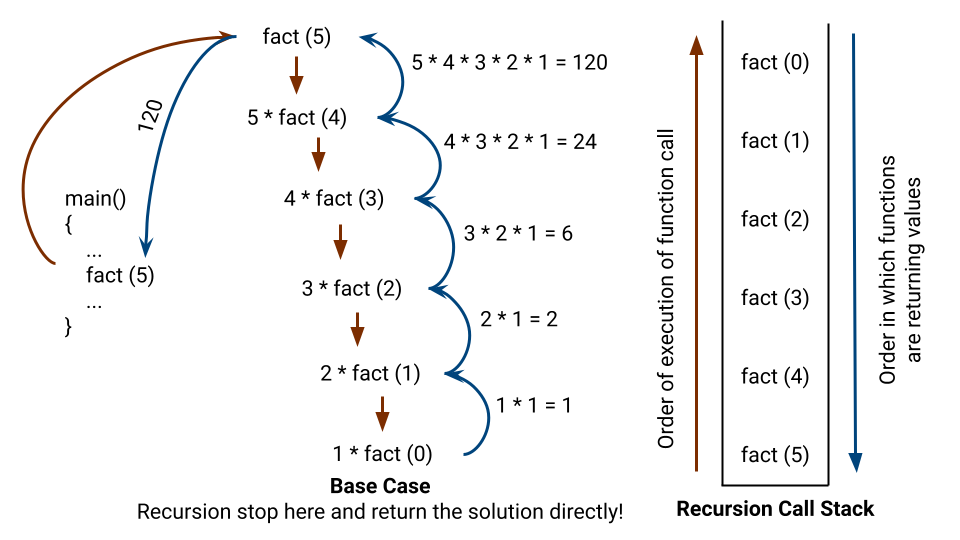
If we call factorial(5), we make 6 calls in total (fact(5) through fact(0)). For an input n, we make n+1 calls. Since the number of calls grows linearly with the input n, we say the time complexity is O(n).
Tree Recursion: fibonacci
For the naive recursive fibonacci(n), the story is dramatically different. Each call fib(n) generates two more calls, fib(n-1) and fib(n-2).
This branching structure leads to an exponential number of nodes. The number of calls roughly doubles with each level of depth, resulting in a time complexity of approximately O(2^n). This is why fib(77) would hang your browser—the number of operations is astronomical. The call tree makes it clear that we are re-computing the same values (like fib(3)) over and over.
Time and Space Complexity for Recursive Algorithms
This reading from Launch School's book provides a clear framework for analyzing the complexity of recursive functions. It walks through both the factorial and fibonacci examples, formalizing the ideas we've just discussed.
Please read the sections on time complexity analysis, the Factorial Function, and the Fibonacci Function. Focus on how the shape of the call tree (linear vs. branching) directly leads to the O(n) and O(2^n) time complexities.
Analyzing Space Complexity: Measuring the Depth
Now for the crucial, and sometimes counter-intuitive, part: space complexity. It's tempting to think that if an algorithm makes an exponential number of calls, it must also use an exponential amount of space. This is incorrect.
Space complexity in recursion is determined not by the total number of calls, but by the maximum number of function calls on the call stack at any single point in time. This corresponds to the depth of the recursion—the longest path from the root of the call tree to a leaf node.
Let's watch a video that makes a clear distinction between the total number of calls and the maximum depth of the call stack.
Finding the Space Complexity of Recursive Algorithms
This Neso Academy video provides an excellent visual explanation for why the number of total function calls can be different from the maximum number of activation records (stack frames) on the call stack.
Watch from this example, which shows how for sequential calls f(), g(), h(), the stack size remains small even though there are many total calls. Then, pay close attention to the conclusion from this summary, which states the key formula: Space Complexity is determined by the depth of recursion.
As the video explains, space complexity for a recursive algorithm can be boiled down to:
For now, we'll focus on the first part, the space used by the call stack itself.
Linear Recursion: factorial
In factorial(n), the call stack grows to its maximum size when fact(0) is called. The stack will contain frames for fact(n), fact(n-1), ..., fact(0). The depth is n+1. Thus, the space complexity is O(n). The diagram of the factorial call stack above shows this perfectly.
Tree Recursion: fibonacci
Here is the key insight. For fib(n), even though the time complexity is O(2^n), the space complexity is only O(n).
Why? Because the JavaScript engine executes the calls in a depth-first manner. When computing fib(n-1) + fib(n-2), the engine must fully resolve the entire fib(n-1) branch first. It goes all the way down to a base case, and as the calls return, their frames are popped off the stack. Only after fib(n-1) has returned a value does the engine start the fib(n-2) call, pushing its frames onto a now-shrunken stack.
The stack's maximum depth is reached by following the longest path, which is fib(n) -> fib(n-1) -> ... -> fib(1). The length of this path is n.
Time and Space Complexity for Recursive Algorithms
Let's return to the same reading to see a detailed analysis of space complexity. It directly addresses the potential misconception about the space usage of the Fibonacci function.
Read the section on Space Complexity in general. Then, carefully follow the step-by-step trace under Fibonacci Call Stack. Notice how the call stack grows and shrinks, but its maximum height never exceeds what's needed for the deepest single path.
The Practical Limit: "Maximum call stack size exceeded"
This analysis has a very direct, practical consequence for you as a JavaScript developer. The call stack is not infinite. Every JavaScript engine imposes a limit on its size. When you write a recursive function that goes too deep, you exhaust this limit and the program crashes.
You've likely encountered this error: Uncaught RangeError: Maximum call stack size exceeded.
The JS Call Stack Explained In 9 Minutes
In this short clip, Colt Steele demonstrates exactly how this error happens and what it means.
Watch from this section where he creates a situation of infinite recursion and triggers the stack overflow error.
How deep is "too deep"? A good rule of thumb for modern JS engines is that the limit is somewhere around 10,000 stack frames.
This article from javascript.info gives us that useful rule of thumb.
Read the first two paragraphs, from the definition of recursion depth to the discussion of its practical limits in JavaScript.
This is a critical constraint. If you're solving a problem where the input n could be, say, 100,000, a recursive solution with O(n) depth like factorial(n) is not viable. It will crash. An iterative solution using a loop, which has O(1) stack space, would be necessary. This trade-off between the elegance of recursion and the practical limits of the call stack is a constant consideration in algorithm design.
Putting It All Together: A Backtracking Preview
Let's analyze one final example that ties these concepts together and previews the backtracking search patterns we'll cover next.
Consider a function that generates all possible binary strings of a given length n. For n=2, it should produce ["00", "01", "10", "11"].
Here's a recursive implementation in TypeScript:
function generateBinaryStrings(n: number): string[] {
  const result: string[] = [];

  function findCombinations(currentString: string) {
    // Base Case: The string is the desired length
    if (currentString.length === n) {
      result.push(currentString);
      return;
    }

    // Recursive Step: Explore both possibilities
    findCombinations(currentString + "0"); // Choice 1
    findCombinations(currentString + "1"); // Choice 2
  }

  findCombinations(""); // Start with an empty string
  return result;
}
Let's analyze generateBinaryStrings(2). The call tree looks like this:
.jpg)
-
Call Count (Time): The tree has a root, 2 nodes at level 1, and 4 nodes at level 2. The total number of nodes is 1 + 2 + 4 = 7. For a general
n, the total number of calls is2^(n+1) - 1. This is O(2^n) time complexity, which makes sense because we have to generate 2^n strings. -
Recursion Depth (Space): Look at the longest path:
"" -> "a" -> "aa". The depth of this path is 2 (orn). The call stack will hold at mostn+1frames (the initial call plusnrecursive steps). The space complexity for the call stack is therefore O(n). -
Stack Overflow Risk: The recursion depth is
n. If you were to callgenerateBinaryStrings(20000), it would definitely crash due to a stack overflow. However, for a typical interview-sized input liken=20, the depth is only 20, which is perfectly safe. The bottleneck would be the O(2^20) time, which is already over a million operations.
Conclusion
In this lesson, we've equipped our call tree model with analytical power. You can now look at a recursive function and estimate its performance costs, a vital skill for any algorithmic problem-solver.
Here are the key takeaways:
- Time Complexity corresponds to the total number of nodes in the call tree. Branching calls can lead to exponential time.
- Space Complexity corresponds to the maximum depth of the call tree. Even with exponential time, space usage can still be linear.
- The call stack's space is determined by the longest single path of "active" calls, not all possible calls.
- JavaScript enforces a stack size limit (around 10,000 calls deep). This makes recursive solutions with a large linear depth (e.g., O(n) where n > 10,000) impractical, requiring an iterative approach instead.
In our next lesson, we will begin our formal study of backtracking. We will start by implementing a classic pattern, "choose-or-skip," to generate all subsets of a set. You'll see that the generateBinaryStrings function we just analyzed is a perfect primer for this powerful technique.