Recommended resources
The freely available resources this lesson will direct you to.
Hello! In our last lesson, we took a major step in intentional sound design by learning how to select a specific filter type to establish the core character of our lead. We now have a harmonically rich sound source that's been shaped by a chosen filter, but it remains sonically polite. Today, we'll inject personality and intensity directly at the filter stage.
This lesson focuses on using two of the most expressive controls in synthesis: resonance and drive. Our goal is to apply them to add controlled aggression for punchy dancefloor and neuro leads, or to create the vocal-like qualities essential for expressive melodies. This is where you move from merely shaping a sound to making it "scream" or "talk."
The Role of Resonance: Adding Emphasis and Tonal Peaks
You'll recall from our last session that resonance is a boost in amplitude at the filter's cutoff frequency. While low resonance is great for subtle shaping, higher resonance values are where its true character-defining power lies.
The "Why" Behind High Resonance:
- To Emphasize Filter Movement: When you modulate the filter cutoff with an envelope or LFO, a high resonance setting creates a sweeping, whistling sound that makes the modulation far more dramatic and audible. This is the foundation of countless "squelchy" acid basslines and "wah-wah" lead effects. The key is that the resonance highlights the path the cutoff frequency is taking.
- To Add a Specific Tonal Character: Even on a static sound with no filter modulation, high resonance imposes its own pitch or tone. It acts like a focused EQ boost, creating a sharp peak that can make a lead sound more "pointed," nasal, or even "singing." At extreme settings, the filter will begin to self-oscillate, producing a sine-wave-like tone at the cutoff frequency.
A classic example of this principle is the iconic Roland TB-303 acid sound, which is built on the interplay between a high-resonance filter, envelope modulation, and distortion.
Synthwave and Acid Bass Sounds
This article from Polarity.me provides an excellent, concise explanation of how high resonance and drive are used to create aggressive bass sounds, a technique directly transferable to lead design.
Focus on the sections "Synthwave Bass," "Acid Bass (303 Style)," and the accompanying video transcription. Note the emphasis on "cranking the resonance" and finding the "sweet spot" of the resonance's center frequency. This concept of searching for a sweet spot is crucial for intentional sound design—it's not about maxing out a knob, but about tuning it to the source material.
Filter Drive: Introducing Controlled Aggression
While resonance accentuates existing frequencies, drive adds new ones. Most filter circuits in synthesizers, both analog and digital, can be overdriven. In Serum, the Drive knob controls the level of the signal being pushed into the filter. Driving the signal causes it to saturate or clip, creating new harmonic overtones.
The "Why" Behind Filter Drive:
- To Add Harmonics and Warmth: Gentle drive can add subtle even or odd-order harmonics, making a sound feel warmer and richer, similar to running a signal through analog hardware.
- To Create Aggression: Pushing the drive harder introduces more aggressive, dense distortion, adding bite and grit to the sound. This is a key technique for helping a lead cut through a busy DnB mix.
Crucially, filter drive is applied before the signal is filtered. This means the harmonics you create with drive are then shaped by the filter's cutoff and resonance. This is different from adding a distortion effect in the FX rack, which processes the sound after it has already been filtered. The order of operations yields fundamentally different sonic results.
Let's look at one of Serum's filters designed specifically for this purpose.
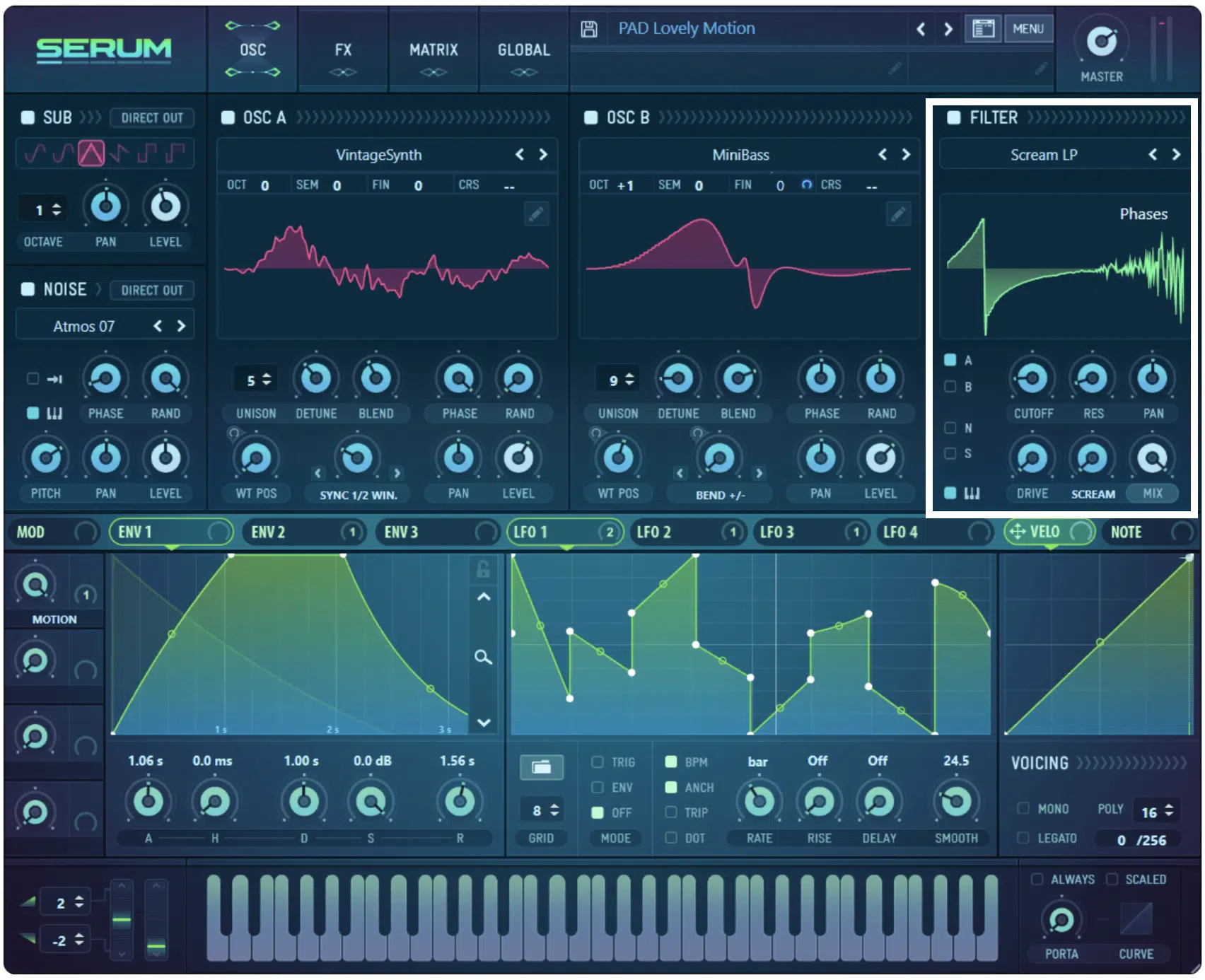
The Scream parameter in this filter is essentially a specialized form of feedback and distortion that interacts heavily with the resonance, perfect for creating the aggressive tones found in Neurofunk.
Now, let's see a practical application of these controls in a Neuro DnB context.
How to make NEURO DNB lead in Serum like Noisia, Mefjus, Camo & Krooked
The video "How to make NEURO DNB lead in Serum" by PHENOMSOUND quickly demonstrates the immediate impact of applying resonance and drive.
Watch the short segment from enabling the filter. The creator selects a filter and immediately dials in the Cutoff, Resonance, and Drive. Listen to how the character of the sound changes from a basic waveform into a much more aggressive and textured lead, simply by adjusting these three parameters.
Synergy in Action: Crafting Specific Lead Characters
Let's combine these concepts with the filter types from our previous lesson to achieve our specific goals: vocal qualities and controlled aggression.
1. Creating Vocal-like Qualities
For this task, the Formant filter is our primary tool. As we discussed, it's designed to mimic the resonant peaks of the human vocal tract. Resonance and drive play a key role in enhancing this effect.
- Resonance will define the sharpness and "intelligibility" of the vowel sound. Higher resonance creates a more pronounced and defined vowel shape.
- Drive can add a gravelly, throaty texture, turning a clean "ooo" sound into a more aggressive "grrr" or adding breathiness.
- Modulating the Cutoff knob is what makes the sound "talk" by moving between different vowel shapes.
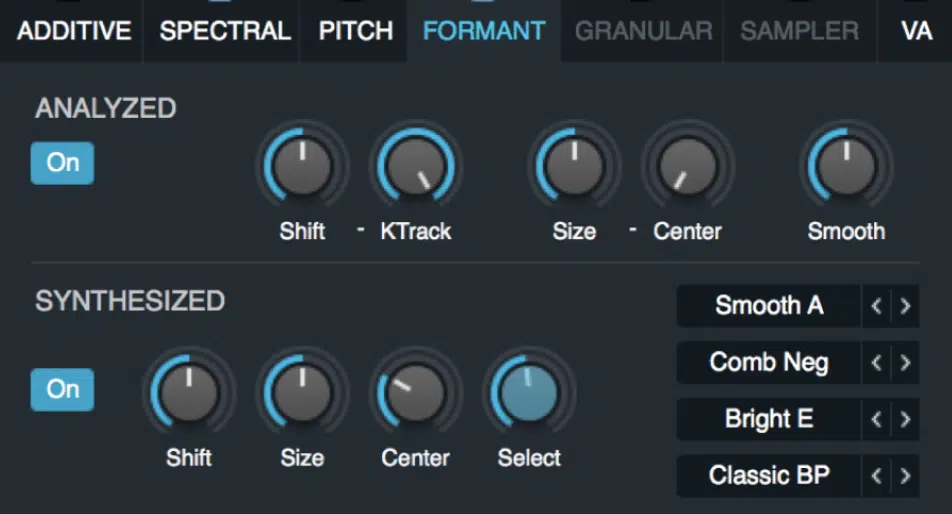
The following video, while focused on bass design, perfectly illustrates the principle of making a synth "talk."
10 Serum 2 Tricks for Modern DnB Bass Sound Design
In this clip from "10 Serum 2 Tricks for Modern DnB Bass Sound Design," STRANJAH demonstrates using a Formant filter.
Watch the section on employing formant filters. Pay attention to how he advises automating the Cutoff to enunciate the vowel, and explicitly mentions increasing the Drive and changing the Formant parameter (which functions like a fine-tune for the vowel character) to alter the vocal tonality. This is exactly the technique you'd use for an expressive Fox Stevenson-style lead.
2. Creating Controlled Aggression
For aggressive leads, we can use a wider variety of filters, but the core technique often involves pushing both resonance and drive.
-
Low-Pass + High Resonance & Drive: This is the Neurofunk and Acid technique we've discussed. Use a filter like the
German LPorScream LP. Set a high resonance to create a sharp tonal peak, then increase theDriveto make that peak saturate and "scream." Modulating the cutoff will produce a tearing, aggressive sweep. -
Phaser/Comb + High Resonance & Drive: These filters create a series of peaks and notches, giving a sound a nasal or metallic quality. Applying resonance and drive here exaggerates that character significantly. This is great for creating the "frog" or "cricket" basses in Jump-Up, and equally useful for creating bizarre, futuristic lead textures.
10 Serum 2 Tricks for Modern DnB Bass Sound Design
Let's return to the STRANJAH video for a perfect example of this.
Watch the segment on employing a phaser filter. He describes how these filters create a "nasal" sound. The key instruction here is to find the sweet spot with the Cutoff and then "boost up the resonance, increase the drive." This is a repeatable formula for adding controlled, textural aggression.
Conclusion
You now have the tools to move beyond simple subtractive filtering and into the realm of expressive character sculpting. Resonance and drive are not just "more" knobs; they are your primary controls for adding intensity, movement, and personality directly within the filter module.
Key Takeaways:
- Resonance is for emphasis: Use it to highlight filter cutoff movement or to create a specific tonal peak that helps a lead "sing" or "whistle."
- Drive is for harmonics: Use it to add saturation, warmth, and aggression before the signal is shaped by the filter cutoff.
- The combination is key: The interplay between filter type, resonance, and drive is what creates iconic synth tones.
- Vocal Qualities: Formant Filter + Resonance (for sharpness) + Drive (for grit).
- Aggression: LP/Phaser Filter + High Resonance (for a tonal peak) + High Drive (to saturate that peak).
- Think in order of operations: Remember that filter drive shapes the sound before the main filter cutoff, while FX-based distortion shapes it after.
Our lead sound now has a rich timbre and a defined character. However, it's still just a continuous drone. In the next lesson, we will finally give it a shape in time by designing an amplitude envelope (ADSR), turning our sound into a usable musical element like a pluck, stab, or sustained note.