Recommended resources
The freely available resources this lesson will direct you to.
- PyTorch Early Stopping and Model Persistence (3.4)www.youtube.com
- Early Stopping. The Most Popular Regularization Technique In Machine Learning.www.youtube.com
- How to handle overfitting in PyTorch models using Early ...www.geeksforgeeks.org
- Use Early Stopping to Halt the Training of Neural Networks ...www.machinelearningmastery.com
Hello! Welcome to the final lesson in our module on training techniques.
Introduction
Throughout this module, we've built a solid toolkit for training deep neural networks effectively. We started with optimizers and weight initialization, then moved on to tackling overfitting with L2 regularization and dropout, and finally, we explored how Batch Normalization can stabilize and accelerate the training process.
A common thread in these lessons has been the challenge of overfitting, where a model learns the training data too well but fails to generalize to new, unseen data. We've seen how to identify it by analyzing training and validation loss curves. Today, we'll learn a very direct and intuitive method to combat it: Early Stopping.
The idea is simple: if our model's performance on the validation set stops improving, we should stop training. This prevents the model from continuing to train to the point of overfitting and saves computational resources. By the end of this lesson, you will be able to implement an early stopping mechanism from scratch and integrate it into a PyTorch training loop.
1. The Core Idea of Early Stopping
In an ideal world, we would know the exact number of epochs needed to train our model to its peak performance. In reality, this number is unknown and depends on the model, the data, and many other hyperparameters. If we train for too few epochs, the model underfits. If we train for too many, it overfits.
Early stopping provides a pragmatic solution. We set the number of training epochs to a large value (more than we think we'll need) and monitor the model's performance on a separate validation set at the end of each epoch.
Let's watch a video that introduces this concept very clearly.
Early Stopping. The Most Popular Regularization Technique In Machine Learning.
This video from the Underfitted channel provides a great visual explanation of underfitting, overfitting, and how the number of training epochs relates to model performance.
Watch from the beginning to 02:58. Focus on the core idea: how can we know when it's the right time to stop training? The video introduces the need for a validation set and a metric to monitor progress.
As the video explains, we can plot the training loss and the validation loss against the number of epochs. Typically, both will decrease initially. However, at some point, the validation loss will bottom out and may start to rise, even as the training loss continues to fall. This point of divergence is exactly where overfitting begins.
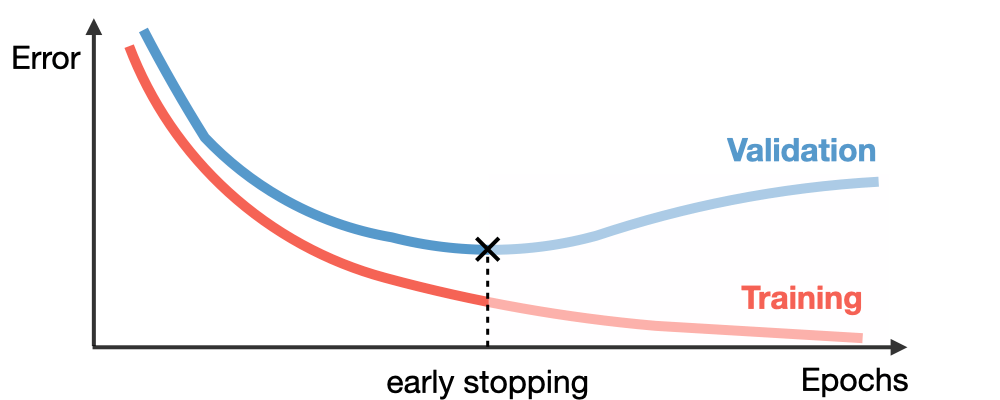
The goal of early stopping is to automatically detect this point and halt the training process, saving the model at its best-performing state.
2. The Components of an Early Stopping Mechanism
A simple strategy of stopping the moment the validation loss increases by any amount can be too sensitive. The training process is often noisy, and the validation loss might fluctuate up and down before settling into a clear upward trend. To build a robust early stopping mechanism, we need a few key ingredients.
Let's continue with the video, which explains these components well.
Early Stopping. The Most Popular Regularization Technique In Machine Learning.
This section of the video explains the practical challenges of early stopping and introduces the concepts of 'patience' and saving the best model.
Watch from 02:58 to the end (05:54). Pay close attention to the explanations of: Why we need 'patience' to handle noisy validation scores. Why we must save the best model state, not the final one.
To summarize the video, a complete early stopping mechanism requires:
- A Validation Set: A holdout portion of your data used to get an unbiased estimate of the model's generalization performance during training.
- A Monitored Metric: Typically, this is the validation loss (
val_loss), which we aim to minimize. It could also be validation accuracy (val_accuracy), which we'd aim to maximize. - Patience: A parameter that defines how many consecutive epochs to wait for an improvement before stopping. For example, a
patienceof 5 means the training will stop only if the validation loss has not improved for 5 epochs in a row. This makes the trigger less sensitive to random fluctuations. - A Model Checkpoint: Since we wait for
patienceepochs, by the time we decide to stop, the model has already been performing sub-optimally for several epochs. Therefore, we must save the model's weights from the epoch with the best score on the monitored metric. When training is halted, we can then load these best weights back into the model.
3. Implementing Early Stopping in PyTorch
Unlike some other frameworks, PyTorch gives you full control over the training loop, which means it doesn't provide a pre-built early stopping "callback". We need to implement this logic ourselves. A clean and reusable way to do this is by creating a dedicated EarlyStopping class.
This class will manage the state of the early stopping logic—such as the current patience counter and the best score seen so far—across epochs.
Let's look at a concrete implementation.
How to handle overfitting in PyTorch models using Early Stopping
The article 'How to handle overfitting in PyTorch models using Early Stopping' from GeeksforGeeks provides a clear, well-structured example of an EarlyStopping class.
Focus on 'Step 3: Implement Early Stopping'. Study the code for the EarlyStopping class. Understand the purpose of each attribute (patience, delta, best_score, counter, best_model_state) and the logic inside the __call__ method.
The core logic of the class you just reviewed is:
- The
__init__method sets up the parameters:patienceanddelta(a minimum change to be considered an improvement). - The
__call__method is the heart of the mechanism. It's executed at the end of each epoch and takes the current validation loss and the model as input.- It compares the current validation loss to the best score recorded so far.
- If there's no improvement, it increments a
counter. If thecounterexceedspatience, it sets theearly_stopflag toTrue. - If there is an improvement, it resets the
counterand saves the current model'sstate_dict()as the new best model state.
For a complementary explanation of these parameters, the next video offers some valuable insights.
PyTorch Early Stopping and Model Persistence (3.4)
In this video, Jeff Heaton discusses his own implementation of an early stopping class, explaining why this manual approach is consistent with PyTorch's design philosophy.
Watch from 00:28 to 03:49. Listen to his explanation of the 'patience' and 'minimum delta' parameters, and the option to 'restore best weights'. This reinforces the concepts from the article.
4. Integrating Early Stopping into the Training Loop
Now that we have our EarlyStopping class, how do we use it? The process is straightforward:
- Instantiate: Before starting the training loop, create an instance of the
EarlyStoppingclass with your desiredpatience. - Call: Inside the training loop, after calculating the validation loss for the current epoch, call the instance with the validation loss and the model.
- Check: Check the
early_stopflag on your instance. If it'sTrue,breakthe loop. - Load Best Model: After the loop finishes (either by breaking early or completing all epochs), load the best model weights that were saved by the class.
Let's see how this looks in code.
How to handle overfitting in PyTorch models using Early Stopping
This section of the GeeksforGeeks article shows the complete training loop with the early stopping logic integrated.
Read 'Step 6: Train the Model with Early Stopping'. Trace how the early_stopping object is used within the for loop. Notice the if early_stopping.early_stop: break line and how load_best_model is called after the loop.
As you can see, this approach elegantly encapsulates the state management of early stopping, keeping the training loop clean and readable. The same class can be reused across different projects, whether for classification or regression. Jeff Heaton's video also demonstrates this by applying the exact same class to both an Iris classification task and an Auto MPG regression task.
Conclusion
Congratulations on completing this module! You've now mastered a set of essential techniques for effectively and efficiently training deep neural networks. Early stopping is a powerful, almost universally used technique that acts as a final safeguard against overfitting.
Key Takeaways:
- Purpose: Early stopping prevents overfitting and saves computation by halting training when the model's performance on a validation set ceases to improve.
- Key Components: A robust implementation relies on a validation metric (e.g.,
val_loss), a patience value to tolerate noise, and a mechanism to save the best model weights. - PyTorch Implementation: Since PyTorch lacks a built-in callback, we implement early stopping using a custom class to manage state (like the patience counter and best score) across epochs.
- Integration: The
EarlyStoppingobject is called at the end of each epoch, and the training loop is broken if the stop condition is met. The best model is then loaded for final evaluation or use.
You are now well-equipped with the fundamental tools to train deep learning models. In our next module, we'll dive into one of the most influential architectures in deep learning: Convolutional Neural Networks (CNNs), the workhorses of computer vision.