Recommended resources
The freely available resources this lesson will direct you to.
- How to make NEURO DNB lead in Serum like Noisia, Mefjus, Camo & Krookedwww.youtube.com
- Polar modulation and X-Y axis modulation using an LFO in Serumwww.youtube.com
- 5 Advanced Features Of Xfer Serummodeaudio.com
- Serum 2 LFO Bus Tutorial | Advanced Modulation Routing for Technowww.mind-flux.com
- SERUM's Matrix Explained | Sound Design Tutorialwww.youtube.com
- Complete Guide To Master Serum 2 – EP6: LFO Movement Tricks For Better Sound Designwww.youtube.com
Welcome back! In our previous lesson, we dove deep into Serum's LFO editor, learning how to craft custom modulation shapes from scratch. This gave you a powerful toolkit for creating unique, intricate modulation sources.
Today, we'll build on that by exploring how to combine these sources to create textures with a new level of depth and evolution. The goal is to move beyond patterns that simply repeat and design sounds that feel alive and unpredictable. This lesson focuses on a key technique for achieving the evolving leads in modern DnB: coordinating multiple modulation sources on a single parameter to create evolving textures. This is central to the complex, shifting timbres you hear in Neurofunk and the subtle, dynamic character of Dancefloor leads.
Why Combine Modulators? The Principle of Interaction
A single LFO, no matter how complex its shape, will eventually create a looping, predictable pattern. To break this repetition and generate genuine evolution, we need to introduce interacting layers of movement. By having multiple sources influence a single parameter, the final modulation becomes the sum of their parts—a richer, more complex curve that can be designed to never repeat in the same way.
Think of it as two separate waves interacting on the surface of water. Where their peaks align, you get a larger peak. Where a peak meets a trough, they cancel out. This interference creates a more complex and dynamic surface than either wave could produce alone.

Technique 1: Direct Stacking (Many-to-One)
The most straightforward way to combine modulators is to assign two or more sources directly to the same destination. The resulting modulation is a simple addition of the outputs of each source.
The "why" here is to create movement on multiple timescales simultaneously. For example, you can create a sound that has both a slow, overarching change and a faster, rhythmic detail.
A common application for a DnB lead:
- LFO 1 (Slow Macro-Movement): A sine or triangle LFO with a rate of 2 or 4 bars, assigned to the filter cutoff. This creates a slow, smooth opening and closing of the filter over a long phrase.
- LFO 2 (Fast Micro-Rhythm): A custom, rhythmic LFO with a faster rate like 1/16 or 1/8, also assigned to the filter cutoff, but with a smaller modulation depth. This adds a rapid, textural pulse on top of the slow sweep.
The result is a sound that breathes and evolves on a macro level while having intricate rhythmic detail on a micro level. The following article provides an excellent overview of this technique.
13 Advanced Sound Design Techniques for INNOVATIVE Producers
This section from a Unison Audio article, "Creating Movement with Multi-LFO Routing," clearly explains the concept of stacking multiple LFOs with different shapes and rates onto various parameters.
Focus on the examples provided, such as combining a slow triangle LFO on a filter with a faster saw wave on a warp mode. This directly illustrates the principle of layering modulation for complexity. Also, note the pro-tip about modulating the speed of one LFO with another—we'll explore that next.
Technique 2: Meta-Modulation and the Auxiliary Source
This is where sound design becomes truly dynamic and generative. Meta-modulation is the practice of using one modulation source to control a parameter of another modulation source. Instead of simply adding two LFOs together, one LFO can change the behavior of the other in real-time.
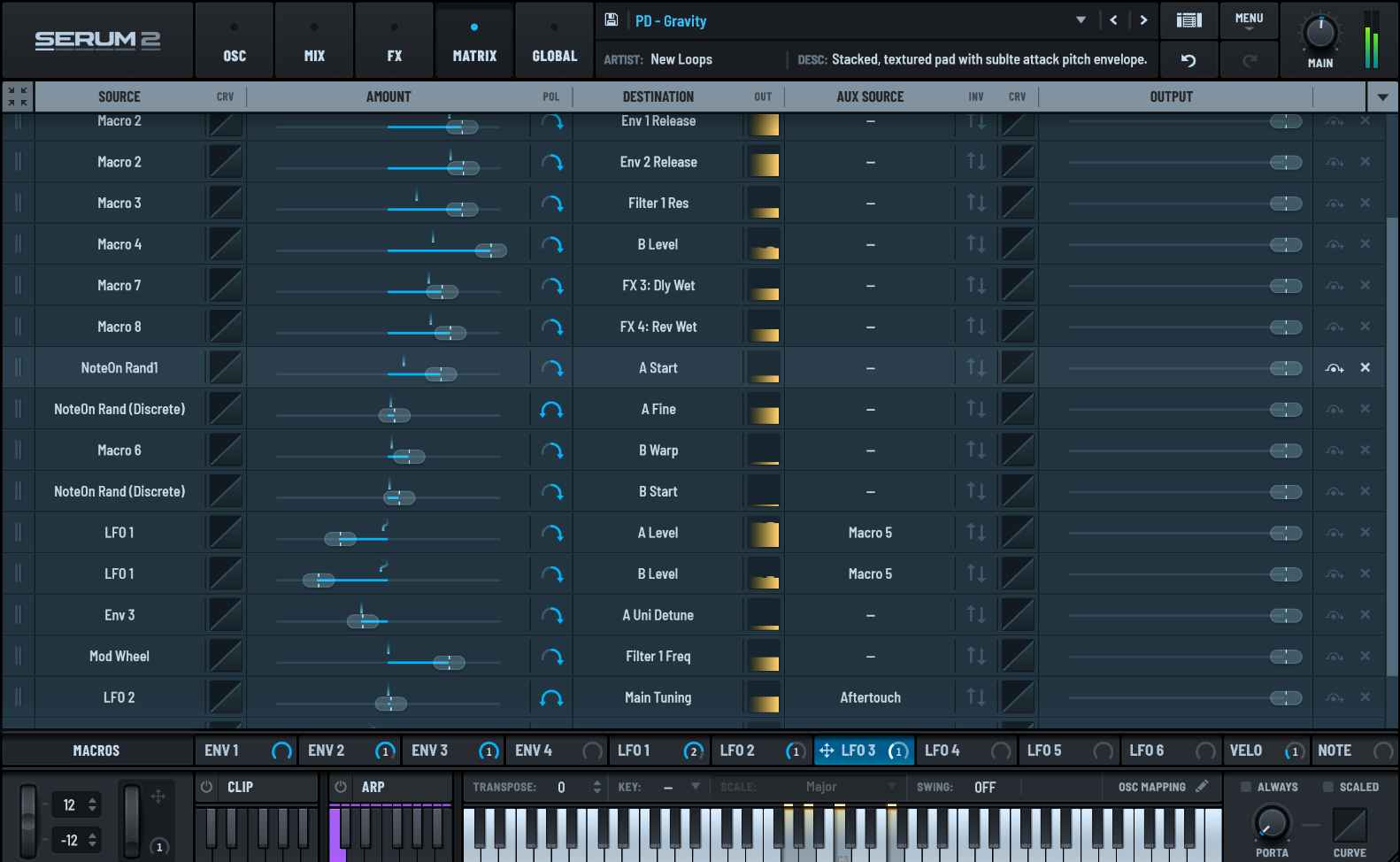
In Serum, the most powerful way to do this is by using an Auxiliary Source in the Modulation Matrix. An auxiliary source allows you to use a modulator (like another LFO, an envelope, or a macro) to control the amount of another modulation routing. It essentially acts as an automated depth control.
This is the key to creating textures that evolve organically, as you can make rhythmic patterns fade in and out, increase in intensity, or change in character over time without manual automation.
This next video provides a perfect, detailed explanation of how the Auxiliary Source works within Serum's Mod Matrix.
SERUM's Matrix Explained | Sound Design Tutorial
The video "SERUM's Matrix Explained" by Ghosthack offers a fantastic breakdown of the Aux Source.
First, watch the main explanation of the Auxiliary Source. The presenter demonstrates a classic use case: using a Macro to control the amount of vibrato (an LFO modulating pitch). This clearly shows how one source can act as a "dry/wet" knob for another modulation. Then, watch the following section on the Aux Curve and Output. This shows how you can shape the response of the auxiliary source for even more precise control over how the modulation depth changes.
By assigning an auxiliary source, you are setting up a hierarchical relationship: one modulator dictates if and how much another modulator is allowed to act.
Advanced Coordination: Polyrhythms and Chaos
To push this concept further and create truly non-repetitive textures, you can combine specific types of LFOs and rates.
1. Polyrhythmic Modulation
Assign two LFOs to the same parameter but run them at different, non-symmetrical rates (e.g., one at a 1/4 triplet and the other at a standard 1/8). The interaction of these two rhythms will create a complex, shifting pattern that takes a very long time to repeat, if ever. This is a staple in Neurofunk for creating basslines that feel like they are constantly morphing.
2. Using Chaos as a Controller
The Chaos and Sample & Hold LFOs, which we touched on in the last lesson, are perfect candidates for an auxiliary source. Because their patterns are non-periodic, they can introduce a layer of controlled randomness to your sound.
Practical Example for an Evolving Neuro Lead:
- Destination: Filter Cutoff.
- LFO 1 (Rhythmic Pulse): A custom-drawn, aggressive shape at a
1/8rate. This provides the core rhythmic movement. - LFO 2 (Organic Evolution): A
ChaosLFO set to a very slow rate (e.g., 8 bars). - Routing: In the Mod Matrix, assign LFO 1 to the Filter Cutoff. Then, set LFO 2 as the Auxiliary Source for that routing.
The result: The main rhythmic pulse from LFO 1 will now fade in and out, or intensify and recede, based on the unpredictable, slow-moving output of the Chaos LFO. The sound feels like it's alive and making its own decisions.
The following article provides excellent theoretical context for these advanced strategies.
Modulation Matrix - Drey Andersson
This text from Drey Andersson's site provides a superb theoretical foundation for what we're doing. It gives professional terminology to these techniques.
Focus on the sections "Complex routing strategies" and "Advanced modulation techniques." Pay close attention to the concepts of "meta-modulation" (using an envelope to control LFO rate) and "polyrhythmic approaches" (layering different modulation rates). This will solidify your understanding of the "why" behind these powerful techniques.
Conclusion
Today, we've moved from creating single modulators to orchestrating them. By coordinating multiple modulation sources on a single parameter, you can craft sounds that evolve, breathe, and defy simple repetition. This is a cornerstone of advanced sound design and is essential for achieving the dynamic, living textures that define modern DnB leads.
Key Takeaways:
- Coordinating multiple modulators on one parameter creates richer, more complex movement than a single source can achieve.
- Direct Stacking (many-to-one) is used to combine movements on different timescales (e.g., a slow sweep with a fast pulse).
- Meta-Modulation involves one source controlling another, often using Serum's Auxiliary Source feature to dynamically change modulation depth.
- Using non-periodic sources like
ChaosLFOs or polyrhythmic rates as your "controller" modulator is key to creating organic, non-repetitive evolution.
We've now seen how the Modulation Matrix is used to facilitate these complex interactions via the Aux Source. In our next lesson, we will perform a comprehensive deep-dive into the Modulation Matrix, learning how to use its full feature set to precisely assign, scale, and manage multiple modulation sources for complete control over your sound design.