Hello! In our last lesson, you created a Product Requirements Document (PRD), which provides a clear and quantitative definition of what your independent project needs to achieve. This document is the engineering specification that will guide all your future design decisions.
Today, we transition from the analytical "what" to the creative "how." This lesson focuses on the learning outcome: Brainstorm and sketch multiple conceptual solutions to the defined problem. This is the divergent phase of the design process, where the goal is to generate a wide range of ideas before narrowing down to a single path. This practice is fundamental in industry to foster innovation and avoid settling on the first, most obvious solution.
1. The Engineering Brainstorming Process
Brainstorming in an engineering context is more than just throwing ideas at a wall; it's a structured creative process. It typically involves three phases: preparation, ideation, and post-processing. Your PRD served as the perfect preparation, giving you a well-defined problem to solve. Today, we'll focus on ideation.
To understand the structure of this process, let's look at the article 'Brainstorming for Engineers' from Five Flute. It provides a great framework for how engineers generate ideas for product development.
First, read the introduction to understand the three phases: 'prepare, run, and postprocess'. Then, jump to the subsection titled 'Ideate'. Pay close attention to the advice given: use a sharpie (or a thick pen) to avoid getting lost in detail, and aim to capture the essence of the idea in under a minute.
The key principle is to separate idea generation from idea evaluation. During brainstorming, there are no bad ideas. The goal is to explore the solution space as broadly as possible.
2. Techniques for Rapid Ideation and Sketching
The most effective way to capture ideas quickly is through sketching. It's crucial to remember that these are not artistic renderings; they are communication tools. Their purpose is to quickly visualize a concept—be it a mechanism, a layout, or a form factor—for yourself and others.

To get into the right mindset, a couple of techniques are extremely effective:
- Go for Quantity: Generate as many ideas as you can, even if they seem silly or unfeasible at first. Sometimes a "bad" idea contains the seed of a brilliant one.
- Time-Boxing: Set a strict time limit for each sketch (e.g., 60-90 seconds). This forces you to stay focused on the core concept and prevents you from getting bogged down in details or judging the idea prematurely.
How to come up with design ideas - without scratching your head!
The video 'How to come up with design ideas' by simply design sketching demonstrates the power of time-boxing. Watch how the creator rapidly generates dozens of ideas by making small, incremental changes from one sketch to the next.
Watch from the beginning to 02:07. Notice how the sketches are simple 2D profiles, starting with basic shapes. The emphasis is on flow and generating a volume of ideas, not on creating a single, perfect drawing.
How to Draw Like a Designer | SKEEHAN Studio Sketching Techniques
The video 'How to Draw Like a Designer' by Tom Skeehan reinforces this workflow and discusses the mindset required to 'fail fast' and overcome the anxiety of a blank page.
Watch from 00:46 to 02:42. Focus on the process: a timed session of rapid, uninhibited sketching, followed by a review process to identify promising concepts. This is exactly what you'll be doing in today's task.
3. Systematic Approaches to Concept Generation
While rapid, freeform sketching is excellent for generating ideas, more structured methods can ensure you're systematically exploring all functional aspects of your design problem. Given your engineering background, you'll find these methods particularly powerful.
4. Concept Generation/Concept Selection
The textbook chapter 'Concept Generation/Concept Selection' from BCcampus provides two excellent, industry-standard methods: Functional Decomposition and the Morphological Approach.
Read the subsections on 'Functional Decomposition Approach' and 'Morphological Approach'. For Functional Decomposition, understand how to break down your main product function into a series of smaller, simpler sub-functions. For the Morphological Approach, see how you can create a chart to brainstorm multiple solutions for each sub-function and then combine them to create complete system-level concepts.
-
Functional Decomposition: This is a top-down approach. You start with the overall function of your product (e.g., "lift a 1kg mass by 300mm") and break it down. What sub-functions are required?
- Convert electrical energy to rotary motion (Motor)
- Convert rotary motion to linear motion (Leadscrew/Belt Drive)
- Guide the linear motion (Rails/Bushings)
- Support the components (Frame/Brackets)
-
Morphological Chart: Once you have your sub-functions, you can brainstorm different ways to achieve each one and organize them in a chart. For "Convert rotary to linear," your options might be a lead screw, a ball screw, a rack and pinion, or a belt and pulley system. By mixing and matching solutions for each sub-function, you can systematically generate a huge number of unique, complete concepts.
Your Task: Brainstorm and Sketch for Your Project (30 minutes)
Now it's time to apply these methods to the project you defined in your PRD. Your goal is to generate at least 10-15 conceptual sketches.
-
Review your PRD: Re-read the requirements and constraints you defined. Keep these at the front of your mind.
-
Decompose the Function (Optional but Recommended): On a blank page, use the Functional Decomposition method to break your project's main function into 3-5 key sub-functions. What are the essential things your device needs to do?
-
Start Sketching:
- Set a timer for 20 minutes.
- Using paper and a pen (a thicker one is better!) or a digital tablet, start sketching ideas.
- Spend no more than 1-2 minutes per sketch. Don't erase or worry about quality.
- For each sub-function you identified, try to sketch 2-3 different ways to solve it.
- Try combining these sub-solutions into full system concepts.
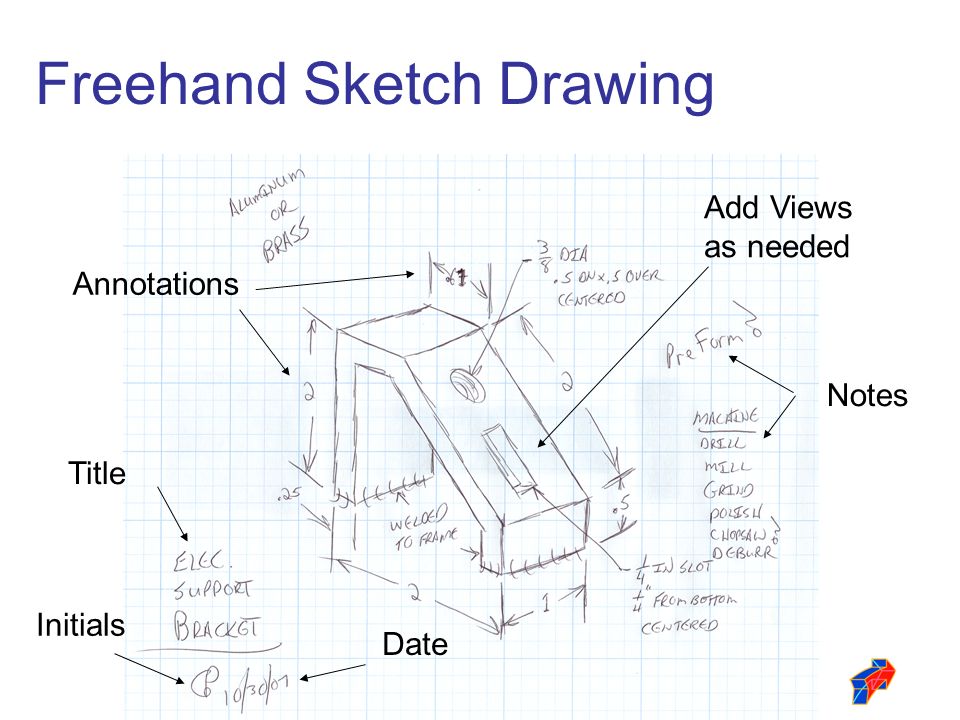
- Your sketches can be simple schematics, kinematic diagrams, or rough 3D views. Label parts and motion as needed. The sketch below is a great example of a concept sketch that includes key technical information.
- Organize your Ideas (Optional): If you used functional decomposition, consider arranging your sketches into a simple Morphological Chart to visualize the different combinations.
The deliverable from this task is a collection of rough sketches that represent a broad exploration of potential solutions for your project.
Conclusion
Great work! You have now populated the "solution space" for your project with a wide variety of ideas. By resisting the urge to settle on the first concept and instead forcing yourself to think divergently, you have significantly increased the chances of finding an elegant, efficient, and innovative solution.
Key Takeaways:
- Conceptual design is a divergent process where quantity of ideas is more important than initial quality.
- Time-boxing your sketches (1-2 minutes each) is a powerful technique to promote rapid ideation and prevent premature judgment.
- Functional Decomposition and Morphological Charts are systematic engineering methods that help ensure you explore all aspects of a design problem and creatively combine sub-solutions.
- Concept sketches are communication tools, not works of art. Their purpose is to capture the essence of a mechanical principle or layout.
Preview of the Next Lesson:
You now have a portfolio of raw ideas. But how do you choose which one to pursue? In the next lesson, we will switch from divergent to convergent thinking. You will learn how to establish a decision matrix with weighted criteria and perform a formal concept selection, allowing you to objectively evaluate your brainstormed ideas against your project requirements and select the most promising concept for development.