Hello! In our last lesson, you did some excellent divergent thinking, brainstorming and sketching a wide range of conceptual solutions for your project. You now have a collection of raw ideas, which is the perfect starting point for the next phase of the design process.
Today, we shift from creative, divergent thinking to analytical, convergent thinking. The goal is to systematically and objectively select the single most promising concept to move forward with into detailed design. This lesson covers the learning outcome: Establish a decision matrix with weighted criteria and perform a formal concept selection.
This is a cornerstone of the professional engineering workflow. Creating a formal decision matrix allows you to justify your design choices with clear, data-driven reasoning—a critical skill to showcase in your portfolio.
1. From Many Ideas to a Few: Concept Screening
Before we perform a detailed quantitative analysis, it's often useful to do a quick first pass to screen out concepts that are clearly weaker. A fantastic tool for this is the Pugh Matrix. It's a semi-quantitative method that compares your new concepts against a baseline or "datum."
To introduce the theory and practice of concept selection, let's start with a high-level overview from a leading engineering course.
5. Concept Selection and Tradespace Exploration
This lecture from MIT OpenCourseWare introduces the overall flow of decision-making in engineering. It then details the Pugh Matrix method, a staple in industry for initial concept screening. The example used, selecting a nuclear reactor architecture, demonstrates how powerful this simple method can be on highly complex systems.
Watch the segment on the Pugh Matrix, from timestamp 10:11 to 26:10. Focus on understanding these key elements: The Datum: What is a datum and how is it used as a reference? The Scoring: How the simple +, -, S (Same) system works. The Process: The steps for filling out the matrix. The Purpose: Why this is used for screening and generating discussion, not necessarily for making the final, definitive choice.
As you saw in the video, the Pugh process is straightforward:
- List Criteria: These are your design requirements (e.g., from your PRD).
- List Concepts: The sketches from your brainstorming session.
- Select a Datum: This is your baseline for comparison. It could be an existing product on the market, or one of your own concepts that seems like a solid, well-understood starting point.
- Score Concepts: For each criterion, compare each concept to the datum. Is it better (+), worse (-), or the same (S)?
- Sum Scores: Tally the number of pluses and minuses for each concept.
The concepts with a poor net score can often be eliminated, while those with many positives are strong candidates for the next stage. A key benefit of this process is that it can also highlight opportunities to create hybrid concepts by combining the best features of several ideas.
Test your understanding!
Imagine you use a Pugh Matrix and Concept A scores +3, -1. Concept B scores +1, -3. Concept C scores +5, -5. Based only on the net scores, what can you confidently conclude? What important information is still missing?
Show answer
Based on net scores (A: +2, B: -2, C: 0), Concept A looks the most promising and Concept B the weakest. However, this method doesn't account for the relative importance of the criteria. The single "minus" for Concept A might be on a critically important criterion (like safety or cost), while the five "pluses" for Concept C might be on minor, "nice-to-have" features. This limitation is why we need a weighted matrix for the final decision.
2. The Final Decision: The Weighted Decision Matrix
The Pugh matrix helps narrow the field, but for the final selection, we need a more rigorous tool that accounts for the fact that not all criteria are created equal. This is the Weighted Decision Matrix, sometimes called a Pugh Matrix with weighted criteria.
This method assigns a numerical weight to each criterion and a numerical score to each option, resulting in a final weighted score that provides a clear, quantitative ranking.
This short video provides a very clear, practical walkthrough of how to set up and use both a simple and a weighted decision matrix.
Watch from 01:31 to 07:32. This covers the simple matrix, the weighted matrix, and a business example. Pay close attention to how the introduction of weights can change the outcome of the decision, leading to a more robust choice.
Here is the step-by-step process to create your own weighted decision matrix:
- List Your Criteria: Transfer 5-7 of the most important requirements from your PRD. These must be the factors that truly differentiate the success of one concept from another (e.g., Manufacturing Cost, Ease of Assembly, Stiffness, Actuation Speed, Compactness).
- Assign Weights: For each criterion, assign a weight (typically as a percentage or a value out of 10) that reflects its relative importance. The sum of all weights should be 100% (or your chosen maximum). This is the most critical step, as it formally defines your project's priorities.
- List Your Concepts: Choose the top 3-4 contenders from your brainstorming or Pugh matrix screening.
- Establish a Scoring Scale: Define a numerical scale, for example, 1 to 5, where:
- 1 = Fails to meet the criterion.
- 3 = Meets the criterion.
- 5 = Significantly exceeds the criterion.
It's crucial to be consistent with this scale.
- Score Each Concept: Objectively evaluate each concept against each criterion and assign a score. Briefly jot down a justification for each score. This objectivity is key.
- Calculate the Weighted Score: For each cell in the matrix, multiply the Score by the Weight.
- Find the Winner: Sum the weighted scores for each concept. The concept with the highest total score is your analytically chosen winner.
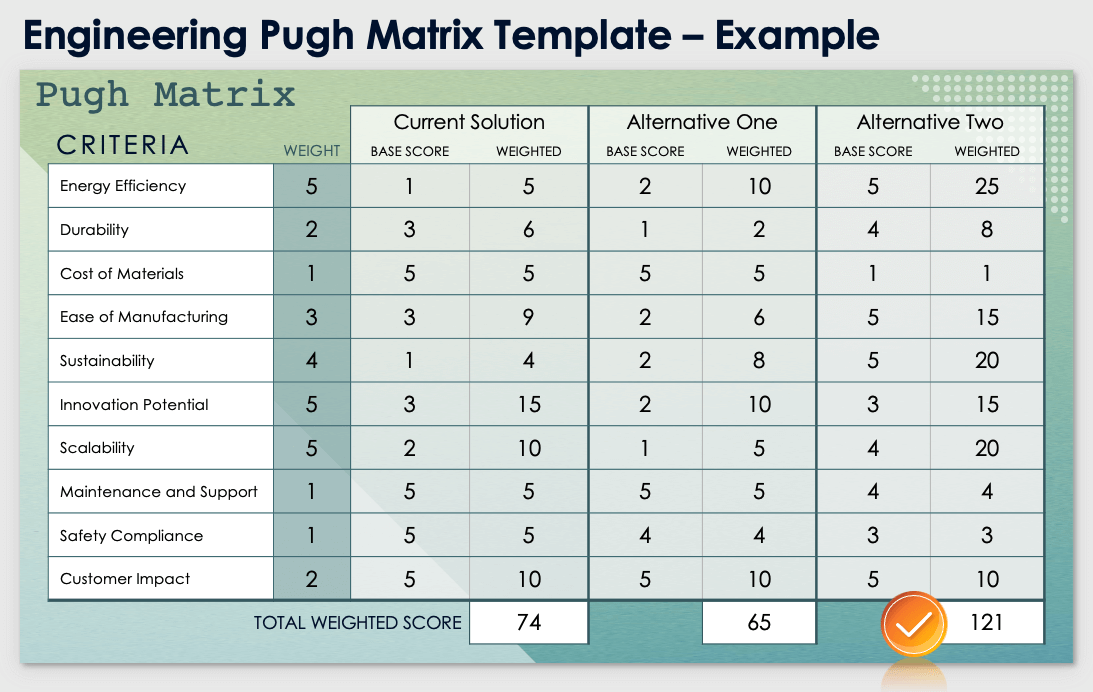
Your Task: Select Your Project Concept (30 minutes)
It's time to apply this to your own project. Take the conceptual sketches you generated in the last lesson and use a weighted decision matrix to select the one you will develop.
Instructions:
- Set Up Your Matrix: Open a spreadsheet program (like Google Sheets or Excel) or use a piece of paper. Create columns for Criteria, Weight, and each of your top 3-4 concepts.
- Populate Criteria and Weights:
- From your PRD, select 5-7 critical criteria.
- Assign a weight to each one, ensuring they sum to 100%. Be prepared to defend these weights—why is cost more important than aesthetics, or vice-versa?
- Score Your Concepts:
- For each concept, go criterion-by-criterion and assign a score (e.g., on a 1-5 scale).
- Be honest and objective. If a concept is complex to manufacture, give it a low score for that criterion, even if you like the idea.
- Do the Math:
- For each concept, calculate the weighted score for each criterion (
Score × Weight). - Sum the weighted scores to get the final total for each concept.
- For each concept, calculate the weighted score for each criterion (
- Analyze the Result:
- Identify the concept with the highest score. This is your selected concept.
- Perform a sanity check. Does the result feel right? If the winning concept seems surprising, re-examine your weights and scores. This iterative process of refinement is part of the tool's power. Sometimes, it reveals that your initial "gut feeling" was biased.
Keep this matrix! It is a key deliverable for your portfolio, demonstrating a rigorous and professional approach to design selection.
Conclusion
Excellent work today. You have successfully navigated one of the most important milestones in the design process: moving from a wide array of ideas to a single, justified path forward. By using a formal decision matrix, you've made this critical choice in a way that is objective, traceable, and defensible.
Key Takeaways:
- Concept selection is a convergent process that narrows down options to find the best solution.
- The Pugh Matrix is a powerful screening tool for quickly comparing concepts against a baseline using a simple
+/-/Sscoring system. - The Weighted Decision Matrix is a more rigorous method for making a final selection. It uses numerical weights and scores to quantitatively rank concepts based on what is most important to the project.
- The process of assigning weights forces you to make conscious, explicit decisions about design trade-offs. The final matrix serves as documentation for these decisions.
Preview of the Next Lesson:
With your winning concept now officially selected, the real fun begins. In our next lesson, we will start the detailed design phase. You will take your chosen concept sketch and begin to develop it into a full 3D assembly in OnShape, applying the parametric modeling, assembly, and motion analysis skills you've acquired.