Hello! Welcome to the final content lesson for your independent project.
In our last session, we focused on using storytelling techniques to shape your design work into a compelling narrative using frameworks like "Problem, Solution, Impact" and the "Hero's Journey." You now have a core story for your project.
Today, we'll tackle the final, critical step in becoming an effective technical communicator, directly addressing the learning outcome: Adapt the content and structure of a technical presentation for different audiences (e.g., engineering peers, managers).
A common mistake engineers make is giving the same presentation to everyone. In the professional world, however, your audience dictates your message. A presentation that impresses your engineering peers might bore a manager, and one that persuades a manager might leave your peers with unanswered technical questions. Mastering the skill of "code-switching" between audiences is essential for getting buy-in for your designs, securing resources, and advancing your career.
By the end of this lesson, you'll have a clear strategy for tailoring your project story to resonate with the specific priorities of different key stakeholders.
1. The Foundation: From Information to Transformation
Before we discuss specific audiences, let's establish the fundamental mindset of a great presenter. The goal isn't just to inform your audience; it's to transform them—to change what they believe, feel, or do.
To understand this powerful concept, please watch the following TEDx talk.
The 3 Magic Ingredients of Amazing Presentations | Phil WAKNELL | TEDxSaclay
In 'The 3 Magic Ingredients of Amazing Presentations,' Phil Waknell introduces a powerful framework called the 'Audience Transformation Roadmap.' This will help you think strategically about your presentation's goal for any audience.
Please watch the following segments: The First Ingredient (01:15 - 02:39): Focus on the core idea that the audience is the most important ingredient. Transformation, Not Information (03:36 - 05:05): Pay attention to the distinction between informing and transforming an audience. The Roadmap (05:05 - 09:29): Understand the four questions of the 'Audience Transformation Roadmap' (Know, Believe, Feel, Do) and how it's used to define presentation objectives.
The key takeaway is that for every presentation, you must first ask:
- Who is my audience?
- What is their starting point (what do they know, believe, feel, and do before my presentation)?
- What is my desired end state (what do I want them to know, believe, feel, and do after my presentation)?
Answering these questions is the first step in adapting your content effectively.
2. Know Your Audience: The Peer vs. The Manager
In your work as a design engineer, two of your most frequent and important audiences will be your fellow engineers (peers) and your manager. They have fundamentally different priorities.
Let's dive into an article that breaks down these differences.
Technical vs Non-Technical Audiences: Communication ...
The article 'Technical vs Non-Technical Audiences: Communication Strategies' provides an excellent, direct comparison of how to communicate with different groups. We will use it to define the needs of your two primary audiences.
Please read the sections titled: 'Understanding Technical Audiences': This describes your peers. 'Understanding Non-Technical Audiences': This describes most managers. 'Technical vs Non-Technical Communication Strategies': Focus closely on the 'Communication Elements Comparison Table'. This is a fantastic cheat sheet.
Based on this reading, let's summarize the key distinctions:
| Element | Technical Audience (Peers) | Strategic Audience (Managers) |
|---|---|---|
| Primary Question | "How does it work?" | "Why should we do this? / So what?" |
| Focus | Technical feasibility, implementation details, trade-offs, methodology, data. | Business impact, ROI, timeline, risk, resources, customer value. |
| Language | Precise, technical jargon is acceptable and expected. | Plain language, minimal jargon. Use of analogies is effective. |
| Structure | Bottom-up: Chronological journey of the design process. | Top-down: Key results and recommendations first, then supporting details. |
Your peer review is a technical deep-dive. Your management review is a business proposal. You are selling the value of your engineering work, not just the work itself.
3. Adapting Your Presentation Structure
The biggest difference in presenting to these two groups is the structure of your story.
For a Technical Audience (Peers)
You can structure your presentation chronologically, following the Hero's Journey we discussed in the last lesson.
- Structure: Bottom-up. Start with the problem, walk through your design process, discuss the hurdles, show your analysis, and conclude with the final design.
- Content: Focus on the how and why of your technical decisions. Show your FEA plots, your tolerance stack-up calculations, your material selection matrix. Discuss the trade-offs you made (e.g., "I could have made this part lighter, but it would have required a 5-axis machine, so I optimized the design for 3-axis machining to keep costs down").
For a Strategic Audience (Managers)
For managers, you need to flip the structure on its head. Lead with the conclusion. This is known as the Pyramid Principle.
PowerPoint Storytelling: How McKinsey, Bain and BCG create compelling presentations
The video 'PowerPoint Storytelling' from Analyst Academy explains how top consulting firms structure their presentations. It provides a great explanation of the Pyramid Principle.
Please watch the segment from 04:44 to 06:06. Focus on how the Pyramid Principle works by starting with the main idea and then layering the supporting details underneath. This 'top-down' approach is exactly what managers want.
- Structure: Top-down. Start with the most important information: the result and your recommendation.
- Content: Translate technical features into business benefits.
Let's look at another resource for tips on making this translation.
Communicating Technical Ideas to Non-Technical People
The article 'Communicating Technical Ideas to Non-Technical People' offers several practical tips. We'll focus on one key concept.
Please read the section 'Engaging the elephant' and focus specifically on tip #3: 'Benefits vs features.'
Here's a practical example from your linear actuator project:
- Feature (for a peer): "I redesigned the motor bracket using a honeycomb infill pattern for 3D printing and ran a topology optimization study."
- Benefit (for a manager): "I've optimized the motor bracket design, which reduces its print time by 20% and material usage by 35%. This cuts the cost of this component by $4 per unit and increases our production throughput."
Test your understanding!
Take one key achievement from your independent project (Project 3). In a few bullet points, how would you describe this achievement to:
- A fellow design engineer during a design review?
- An engineering manager in a project update meeting?
Show answer
Let's say your achievement was redesigning a part to be made from sheet metal instead of being machined.
-
For a peer:
- "I converted the main housing from a machined block to a 3-piece sheet metal assembly."
- "I used OnShape's sheet metal tools to model the bends and ensure a flat pattern with minimal waste."
- "The design uses tab-and-slot features for self-alignment during welding and PEM nuts for easy fastener installation."
-
For a manager:
- "I've redesigned the main housing for sheet metal manufacturing, which will reduce the part cost by an estimated 70%."
- "This change cuts the lead time from 4 weeks for machining to 5 days for laser cutting and bending."
- "The new design is also 25% lighter, which improves the overall performance of the system."
Notice how the first focuses on the how (technical execution) and the second on the impact (cost, time, performance).
4. A Level Deeper: Not All Managers Are the Same
To make your presentations truly effective, it's helpful to recognize that "manager" can mean different things. Your direct manager who oversees a specific project has different concerns from a director who oversees the entire engineering department.
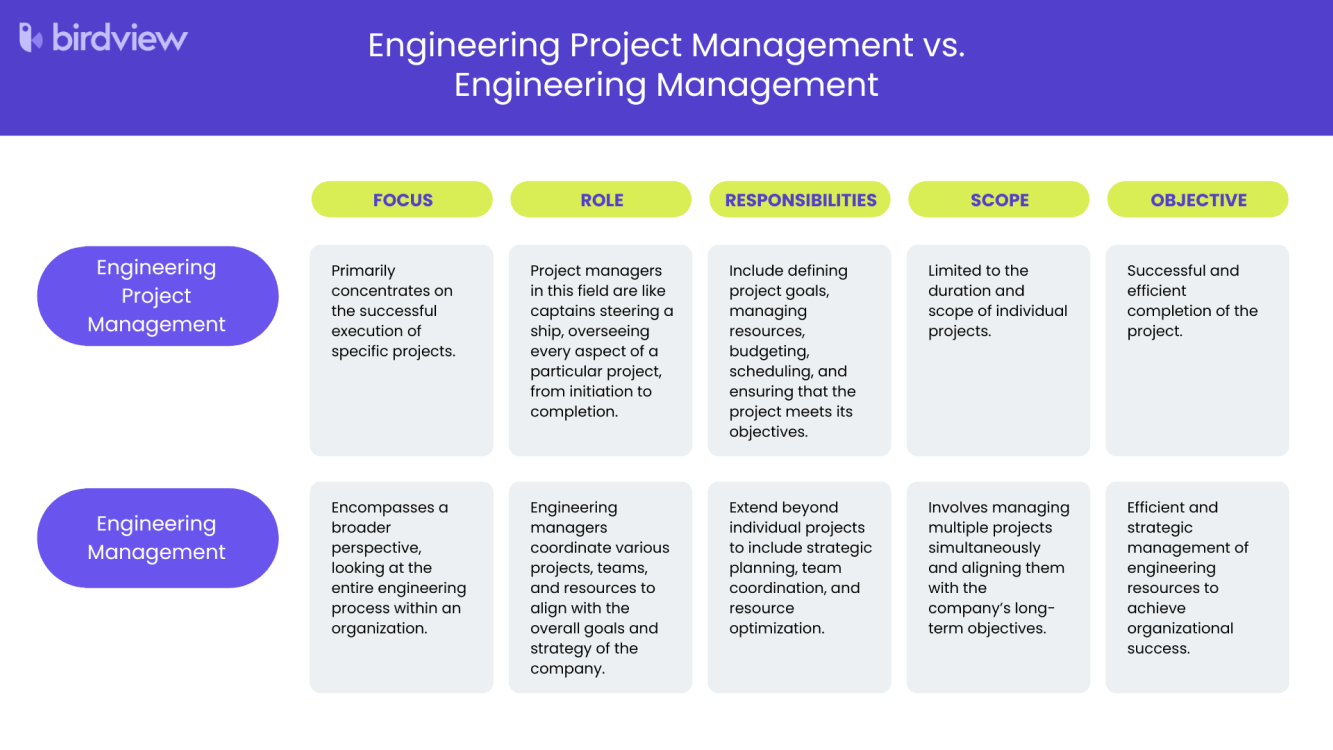
As the image illustrates:
- An Engineering Project Manager is focused on the successful execution of your specific project. They care deeply about your project's timeline, budget, and resource risks. Your presentation to them should be top-down but focused on project-level metrics.
- An Engineering Manager or Director is focused on the entire engineering organization. They care about how your project aligns with broader company goals, team development, resource allocation across multiple projects, and long-term strategy. Your presentation to them should be very high-level, focusing on strategic value.
Understanding this nuance allows you to fine-tune your "manager" presentation even further.
Conclusion
You have now completed the journey from structuring a technical project to crafting a compelling story and, finally, to adapting that story for maximum impact with any audience. This is a set of skills that will serve you throughout your entire engineering career.
Key Takeaways:
- Think Transformation, Not Information: Your goal is to change what your audience knows, believes, feels, or does.
- Know Your Audience's Priorities: Peers care about the how (technical details), while managers care about the so what (business impact).
- Structure Accordingly: Use a bottom-up, chronological structure for peers and a top-down, results-first Pyramid Principle for managers.
- Translate Features into Benefits: Don't just state what your design does; explain the value it creates in terms of cost, time, or performance.
Preview of the Next Lesson:
With the presentation strategy complete, our next and final lesson for this project will be a wrap-up: "Curate project deliverables (CAD, drawings, presentation) for portfolio inclusion." We will focus on organizing all the excellent work you've done into a clean, professional package ready for your portfolio.