Hello! Welcome back to our module on Binary Trees and Traversals.
In our last lesson, we learned how to represent a binary tree by creating a Node class and linking nodes together. This gave us the ability to build a tree. Now, we need to learn how to systematically visit and process the information in every node. This fundamental process is called tree traversal.
Today's lesson focuses on the most common and intuitive methods for tree traversal. Our goal is to implement recursive preorder, inorder, and postorder traversals. These three techniques form the bedrock of many tree-based algorithms and are essential tools for competitive programming.
1. What is Tree Traversal?
Unlike linear data structures like arrays, trees can be traversed in multiple ways. The three methods we'll learn today are all types of Depth-First Search (DFS), where we go as deep as possible down one path before backtracking.
The difference between them lies in the order in which they visit three key components at any given node:
- The node itself (which we'll call
Rootfor simplicity) - The entire left subtree
- The entire right subtree
The order in which you perform these three actions defines the traversal type.
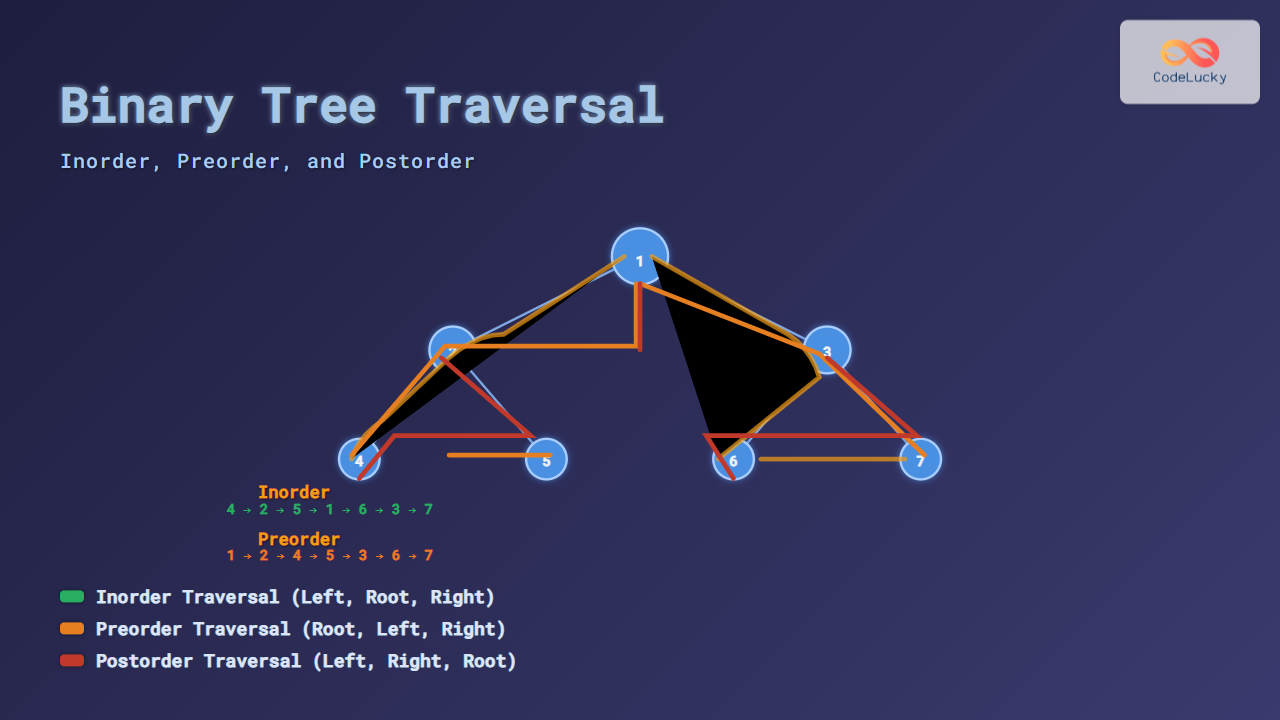
Let's define the three main orders:
- Preorder Traversal: Visit the
Rootfirst, then recursively traverse theLeftsubtree, and finally, recursively traverse theRightsubtree. (Order: Root -> Left -> Right) - Inorder Traversal: Recursively traverse the
Leftsubtree first, then visit theRoot, and finally, recursively traverse theRightsubtree. (Order: Left -> Root -> Right) - Postorder Traversal: Recursively traverse the
Leftsubtree first, then theRightsubtree, and finally, visit theRoot. (Order: Left -> Right -> Root)
To see these definitions and a clear explanation of their recursive nature, the following article is an excellent reference.
Preorder, Inorder and Postorder Traversal using Recursion
Read this section from EnjoyAlgorithms to solidify your understanding of the three main recursive traversal types.
Read the 'Introduction to binary tree traversal' and 'Types of binary tree traversal using recursion' sections. Focus on how the classification is based on the order in which the root is visited.
2. Recursive Implementation in Python
The beauty of these traversals is that their recursive structure leads to very elegant and concise code. The core idea for each is the same:
- Base Case: If the current node is
None, we have reached the end of a path, so we do nothing and return. - Recursive Step: Perform the three actions (
visit Root,traverse Left,traverse Right) in the specific order for the traversal type.
Let's build the code for each one. The following video provides a fantastic, step-by-step walkthrough of building a tree and implementing these traversals. We will use it as a guide.
Binary Trees in Python: Introduction and Traversal Algorithms
This video from LucidProgramming will guide you through the implementation of a binary tree and all three traversal algorithms. It's a great practical demonstration of the concepts.
You can watch from the beginning (00:00) to see a quick recap of building a tree. Then, pay close attention to the implementation of each traversal: Preorder (11:29), Inorder (20:26), and Postorder (25:33). Notice how similar the functions are!
Let's break down the implementation for each traversal. We will assume we have the Node class from the previous lesson and are writing functions that take a root node as input.
Preorder Traversal (Root -> Left -> Right)
This traversal is useful when you need to process the root before its descendants, for example, when creating a copy of a tree.
Conceptual Walkthrough:
- Start at the root. Print its value.
- Move to the left child. Print its value.
- Continue down the left path, printing values, until you hit
None. - Backtrack to the last node and go to its right child.
- Repeat the process.
Here's a simple and common way to write it in Python, often seen in competitive programming platforms:
# Assuming the Node class is defined as in the previous lesson
class Node:
    def __init__(self, val):
        self.val = val
        self.left = None
        self.right = None

def preorder_traversal(node):
    """Performs a preorder traversal of the tree."""
    if node is None:
        return

    # 1. Visit the root
    print(node.val, end=' ')

    # 2. Traverse the left subtree
    preorder_traversal(node.left)

    # 3. Traverse the right subtree
    preorder_traversal(node.right)
Inorder Traversal (Left -> Root -> Right)
This traversal is famous for its application in Binary Search Trees (BSTs), as it visits the nodes in sorted order. We will explore BSTs in a later module.
Conceptual Walkthrough:
- Start at the root, but don't print yet.
- Go as far left as possible.
- When you can't go left anymore, print the current node's value.
- Move to the right child of that node and repeat the process.
- As you backtrack up the tree, print the parent nodes' values.
The code is a simple permutation of the preorder function:
def inorder_traversal(node):
    """Performs an inorder traversal of the tree."""
    if node is None:
        return

    # 1. Traverse the left subtree
    inorder_traversal(node.left)

    # 2. Visit the root
    print(node.val, end=' ')

    # 3. Traverse the right subtree
    inorder_traversal(node.right)
Notice how the only thing that changed is the position of the print() statement!
Postorder Traversal (Left -> Right -> Root)
This is useful when you need to process the children before the node itself. A classic example is deleting a tree from memory, as you must delete the children before you can delete their parent.
Conceptual Walkthrough:
- Start at the root, but don't print.
- Go as far left as possible.
- From there, explore the right subtree.
- Only print a node's value after you have fully explored both its left and right subtrees.
Again, we just rearrange the operations:
def postorder_traversal(node):
    """Performs a postorder traversal of the tree."""
    if node is None:
        return

    # 1. Traverse the left subtree
    postorder_traversal(node.left)

    # 2. Traverse the right subtree
    postorder_traversal(node.right)

    # 3. Visit the root
    print(node.val, end=' ')
Test your understanding!
Consider the following binary tree:
      F
     / \
    B   G
   / \   \
  A   D   I
     / \ /
    C  E H
What would be the output sequence of nodes for each of the three traversals?
Show answer
- Preorder (Root -> Left -> Right): F, B, A, D, C, E, G, I, H
- Inorder (Left -> Root -> Right): A, B, C, D, E, F, G, H, I
- Postorder (Left -> Right -> Root): A, C, E, D, B, H, I, G, F
3. Complexity Analysis for Competitive Programming
For competitive programming, understanding the efficiency of an algorithm is just as important as knowing how to implement it.
Time Complexity
In all three recursive traversals, we visit every node in the tree exactly once. Therefore, the time complexity is directly proportional to the number of nodes, .
- Time Complexity:
Space Complexity
The space complexity comes from the memory used by the recursion call stack. The maximum depth of the recursion is equal to the height of the tree, .
- Best Case (Balanced Tree): In a well-balanced tree, the height is approximately . So, the space complexity is .
- Worst Case (Skewed Tree): In a completely unbalanced tree (like a linked list), the height is equal to the number of nodes . So, the space complexity is .
This is a critical trade-off to remember. While recursion is elegant, a very deep, unbalanced tree can lead to a StackOverflowError.
For a more formal look at this analysis, the following resource is very helpful.
Preorder, Inorder and Postorder Traversal using Recursion
This section from EnjoyAlgorithms breaks down the time and space complexity for these traversals.
Read the sections 'Time complexity analysis of recursive DFS Traversals' and 'The space complexity of recursive DFS traversals'. Pay attention to the distinction between the best-case (balanced tree) and worst-case (skewed tree) space complexity.
Conclusion
In this lesson, we demystified the three fundamental recursive tree traversals. You've learned not only how to implement them but also why their structure is so powerful and how to analyze their performance.
Key Takeaways:
- Tree traversal is the process of visiting every node in a tree.
- The three main recursive DFS traversals are preorder (
Root-Left-Right), inorder (Left-Root-Right), and postorder (Left-Right-Root). - The recursive implementations are elegant and differ only in the order of three operations: visiting the root, traversing left, and traversing right.
- The time complexity for all three is .
- The space complexity is , where is the tree's height, leading to a best case of and a worst case of .
Up Next:
Recursion is a natural fit for tree problems, but it's not the only way. Sometimes, an iterative approach is preferred, either to avoid recursion depth limits or for specific problem constraints. In our next lesson, we will learn how to implement an inorder traversal iteratively using a stack.