Hello! Welcome to our next lesson.
In our last session, we drew a crucial distinction between zero-sum (value-claiming) and non-zero-sum (value-creating) negotiations. We established that understanding the nature of the "pie"—whether it's fixed or expandable—is fundamental to choosing the right strategy. We also have our core components in place: players, strategies, and payoffs.
Today, we're going to take these abstract components and give them a concrete, visual structure. You'll learn how to represent a simple negotiation on a single page, allowing you to see the entire strategic landscape at a glance. We will focus on simultaneous-move games, where both parties choose their actions without knowing what the other has decided. This is more common in business than you might think—it applies to situations like submitting sealed bids, deciding on a product launch date, or setting an annual pricing strategy.
By the end of this lesson, you will be able to represent a simple, simultaneous-move negotiation using a payoff matrix, the most fundamental tool in the game theorist's toolkit.
Mapping the Game: The Payoff Matrix
The first step in moving from intuitive persuasion to analytical strategy is to create a map of the negotiation. In game theory, for simultaneous-move games, this map is called a payoff matrix (or, more formally, the Normal Form of the game).
A payoff matrix is simply a table that shows every possible outcome of a game and what each player gets in each scenario. It's a powerful tool for visualizing the interdependence of decisions.
Payoff Matrices: How to visualize any two-player game - Rafiul Alam
This article provides an excellent, clear breakdown of the structure of a payoff matrix. This is the foundational grammar for all the analysis we will do later.
Please read the section titled The Anatomy of a Payoff Matrix. Pay very close attention to the convention for how payoffs are written: (Player 1’s payoff, Player 2’s payoff). This is a strict rule we will follow.
As you just read, the structure is simple but rigid:
- Players: One player's choices define the rows (the "Row Player"), and the other's define the columns (the "Column Player").
- Strategies: Each row or column represents one possible strategy a player can choose.
- Payoffs: Each cell in the matrix shows the outcome that results from a specific combination of strategies. The first number in the cell is always the payoff for the Row Player, and the second number is for the Column Player.
Let's make this concrete with a classic business scenario.
The Pricing Duel: A Payoff Matrix in Action
Imagine you and your main competitor are deciding whether to set a high price or a low price for your flagship product for the upcoming year. You have to make your decisions without knowing for sure what the other will do. This is a simultaneous-move game.
We can represent this situation with a payoff matrix.

Let's read this map together:
- Players: Firm A and Firm B.
- Strategies: Each firm can choose either "Low Price" or "High Price".
- Payoffs: The numbers in the cells represent the profits for each firm.
To understand how to read it, pick a strategy for each firm and find the cell where they intersect. For example:
- If Firm A (Row Player) chooses "Low Price" and Firm B (Column Player) also chooses "Low Price", we look at the top-left cell. The payoff is (10, 10). This means Firm A gets 10 and Firm B gets 10. A price war erodes profits for both.
- Now, what if Firm A chooses "High Price" and Firm B chooses "Low Price"? We find the bottom-left cell. The payoff is (5, 25). Firm A, with its high price, loses market share and gets a low profit of 5, while Firm B cleans up with a profit of 25.
By mapping the game this way, you can see all four possible outcomes of your pricing strategies on one clear diagram. The interdependence is obvious: your profit isn't just determined by your price, but by your competitor's price as well.
From Scenario to Matrix: The Building Process
Reading a matrix is one thing; building one from a real-world situation is the key skill. This process forces you to clarify your thinking and identify the essential elements of the negotiation.
The steps are straightforward:
- Identify the Players: Who are the key decision-makers?
- List the Strategies: What are the possible actions each player can take? Keep it simple to start; focus on the most critical choices.
- Determine the Payoffs: For each combination of strategies, what is the outcome for each player?
- Construct the Matrix: Draw the grid and fill in the payoffs, remembering the (Row, Column) convention.
The hardest step is #3: determining the payoffs. These payoffs don't have to be exact dollar amounts. They can represent market share, personal satisfaction, or simply a ranking of preferences (e.g., 4=best outcome, 3=second best, etc.).
The following video provides an excellent, practical walkthrough of this thought process. The example is about "white lies," which may seem unusual, but it's a brilliant demonstration of how to take a messy human interaction, identify players and strategies, rank the preferences for each outcome, and translate them into numerical payoffs to build a matrix from scratch.
The Game Theory of White Lies | How to Construct a Matrix from Scratch
In this video, Professor Ashley Hodgson demonstrates the intellectual process of building a game matrix from a real-world scenario.
Watch how she sets up the game and translates subjective preferences into numerical payoffs. First, see how she defines the players (girlfriend, boyfriend) and their strategies. Next, observe the core process for determining the girlfriend's payoffs. Notice how she ranks the outcomes from favorite to least favorite and then assigns numbers. This is the key step. She then repeats the process for the boyfriend. Finally, watch as she assembles the final matrix, which now contains all the information in a structured way.
This method of ranking preferences and then assigning numbers is a powerful way to structure problems even when you don't have hard financial data. It allows you to model situations involving reputation, relationships, or other intangible values that are crucial in complex negotiations.
Case Study: Bidding at an Auction
Let's solidify this process by applying it to another business context. Imagine you are in a negotiation that resembles a sealed-bid auction.
What's Payoff Matrix? How to use Payoff Matrices for Prioritization?
This case study applies the matrix-building process to a competitive bidding scenario, which is a classic simultaneous-move game.
Please read Case Study 2 – Business rivalty with pay off matrix. You will see the author follow the exact steps we've outlined: defining the scenario, identifying the players (Alice and Bob), listing their options (strategies), and then constructing the matrix by determining the payoffs for each of the four possible outcomes.
This auction example, your pricing duel with a competitor, and the coffee shop decision from the earlier reading all share the same underlying structure. The payoff matrix gives us a universal language to describe and begin analyzing all of them.
Here is another famous example, the Prisoner's Dilemma, which we will analyze in great detail later in the course. For now, just look at its structure.
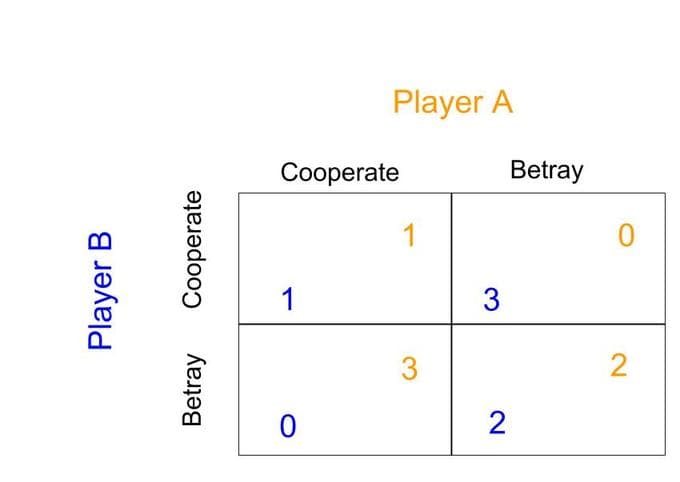
Notice it has the same components: two players, two strategies each (Cooperate, Betray), and four cells with payoffs for each combination.
Conclusion
In this lesson, you've acquired a foundational tool for strategic analysis. You've moved from discussing players, strategies, and payoffs in the abstract to representing them in a structured, visual format.
Key Takeaways:
- A Payoff Matrix (or Normal Form) is a table used to represent a simultaneous-move game.
- It clearly shows the players, their strategies, and the payoffs that result from every possible combination of choices.
- The universal convention for reading a cell is (Row Player's Payoff, Column Player's Payoff).
- To build a matrix, you must identify the players and strategies, and then systematically determine the payoff for each player in every possible outcome. This process itself forces strategic clarity.
You can now map the basic structure of any two-player, two-strategy simultaneous negotiation. In our next lesson, we will connect this new tool back to the most important concept from the start of our course: the BATNA. We will explore how a change in a player's Best Alternative to a Negotiated Agreement can radically alter the numbers in the payoff matrix and completely change the outcome of the game.